CONTENTS

🤓 The 2026 Local Search Ranking Factors are here!! Check out the report!

Our industry has seen some wild studies, like black hat SEOs putting a hundred phones in their cars to see if manipulating demand for driving directions altered local rank, but Darren Shaw and I wanted to test something simpler: whether clicks on or shares of particular Google Maps listing photos correlated with ranking changes.
We know that images in the Google Business Profile/Google Maps environment are influential. For example, the Google Business Profile Playbooks that were published this year shared these stats:
Given the remarkable impacts of images on user behavior, it stands to reason that the contents of the photos that users see first must matter a lot. Can you do anything to influence the order in which they are shown to Google searchers? We’ll share the results of our click study and, also, our top tips for optimizing this powerful part of your brand’s online presence.
Whitespark asked 172 participants to follow a simple set of instructions involving:
Then:
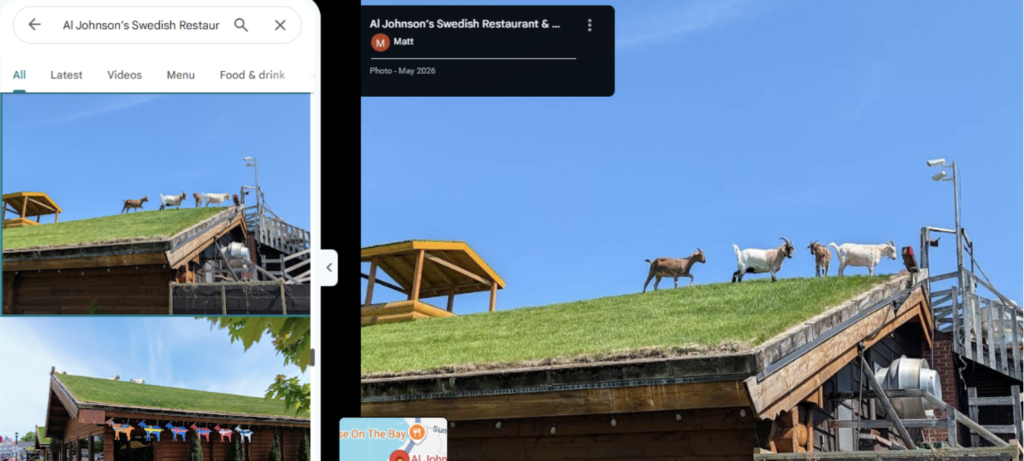
For Business A (shout out to Al Johnson’s Swedish Restaurant and Boutique in Sister Bay, WI, which is famed for its ethnic cuisine and for having goats on its grassy roof), we asked participants simply to click on this image of the business’ sign:
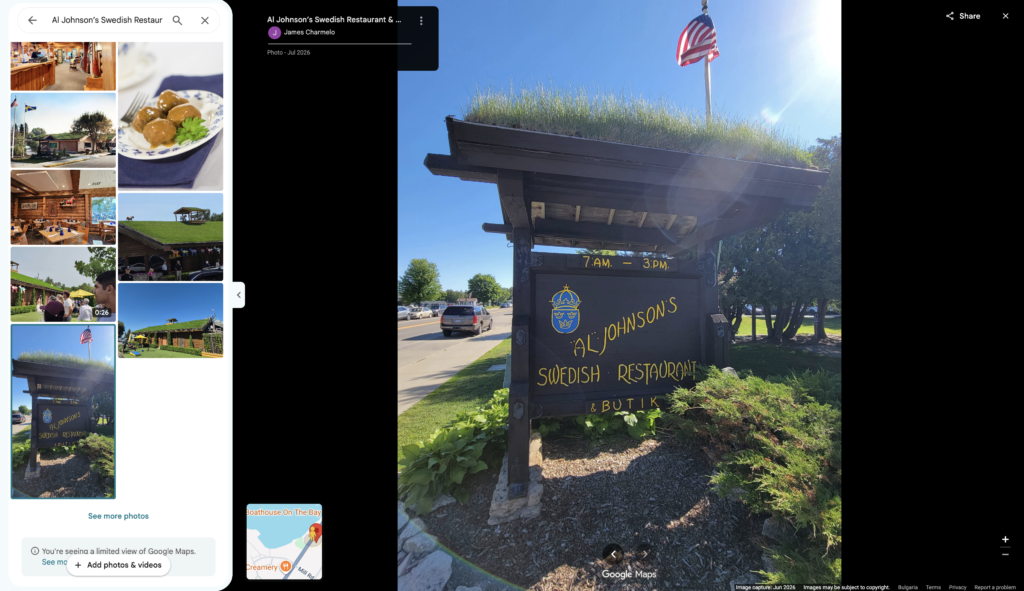
Participants were to dwell on the image for about 15 seconds, mouse around it, zoom in and out, and click on parts of the photo. Then, they were to leave the listing without clicking on any other images.
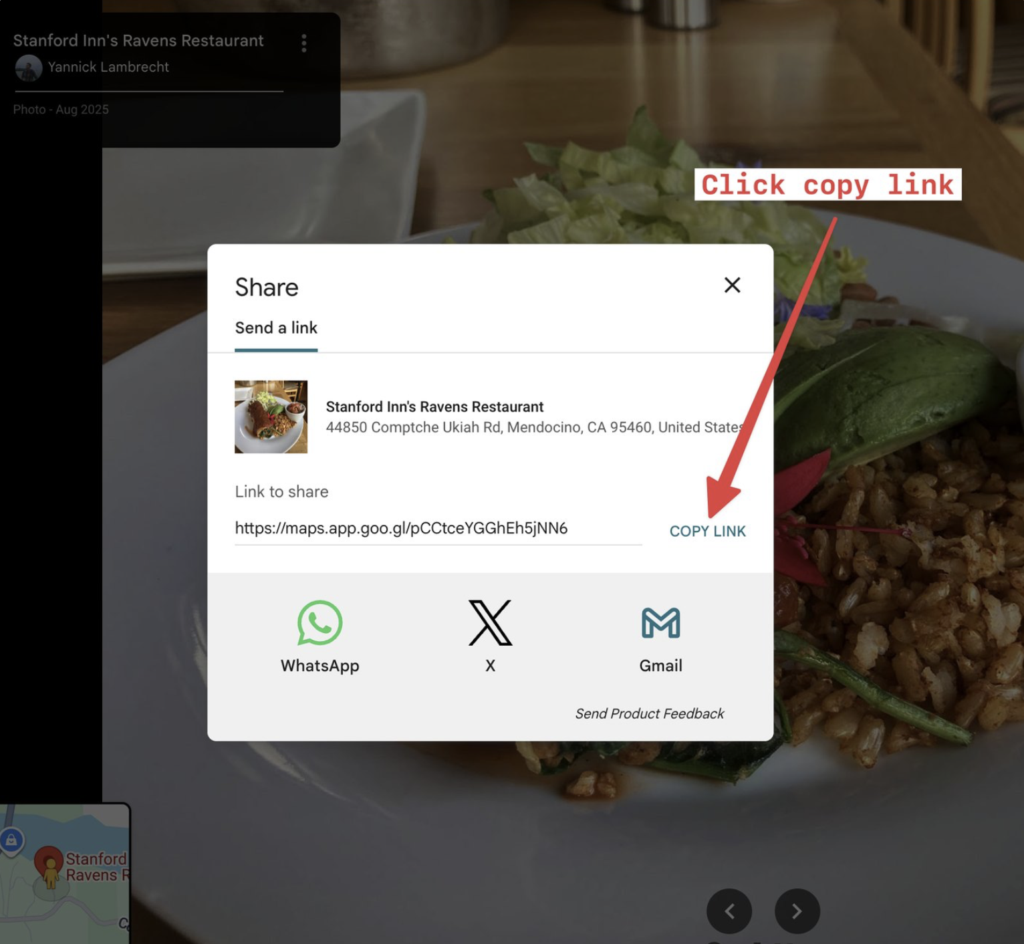
For Business B (if you’re ever in Mendocino, CA, book a table at the Stanford Inn’s Ravens Restaurant for vegetarian dining in a gorgeous setting), participants were instructed to locate this image of an entree:
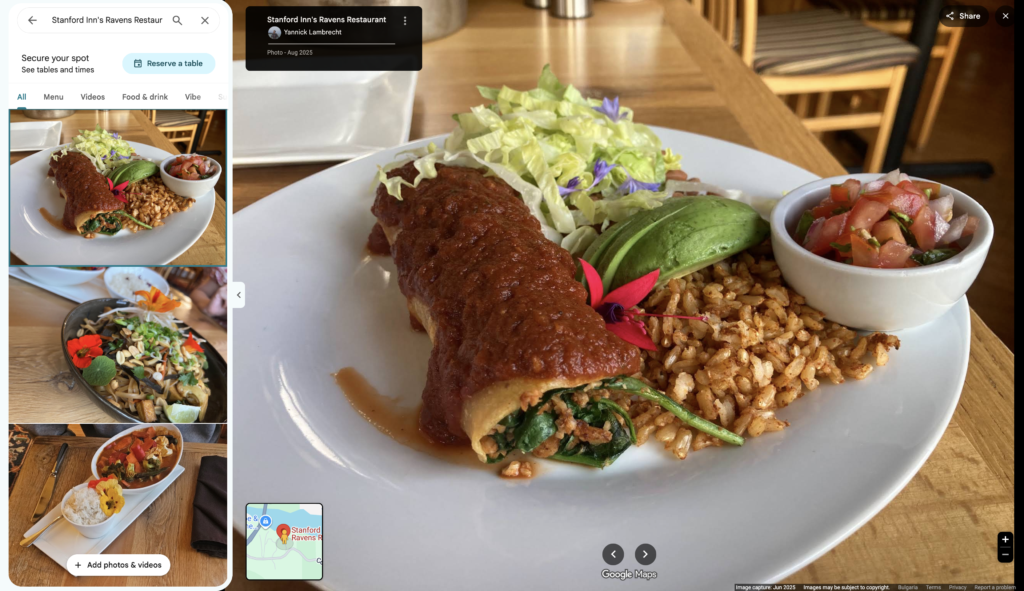
Participants were instructed not to do anything else but to click this “Share” button in the upper right corner of the image:
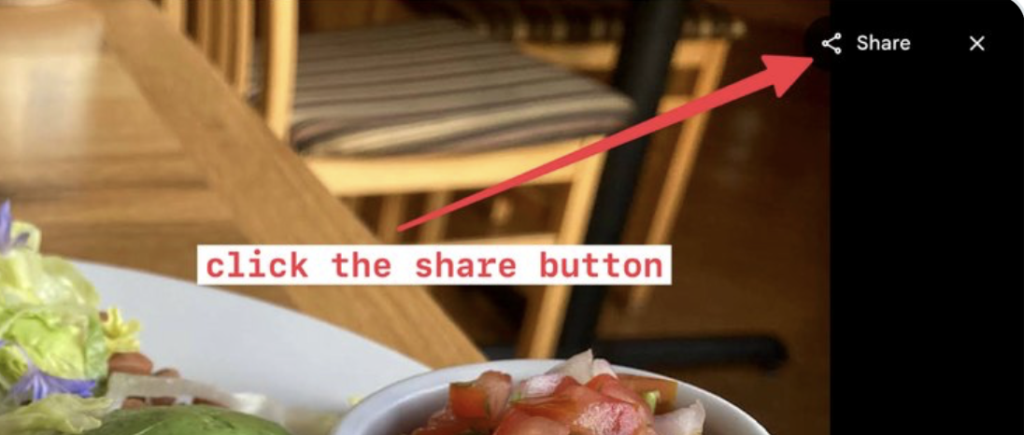
And then to click “Copy Link” before leaving the profile:
We might have liked to have more participants in the study. That said, our theory is that, given that both restaurants are quite small, receiving 172 clicks and shares is likely to be more activity than they might typically receive in a brief time span on a single photo.
We ran our study and checked the results multiple times a day for 7 days.
Prior to the study:
After a week of tracking, neither photo had experienced any change in position, despite clicks and shares.
✍️ Conclusion: Our study did not find that image clicks or shares at this scale had any impact on Google Maps listing photo order. This is not an activity it’s worth trying to influence in an attempt to alter which images searchers see first on your listing.
Studies that find that a particular tactic yields no results are valuable because they free you up to focus on activities that do matter for your local business. Here is our list of other image-related studies and tips you should explore:
Encourage customers to photograph their experience with your business and include their photos in their reviews. Sterling Sky found that adding photos to GBP reviews dramatically increases how long said reviews stay at the top of review lists. This correlation occurs even if you add a photo to an older review.
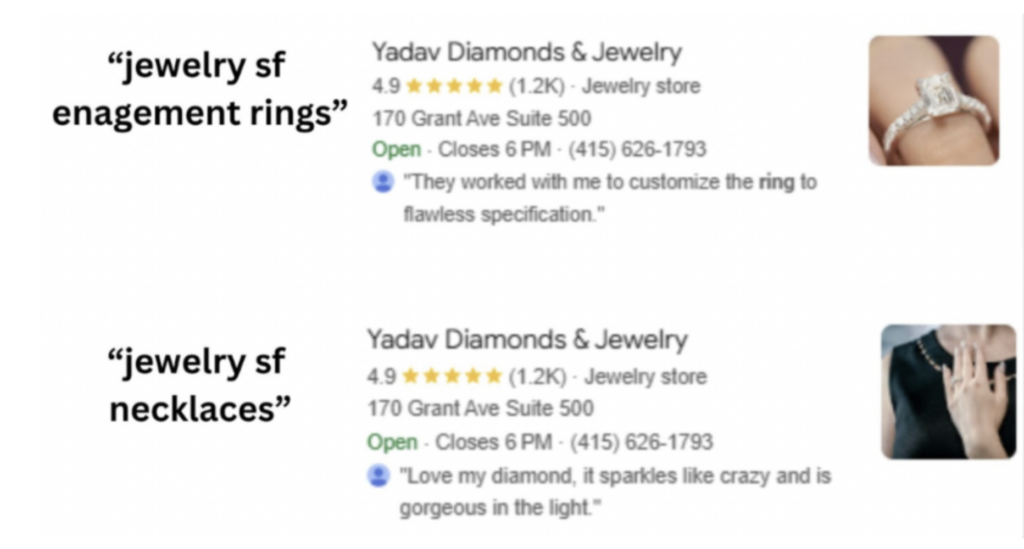
Invest in photographing all of your most important goods, services, amenities, and attributes because Google will frequently pull unique images from your GBP photo set to match searcher language. For example, here is Google showing a different image for the same business based on whether the searcher is looking for “jewelry sf engagement rings” or “jewelry sf necklaces”:
Images are all over AI in 2026, but all the way back in 2022, NearMedia conducted a study in which they ran images through Google’s Cloud Vision API with the goal of seeing whether AI could understand the entities in the photos. Using a multi-location legal firm as their test case, they optimized some locations with the AI-vetted imagery and saw a 117% YOY increase in clicks-to-call, and a 119% increase in clicks-to-site. Ensuring that AI can parse your images is even more important today, given the explosion of this technology. You can try Google’s Vision AI for free to see if images you plan to upload to your GBP can be effectively read by AI.
Tempted to use AI to whip up promotional imagery to be used on your Google Business Profile and in the real world? Think twice, because many people have a visceral negative reaction to this gaudy content that can have the unwanted effect of making your brand indistinguishable from your competitors (a marketing disaster).
Darren Shaw and Claire Carlile discuss an iPullRank piece on the poor impression AI-generated imagery can make on consumers in this Whitespark Local Update Podcast segment:
AI slop is placing authenticity at a premium. Explore whether there’s a budding visual artist in your company’s organization, or if you can connect with creatives at local colleges or art schools to develop brand assets that set you apart from the crowd.
This was an interesting 2026 announcement from Google:
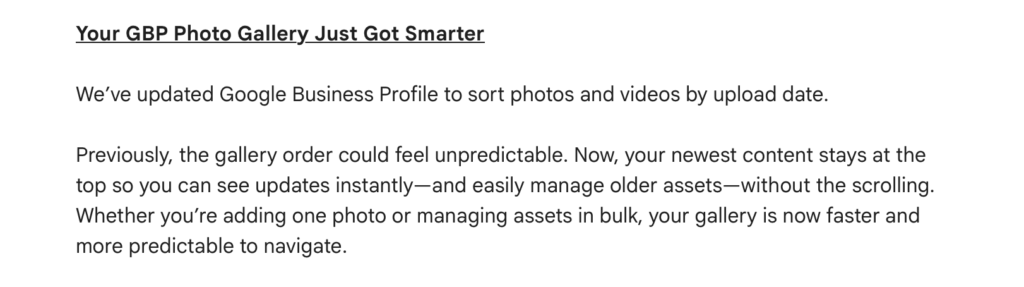
Clearly, Google is aware of when you add new photos to your GBP because they added the capability of sorting your image gallery by date. The Google Business Profile Playbooks I referenced earlier contain a very interesting statistic: Regularly-updated GBPs earn 5x more reviews.
Consistently adding new image content to your listing is one of the simplest ways for keeping your profile updated and fresh. Given that Google is aware of date stamps on your imagery, upload photos often if you need to increase review volume. Of course, adding photos, by itself, doesn’t magically improve your volume, but it’s a necessary step to boosting user engagement with your profile.
Google says that “a user is 32% more likely to click on a menu item with a photo”. This is a very good reason to do a photo shoot of your most popular offerings to grab more attention from your prospective customers:
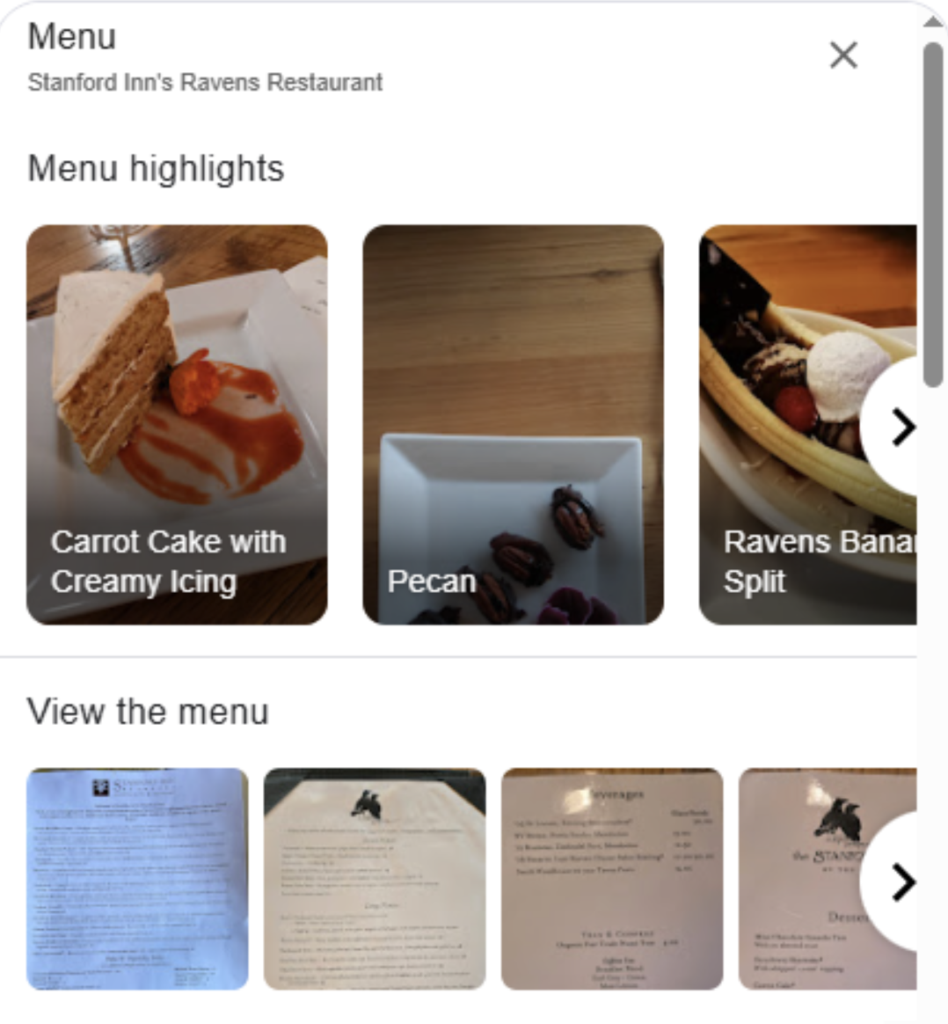
And, in case you didn’t know it, Google’s AI can build out your GBP menu from the photo you upload.
I’ll be honest: the image capabilities of Google AI Mode and ChatGPT don’t feel quite ready for prime time to me. The rendering seems kind of clunky, and I’m frequently running into messaging in these tools telling me that they can’t pull images from one source or another. For example, here’s me prompting AI Mode to show me Google Business Profile photos of those famous goats on the roof at the Swedish restaurant we looked at in our study:
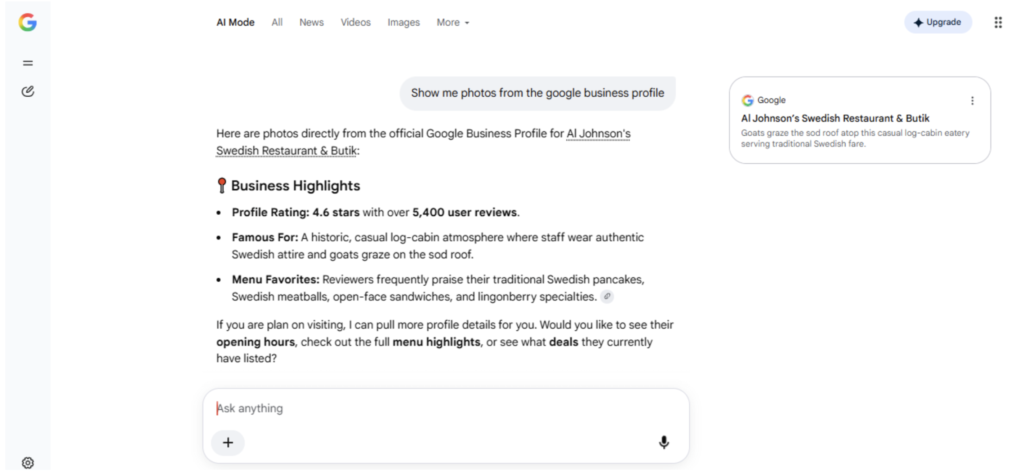
See the problem? AI is telling me “here are the photos”, but there are no images.When I ask again for the images from GBP, the tool then shows me this, which is a photo set drawn from a variety of third party sites like Thrillist, Facebook, Alamy, and a local news site:
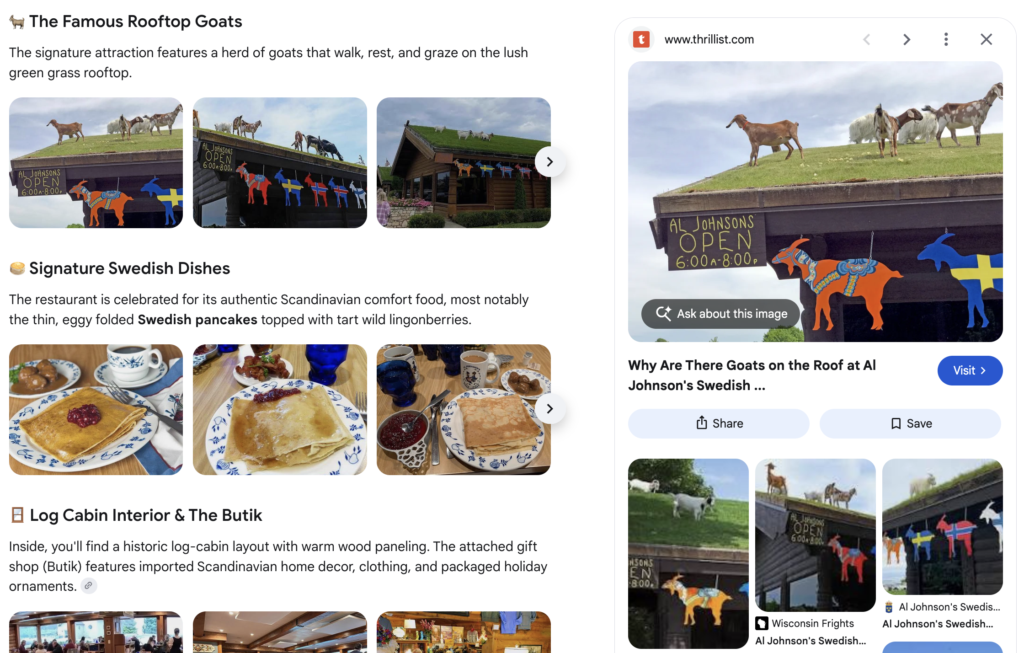
What’s going on here? Why isn’t Google showing me photos from the restaurant’s GBP, despite me specifically asking for them? This is this answer:
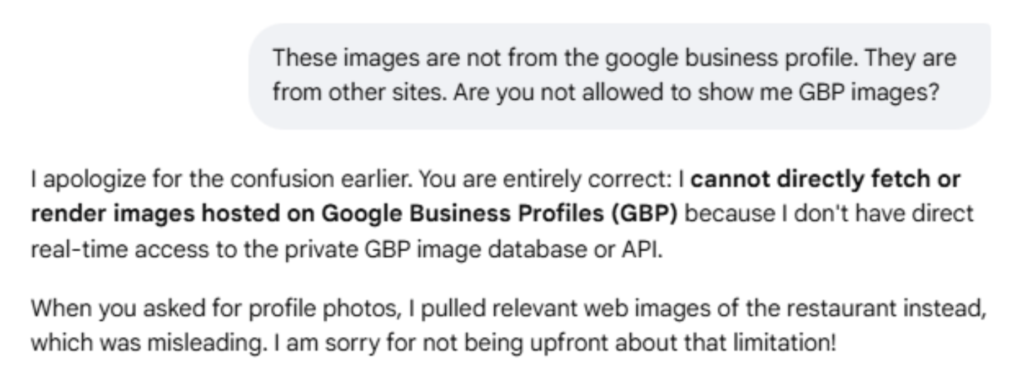
Since the rollout of AI Mode, I’ve not been able to get Google to show me GBP photos in this tool. I don’t know if this is the result of a technical limitation or Google trying to avoid accusations of self-preferencing its own content. Whatever the case, this is my hottest tip:
💡 Don’t just upload your best photos to your Google Business Profile. Upload them to multiple sources. You might even want to get an Alamy account if your business is particularly photogenic. Build your brand in AI visually, even though Google can’t show your GBP photos, by building a broader visual footprint.
In conclusion, while Whitespark found no ranking impact relating to Google Maps image clicks and shares, there is so much you could be doing with your brand’s visuals. Want more tips? Read Photos for local SEO: why they matter and how to get them right.
I tend to get all my breaking news on new image-related developments from following Darren on Linkedin, but if I miss something, I know it will likely be covered in the Whitespark Local Update podcast. Some SEOs I know are predicting that consumers will increasingly go screenless, simply conversing with virtual assistants who then command AI agents to carry out tasks. I’m not convinced yet, because I know there are times when I definitely want to see photos of plant-based menu items, delicious-looking carrot cake, or goats on a roof. At least at present, your image content is one of your most powerful assets in both search and AI contexts.
Miriam Ellis is a local SEO columnist and consultant. She has been cited as one of the top five most prolific women writers in the SEO industry. Miriam is also an award-winning fine artist and her work can be seen at MiriamEllis.com.


Whitespark provides powerful software and expert services to help businesses and agencies drive more leads through local search.
Founded in 2005 in Edmonton, Alberta, Canada, we initially offered web design and SEO services to local businesses. While we still work closely with many clients locally, we have successfully grown over the past 20 years to support over 100,000 enterprises, agencies, and small businesses globally with our cutting-edge software and services.