CONTENTS

🤓 The 2026 Local Search Ranking Factors are here!! Check out the report!

TL;DR
• Google AI Mode (launched 2025) lets users have conversational, multi-turn exchanges instead of single keyword searches
• ~48% of US consumers already use conversational AI to find local businesses; AI Overviews appear on ~68% of local searches
• Each user may see different AI Mode results for the same query, making prominence hard to track
• AI hallucinates — pulling from outdated or unrelated sources, which can mislead customers and create liability risk
What to do now:
• Tighten NAP accuracy across your website, GBP, and all listings
• Document customer FAQs in natural, conversational language
• Audit which sources AI Mode cites for your industry and top competitors
• Double down on reviews and unstructured citations (blogs, news, community pages)
• Expand FAQ content and photos across platforms
Bottom line: Traditional local SEO still matters — but AI Mode adds a new layer that rewards broad authoritative content, strong reputation management, and investment in channels you control.
Today is the day you’re going to sit down, confront how Google AI Mode is expanding the definition of local search, and understand how this emerging consumer activity layer presents new risks, challenges, and opportunities for the local businesses you market.
We won’t get deep into the technical weeds of how artificial intelligence (AI) works; instead, this is a practical guide to how to incorporate the realities of Google AI Mode into your overall concept of daily local search marketing.
By reading this guide, you will be ahead of less-motivated competitors in your markets who are snoozing on how Google AI Mode is changing the local search landscape in significant ways. We’ll cover what you really need to know and position you to make smarter marketing decisions based on a comfortable understanding of new ways in which potential customers may be encountering influential information about local businesses like yours.

Imagine you own a pizza restaurant in San Francisco. Meet Jack and Jill – a couple who live in the Haight-Ashbury district of the city on the east side of Golden Gate Park. They are potential customers whom you want to be discovered and chosen by for lunch today.
Jack and Jill want to order an organic pizza. Prior to Google’s launch of AI Mode in 2025, here is what Jack and Jill saw when they searched for “organic pizza near Golden Gate Park SF” while looking at their personal laptops in their living room:
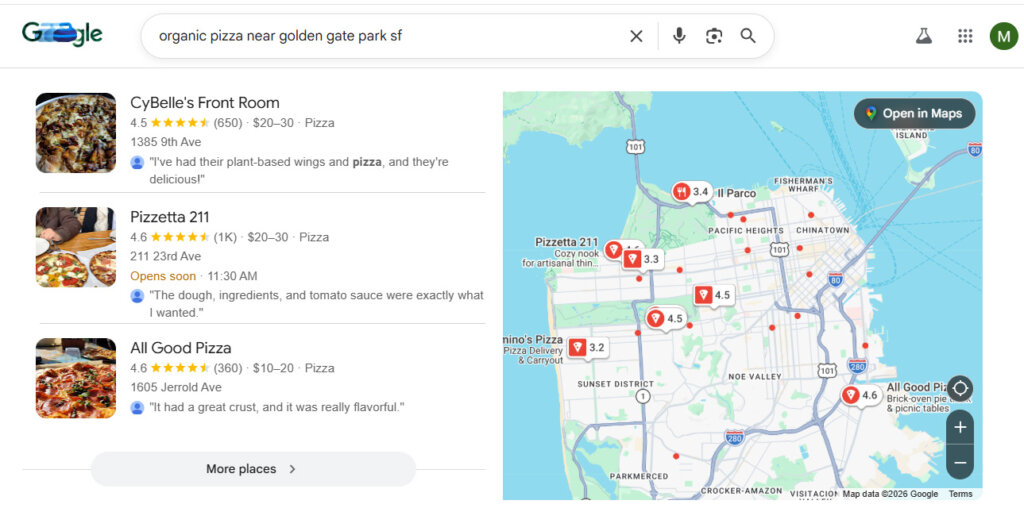
It’s a typical Google local pack showing 3 pizza places. It’s not actually completely helpful because some of the restaurants shown aren’t near Golden Gate Park at all, and nothing about the details in this particular local pack is showing why these 3 eateries are being ranked so highly for organic pizza.
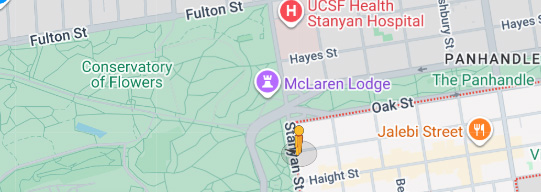
Jack and Jill haven’t made a choice yet, and it’s time for their morning run. At this point, Jack gets his exercise by running around the Conservatory of Flowers on the northeast side of Golden Gate Park.
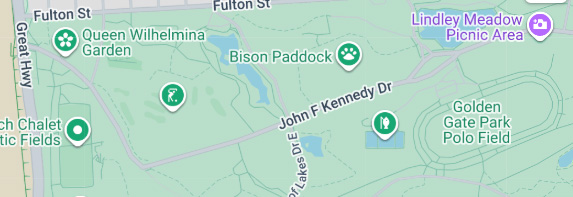
Meanwhile, Jill heads for the Queen Wilhelmina Garden, all the way over at the western side of the park.
When Jack performs the same pizza search on his mobile phone while he is at the Conservatory, Google shows him a different local pack based on his new physical location:
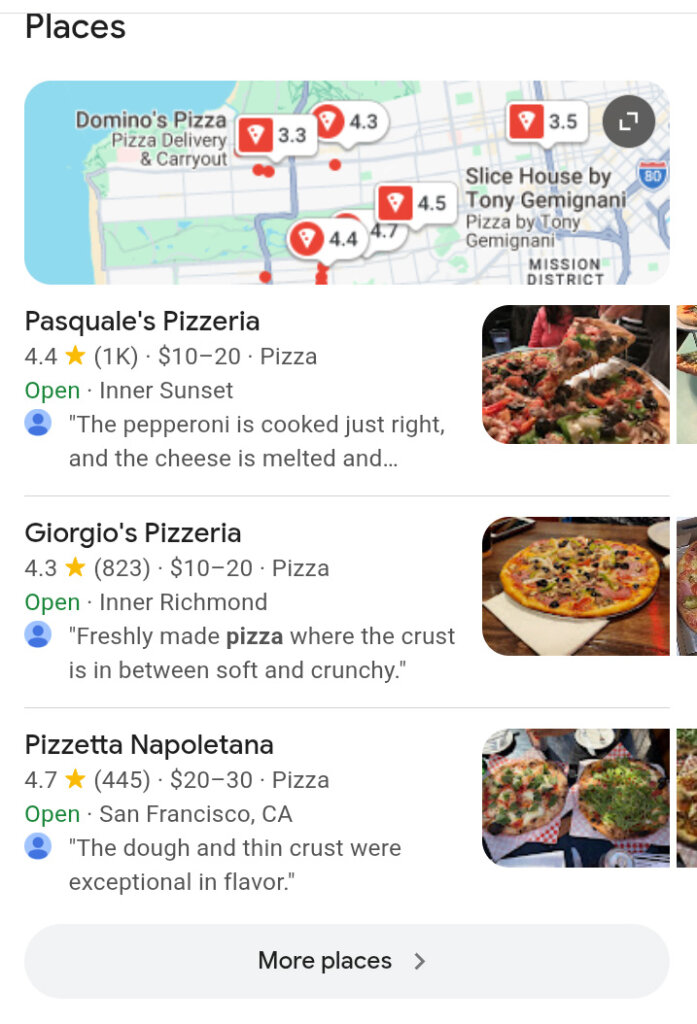
And when Jill also searches from her location at the Garden, she, too, gets quite a different local pack result from her physical location:
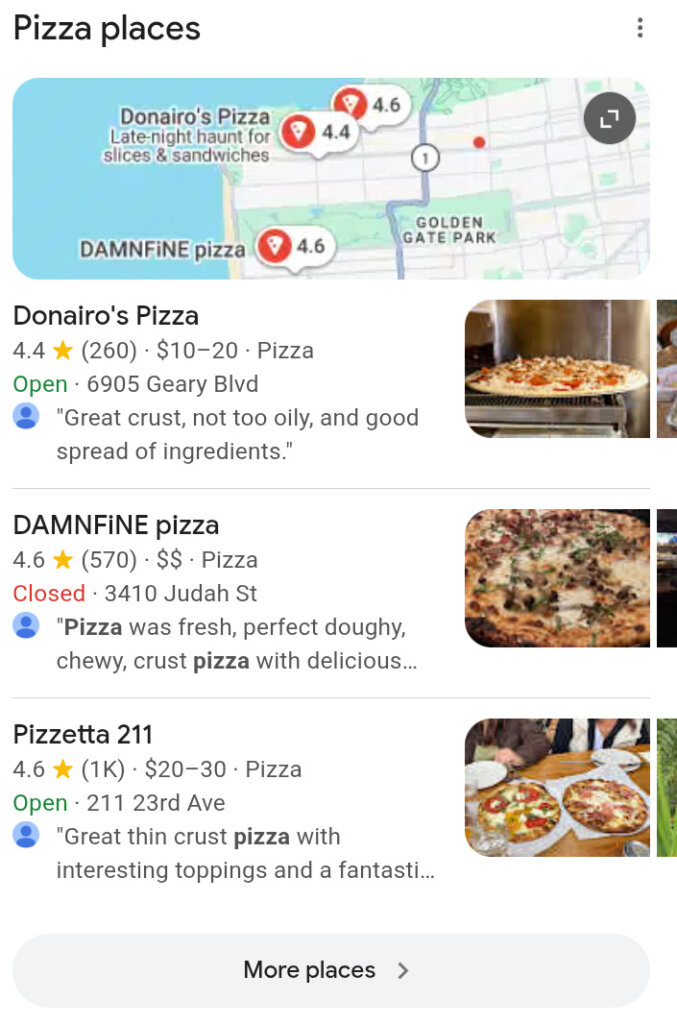
This is local search as we knew it until 2025. Google’s main customization of local results has long been based on the physical proximity of a searcher to a business. This dynamic makes it relatively simple for local business owners and their marketers to understand their local pack and Google Maps rankings for potential customers located in different parts of a town or city.
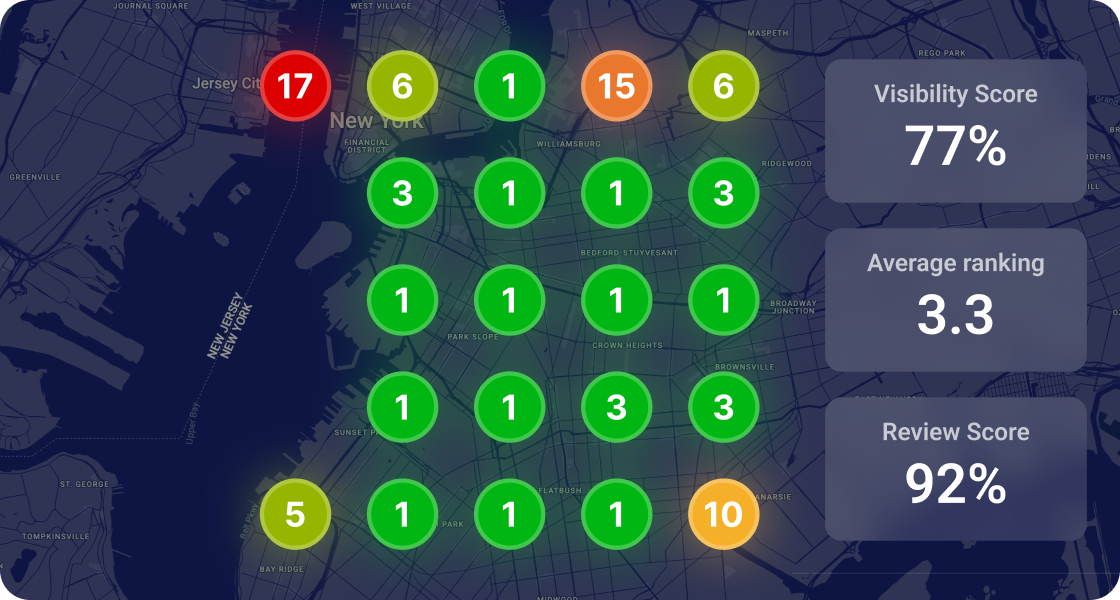
By using an amazing tool like Whitespark’s Local Ranking Grids, any business owner or marketer can see how they rank in traditional local search results by emulating Jack or Jill’s location to understand visibility to potential customers located at different spots on the map, like this:

It’s vital for you to know that everything you’ve learned about local search still matters today. Your best tactics and tools remain absolutely relevant, but Google’s introduction of AI Mode is what is known as a “market disruptor”. It’s changing consumer behavior by offering new options.
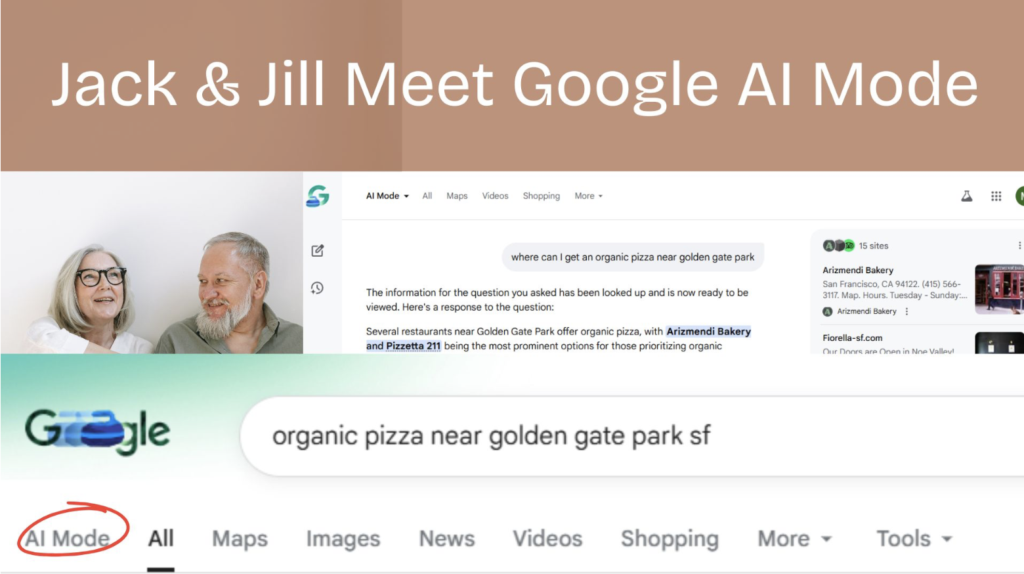
Prior to 2025, if Jack and Jill didn’t like the local pack or Maps results Google showed them, there wasn’t much they could do about it beyond trying to perform another search in case Google would pick up on the nuances of their altered search language to show them more relevant results. But, now, your potential customers are seeing the “AI Mode” tab (shown above) right at the top of the organic SERPs, inviting them to explore a different way of accessing information.
Our hypothetical couple may still see a local pack for many traditional local searches on their desktop devices, or, they may encounter an AI Overview like this one, which is an AI-generated summary. Notice how it includes a large prompt to “Dive deeper in AI Mode”:
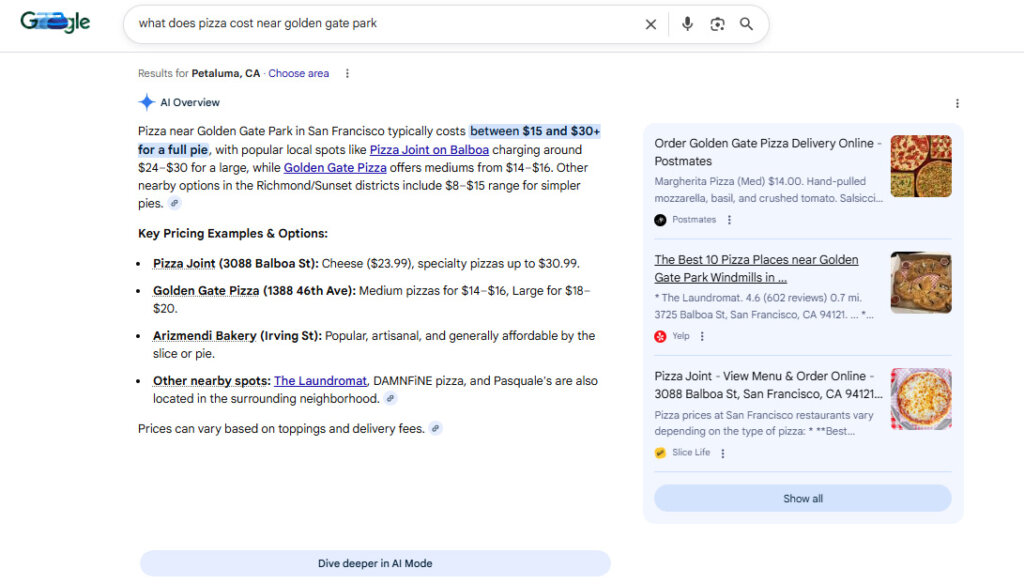
When Whitespark studied AI Overviews in Q1 2025, we found that they were appearing for an average of 68% of local searches. While such figures may alter over time, your takeaway is that Google is doing everything it can to get the public to engage with AI Mode.
Your potential customers are no longer limited to Google’s local packs and Maps. Again, numbers may vary over time, but a Q3 2025 study by GatherUp of 1,000+ US consumers found that 48% of respondents had interacted with a conversational AI tool while looking for local business information. If anywhere near half of your local community is experimenting with AI Mode, it’s something you absolutely need to know more about.
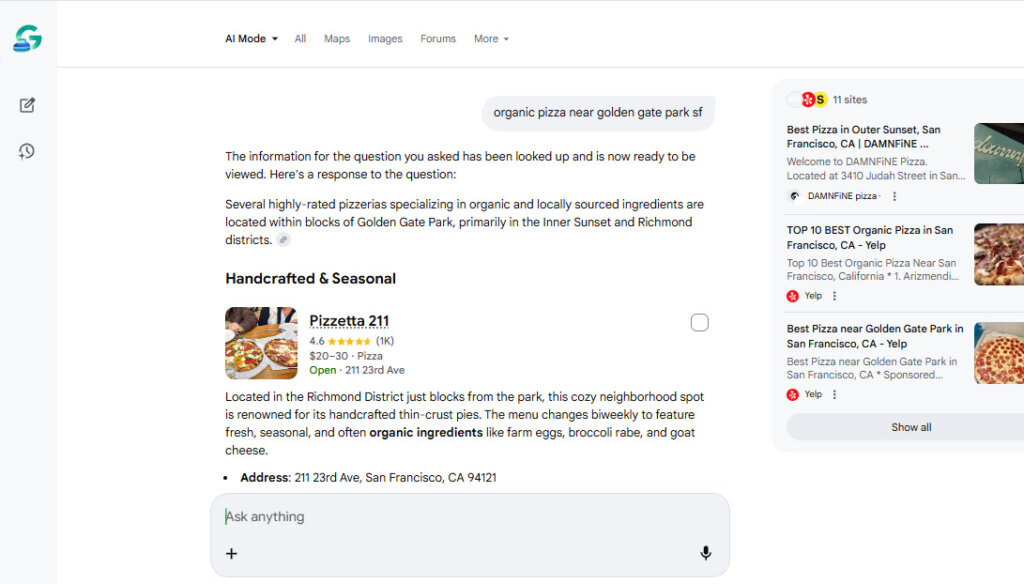
Once searchers enter AI Mode, they have a space to write a prompt like our couple’s original search for “organic pizza near golden gate park sf”. A local search like this will typically be met with a main column of information that Google has scraped from a variety of sources, accompanied by a right-hand column made up of citations of some of the sources Google is scraping. These results can scroll at great length, offering AI-generated summaries about businesses and information about star ratings, review volumes, pricing, hours of operation, and other basic facts pulled from Google Business Profiles or other sources. The results also frequently contain suggested further prompts for more information, like these:
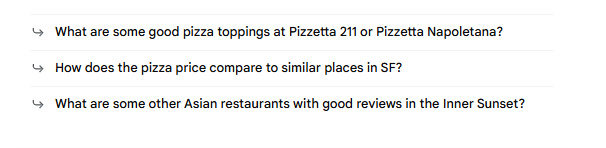
Now let’s move on to the key capabilities that make AI Mode different from traditional organic search. If Jack doesn’t see a relevant answer to his initial prompt, he can continue a conversation with AI Mode hanging onto the context of what was previously being discussed. Organic search can’t do this. Look at what happens when Jack makes a second prompt:
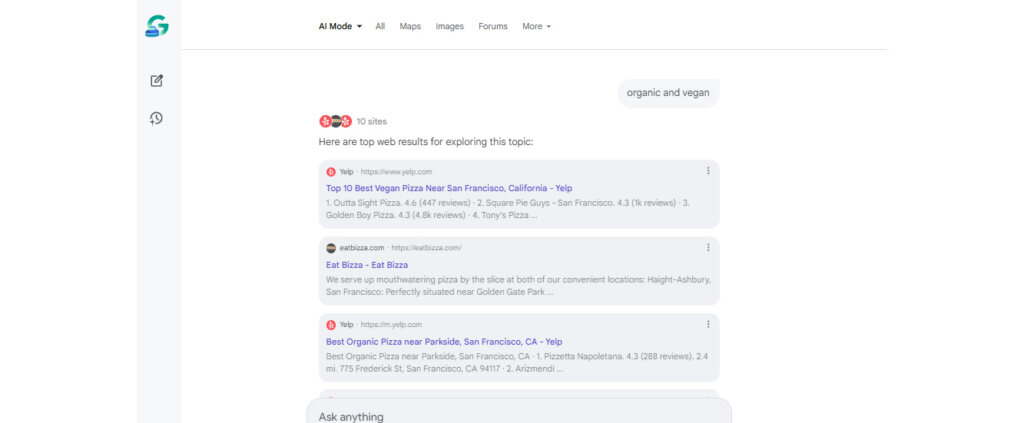
Jack prompts AI Mode with “organic and vegan”, and the tool brings up a new set of information. What’s phenomenal here is that AI Mode has retained the context of the overall conversation. It still knows that Jack is talking about pizza, and it still knows that he’s talking about San Francisco, without him having to re-enter those phrases. The new results are showing organic and vegan pizza options based on Jack’s new set of criteria in an ongoing conversation.
In the local search context, this is really one of the main value propositions conversational AI offers to consumers: the ability to have a nuanced, detailed, ongoing exchange without having to keep searching afresh every time.
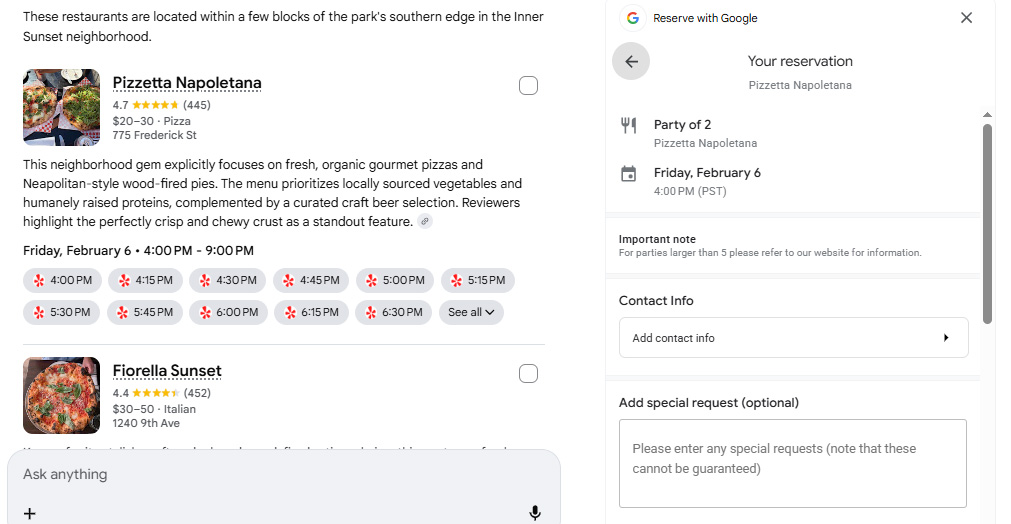
Some elements of Google AI mode results are actionable, like this suggestion that you let Google find a reservation for you:
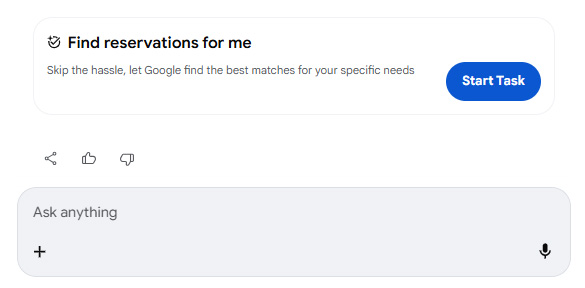
When clicked on, this function lets the user know it may take some time and then it begins running a number of queries, like this:
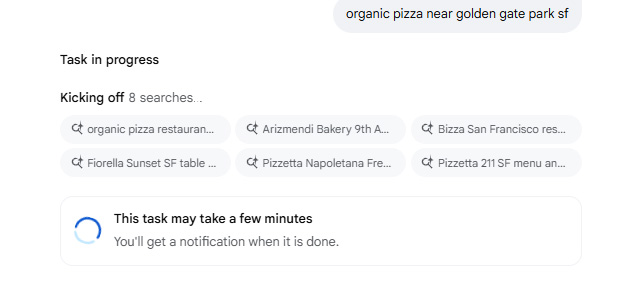
While a traditional local search sparks a single query, AI Mode operates via “query fan out”, making multiple queries/calculations to arrive at the information it shows users. Typically, after a couple of minutes, this particular task results in a display like this, in which the user is given the option to use the “Reserve with Google” function to book a table, like this:
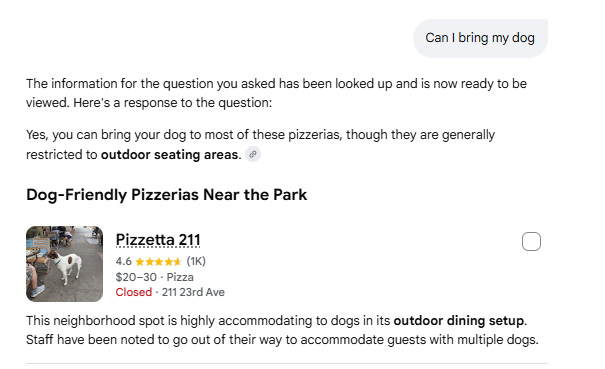
Meanwhile, context continues to be retained if Jack suddenly remembers that he’d like to bring his dog with him to lunch:
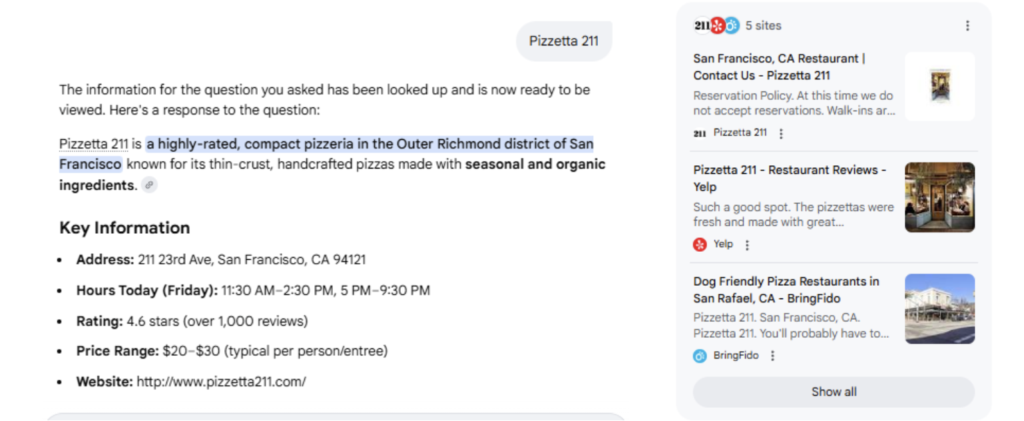
And if Jack does a branded prompt, like “Pizzetta 211” because he wants more information about a particular restaurant he knows of by name, AI Mode will typically show him a summary like this, made up of basic info and citing a combination of review content from sites like Yelp and unstructured citations, like a mention on a site dedicated to dining with dogs:
A branded prompt will also frequently bring up a small map. If Jack clicks on the map marker on the map, he’ll get a display that is very like the Google Business Profile display with which you’re already familiar as a local business owner:
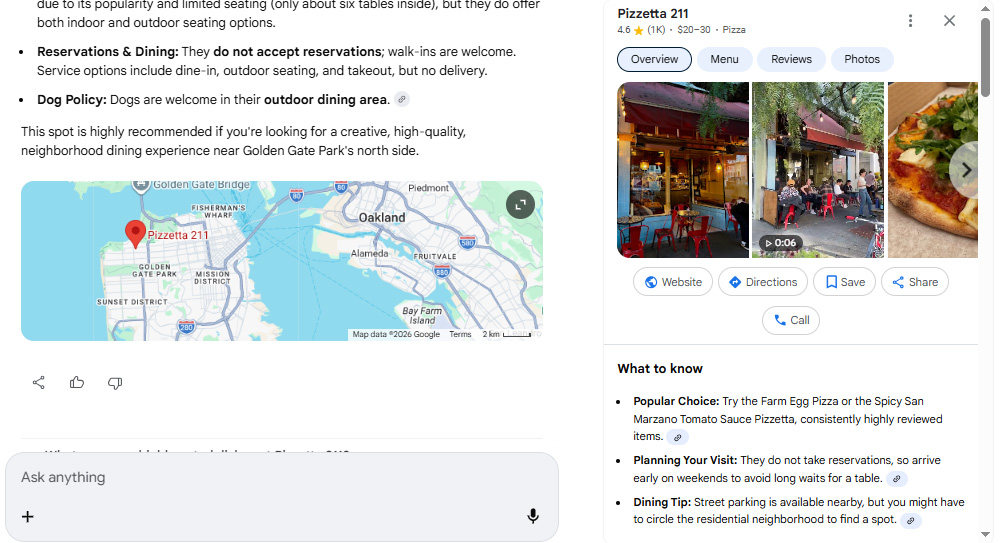
There are the typical components of a GBP (like ratings, reviews, menus, photos, and actionable buttons to make a call, get directions, visit the website, etc.) but there are also lots of bits of AI-generated information thrown in. Examples include content in the “What to know” section shown above. Google Maps app users are increasingly being shown AI-generated content in Google Business Profiles when searching via their phones, and the ruling principle of both environments appears to be to give users as much information as quickly as possible about their local options.
If all this is sounding pretty good so far, in terms of being discovered and chosen by Jack and Jill for lunch today, you’re getting a good sense of the positive opportunities of a tool like Google AI Mode. But, to have a fuller understanding, keep reading.
Just like traditional local search, Google AI Mode customizes outputs based on the searcher’s location if they have that information. In other words, if both Jack and Jill search for “pizza near me” while sitting in their living room, Google will show them SF-based eateries because it is tracking their location.
But here we encounter our first problem with the technology. It’s a real oddity, and a huge challenge. AI Mode showed Jack the result we saw above for “organic pizza near golden gate park SF”, but here’s what it shows Jill, making the same search in the exact same location:
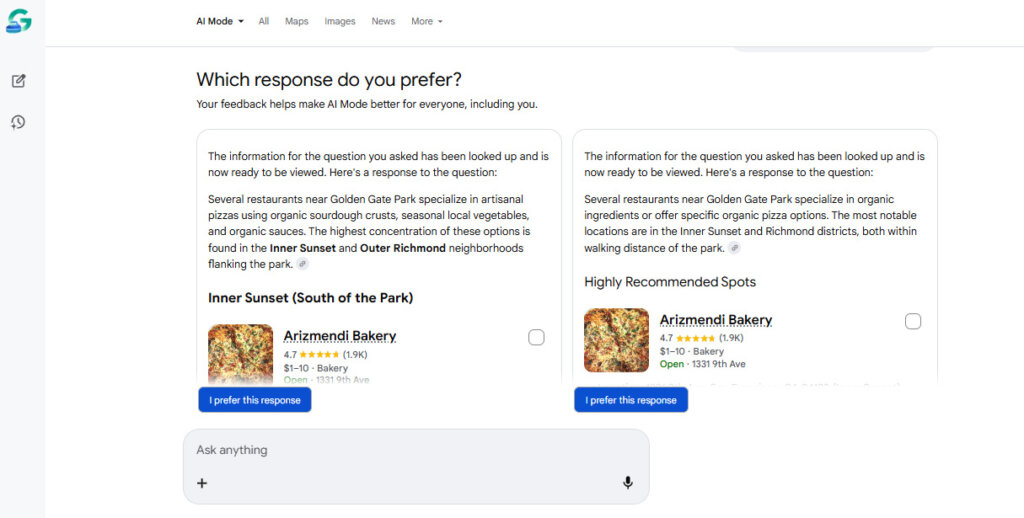
This second result looks nothing like what Jack saw. Instead, it’s showing Jill tables of local business information and asking her to provide feedback on her preferences. Why is this so problematic for business owners and marketers? Because, at least at present, there is no practical way to understand what each of your potential customers is being shown by AI Mode.
For an excellent technical explanation, head to about minute 4 in this podcast episode in which Michael King explains to Rand Fishkin how a study by Ziptie found that being ranked in the top 10 of Google’s organic results gives your business only a 25% chance of appearing in AI Overviews.
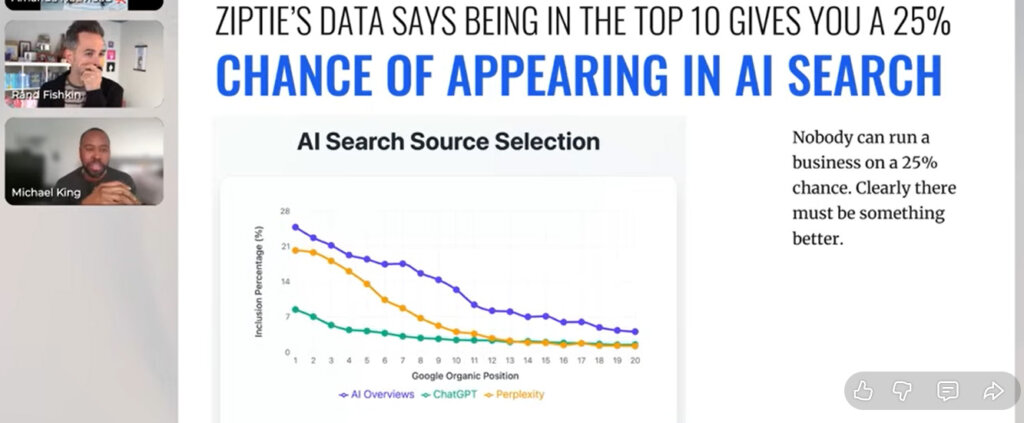
While exact figures may differ, this same type of variation is present for local search queries. Your local pack rankings are not a guarantee of equal visibility in AI Mode. This makes understanding your prominence in AI Mode impractical, because each of your potential customers may be seeing different things.
A second major problem is the one that has caused generative AI to make headlines for showing users bizarre and even dangerous information. AI gets things wrong, and in the local business context, a significant problem is hiding in this screenshot:
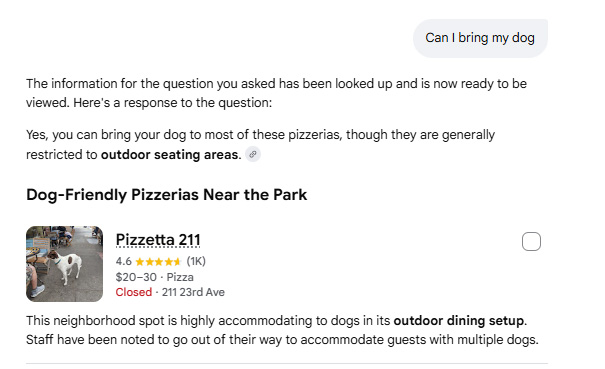
Jill is asking if she can bring her dog to a restaurant called Pizza Gallery in Emeryville. Google AI Mode is assuring her that she can, but it is basing this answer on:
AI’s so-called “hallucinations” present multiple risks to your local business because:
Local business owners are already familiar with the real-world impacts of a lack of full control over a product like Google Business Profiles. Incorrect information on them, malicious or mistaken public edits, spam reviews, and random suspensions can all have significant financial impacts, which occur in an environment that has never been adequately supported by Google. Some problems can be very difficult to resolve while business reputation and profits suffer. Serious issues can even lead to business closure.
Google AI Mode takes this central issue of a loss of control to a new level. Local businesses not only lack oversight and input into how they are being represented, but also any practical way to see what local consumers may be seeing due to the variation of results. Whether tools may emerge to track performance in AI in a practical way remains to be seen. For now, the environment is mainly a big black box and quite uncomfortable for marketers who are used to being able to track nearly everything.
Despite these problems, consumer use of Google AI Mode makes it a necessary component of any full picture of online local visibility. What should your local business be doing right now about the rise of Google AI Mode? Keep reading.
Every local business owner benefits from the time the local SEO industry has had to study how to improve visibility in Google’s traditional local search results. Studies like Whitespark’s Local Search Ranking Factors can be used as a blueprint for optimizing your Google Business Profile and other digital assets to achieve high rankings.
When it comes to Google AI Mode, we are still in a nascent stage, but we do have enough information to begin formulating a plan for AI prominence. Sign up here to download a PDF version of this checklist to share with your teams and clients:
Google AI Mode Prominence Checklist For Local Businesses
☑ Start by getting your existing digital assets in good order. Be sure basic information about your business name, address, hours of operation, phone numbers, and other contact info is accurate on your website, Google Business Profile, listings on third-party platforms, social profiles, and structured citations. This ensures that AI has plenty of accurate data to scrape about your business and could, perhaps, limit its hallucinations. Structured citation accuracy and consistency has gained in importance as a result of the emergence of conversational AI tools.
☑ If you don’t already track the FAQs your business receives, using customers’ real-world language, begin doing so now. Empower public-facing staff to document all questions being routinely received at each location of your brand. Google AI Mode is conversational, mimicking human language. You need to think in terms of human questions and complex contexts instead of in keywords when optimizing for this technology.
☑ Take your FAQ list into AI Mode and begin prompting for each of your questions. You are looking for 3 insights with this task. 1) Whether your brand is appearing in Google AI Mode for these questions. 2) What sources are being cited to answer these questions. 3) Whether you are currently mentioned on the sources being cited. Bearing in mind that each AI Mode user may be seeing unique results, this exercise will at least give you a starting point list of sources the tool is citing to generate answers to some of your customers’ known FAQs.
☑ If you have a paid Gemini API key, you can use a free tool like Qforia to emulate query fan out to better understand how a single prompt generates multiple related queries. This can help you develop content on your website and other digital assets that covers a wider variety of queries in hopes of earning increased Google AI Mode prominence.
☑ Prompt AI Mode with the brand names of your top local pack competitors, as well as with the brand names you saw coming up in the tool for your FAQs. Document the sources being cited in association with these brands. This gives you a list of publications on which it may be important for your brand to be mentioned or listed.
☑ Double down on professional reputation management. Reviews have emerged as one of the key sources of information Google AI Mode is returning in response to local search prompts. Invest in acquiring recent reviews at a competitive velocity and in responding to negative reviews with the goal of winning back customers who will improve your star rating and overall consumer sentiment by updating their initial review to reflect a better subsequent experience with your brand.
☑ Double down on unstructured citation development. Continuously seek out ways to earn mentions of your business via local and industry involvement. Google AI Mode is depending heavily on these types of citations for its responses to local search queries. Earn mentions on blogs, online news sites, social media, community hubs, industry publications, sponsorship pages, job sites, local business association sites, and the websites of your local business peers.
☑ Double down on making your website the authoritative source of answers to your customers’ FAQs. This has always been a local business website best practice, but as AI familiarizes consumers with being able to get fast answers to nuanced questions, you will benefit if your brand is already publishing in this framework.
☑ Seek inclusion in assets like Yelp 10-Best lists if your investigation shows that Google AI Mode is heavily citing these in your locale or industry.
☑ Photograph all aspects of your business and publish your photos on your website, local business listings, review platform listings, and social media profiles. Google AI Mode is displaying large image galleries in response to requests. Pay attention to the sources that are coming up for prompts like “photos of X brand”. Add your photos to these sources where possible.
☑ Enroll in Google programs where possible. If “Reserve with Google” is frequently cited in response to your prompts, you should be part of this program. Do the necessary research to identify actionable Google AI Mode features you can be part of.
☑ Expect change. This is a rapidly-altering technology. Cited sources can continuously change. Keep experimenting with how AI is responding to your customers’ FAQs to spot new ways to earn prominence.
If this checklist seems overwhelming, Whitespark can help with multiple aspects of it, from reviews, to citations, to competitive research.

At best, predictions are speculative, but there are 3 developments you should stay tuned into when it comes to how consumer experiences of local search may evolve:
1. Google Web Guides
There is strong feeling in corners of the marketing world that the beta Google Search Labs product, Google Web Guides, could be the future of organic search results. You can see an example of this in the above screenshot in which a search query about traveling solo in Japan is met with AI-generated content based on a query fan out process. If you’d like to read more about the Google Web Guides experiment, read Dr. Peter J. Meyers’ A Guide to Web Guide: Our Hybrid Search Future.
2. A Pressurized Paid Environment
Google accelerated its march to a pay-to-play local search dynamic with the introduction of Local Services Ads which beta-launched in 2015 and has gradually grown to encompass more and more industries. Most recently, Google is moving to maximize its revenue, as documented by Sterling Sky, with the following actions designed to preference paid results:
If AI local packs become the norm, your brand may end up having to pay for visibility and consumer engagements you previously enjoyed for free.
3. Agentic Features
In this guide, you saw an example of Google AI Mode offering to book a table for Jack and Jill. Some marketers and stakeholders believe that the future of local commerce will be filled with agentic technology like Google’s experimental “ask Google to call local businesses for you” feature. In other words, instead of Jack and Jill calling you, a robot can do it for them to inquire about your menu, your prices, your hours of operation, reservations, etc. In fact, perhaps you won’t even be picking up the phone at your place of business anymore. Your robot will take care of that.
Google hopes local shopping will become largely agentic. Will people really trust their credit cards to this environment? We’ll see. If autonomous execution of daily tasks sounds too space-age to you, you could be right, but it’s something to be aware of and NearMedia has a good write-up on this developing technology.
You’re not alone if you feel this technology is being forced upon you and the local communities you serve without anyone having asked for it. AI does create novel capabilities and opportunities that local consumers previously lacked, but public sentiment about multiple aspects of AI is not universally favorable.
If you don’t find yourself sitting in the AI rooting section at this point in time, here are two actionable strategies for you:
1. Survey your own community to gauge behavior and sentiment
While consumer survey data isn’t always perfect, it can help you to read the room. Query your existing customer base to find out how many people say they found you via a tool like Google AI Mode. You can also conduct surveys to discover whether AI is viewed as a positive or negative resource in different towns and cities your multi-location brand serves. It seems clear that all local businesses need to be concerned about how they are being represented in Google AI Mode, but the degree to which you invest marketing budget and energy into the pursuit of AI prominence should be dictated by your own customers’ needs. As with everything else in the local business environment, success hinges on giving customers what they want.
2. Invest more in channels you control
Build up your email list. Ask for first-party reviews and testimonials. Launch your own podcast or video channel. Participate in real-world community life. Build an attractive offline referral program. Improve in-store customer service. All of these areas are ones over which you control the narrative and can directly communicate with the people you want to serve.
Finally, remember: you can safely ignore all clickbait claims that AI means that “local SEO is dead” or that “SEO is dead” or that “marketing is dead”, etc. The truth is that artificial intelligence is only as “smart” as the sources it scrapes. The need to create a broad digital footprint of authoritative content about your local business has never been greater. As your next step, read Whitespark’s Ultimate Guide to Local Business Reputation Management to root yourself deeply in why good customer service will stand the test of time.
Miriam Ellis is a local SEO columnist and consultant. She has been cited as one of the top five most prolific women writers in the SEO industry. Miriam is also an award-winning fine artist and her work can be seen at MiriamEllis.com.


Whitespark provides powerful software and expert services to help businesses and agencies drive more leads through local search.
Founded in 2005 in Edmonton, Alberta, Canada, we initially offered web design and SEO services to local businesses. While we still work closely with many clients locally, we have successfully grown over the past 20 years to support over 100,000 enterprises, agencies, and small businesses globally with our cutting-edge software and services.