CONTENTS
🤓 The 2026 Local Search Ranking Factors are here!! Check out the report!

🤓 The 2026 Local Search Ranking Factors are here!! Check out the report!


The majority of local search marketing content is, understandably, devoted to improving your online presence to represent your business via assets like local business listings and your website. You can think of this as online consumer experiences impacting offline business results.
Today, we’re going to flip the script on this narrative because the way the local web is evolving is bringing new emphasis to real-world authenticity and assets. You can think of this as offline business marketing impacting online consumer experiences.
We’ll cover key practices that bridge the offline-to-online gap, helping you create both a loyal local consumer base and an incredible digital footprint.
Local SEO best practices remain as important as they’ve always been, but the risks of getting trapped in an online-only bubble are increasing. Why? Consider:
There is a danger hiding in statistics capturing how consumers are using AI in trying to get answers about nearby businesses. It’s easy to mistakenly conclude from this that your customers want to spend more time chatting with AI, when, in fact, a better takeaway from this is that consumers are still having a hard time accessing all the information they need before they can confidently choose your business. AI is filling a gap created by the fact that traditional search doesn’t offer enough assistance or information.
While AI inclusion has quickly become a necessity for local brands, there’s an additional danger lurking in concluding that, if you’ve achieved visibility in platforms like ChatGPT or Google AI Mode, you’re succeeding. The risk here lies in letting AI be the authority about your brand. AI is notoriously prone to error and will eagerly show misinformation to your potential customers while also happily recommending your competitors. You and your staff are the only real authorities about your business, and while AI inclusion is necessary to a full local search marketing campaign, the smartest brands will prioritize any activities that cut out intermediaries wherever possible, creating direct, one-on-one relationships with real-world consumers.
Finally, AI’s inaccuracies are combining with the rise of local business spam to create a new kind of monster. When spammers create fake local business listings and publish fraudulent reviews, AI brings this deceptive content to new prominence, making it look authoritative to less-savvy consumers. Incoming studies suggest that only a small percentage of online users fact-check the sources AI cites. Unfortunately, AI cannot understand the validity of what it scrapes, and if you’ve spent years trying to fight spam in a platform like Google Business Profile, it’s important to understand that conversational AI has created a whole new front on which local commercial landscapes and business reputation can be misrepresented with little regulation.
Problems like these highlight the importance of taking as much charge as you can in the setting over which you have the most control: offline consumer experiences. When you can make direct connections with customers in your stores or in the field, you decrease their dependence on third parties like search and AI. Meanwhile, the more satisfaction you deliver offline, the stronger your online representation will naturally become, giving bots and scrapers a better chance of presenting your business more accurately on their platforms.
Now that we’ve looked at some of the downsides of the current state of digital local search marketing, let’s dive into the elements of building a strong offline brand that results in more online wins for your business.
Each of these foundational real-world elements have online outcomes.
Can your community sufficiently support your business? Every day, local businesses that began as someone’s dreams close due to a misunderstanding of consumer demand. A town that can support one organic Peruvian restaurant, gluten-free pie shop, or plus size clothing boutique may not be able to support two. Even great business ideas can fail to capture enough local customers to be profitable.
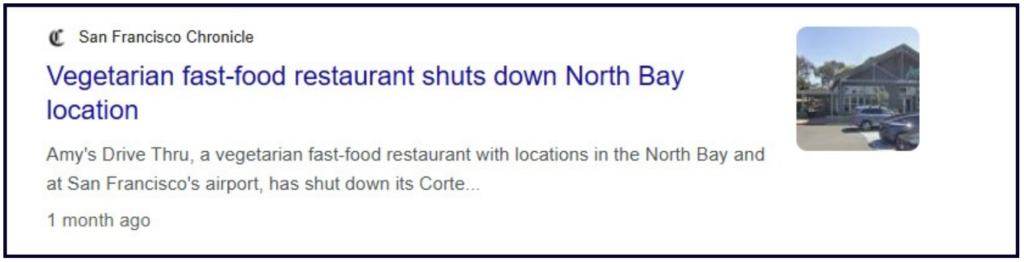
The causes of business closures are typically complex. A story I’ve been following with interest is that of a San Francisco Bay Area vegetarian restaurant chain that has promoted itself as an ethical alternative to the average fast-food franchise. Lots of my friends and family loved visiting its drive-thrus and felt good about patronizing a greener brand. Now, the company is having to close its most visible branch, located in a part of California that is famous for 1) its wealth, and 2) its friendliness to alternative lifestyles. There is no lack of local money nor plant-based eaters, and while official statements from the brand cite a variety of causes for branch closure, I suspect the company began running into trouble as a result of very public disputes with labor.
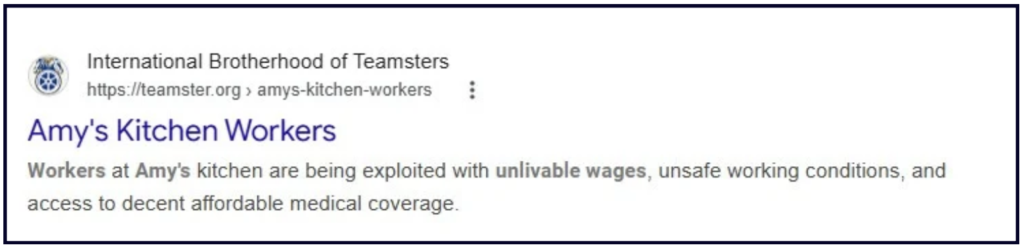
When stories like the above began filling online publications, local news, and social media, they revealed a failure on the part of the business to understand local demand. Instead of being a mere numbers game (a common cause of closure), a societal disconnect emerged. Plant-based eaters frequently prioritize ethical choices and the restaurant chain found itself the subject of boycotts when its workers began alleging unfair and unsafe practices. In our social media age, being seen as failing to walk the talk can contribute to business closure, just like a basic lack of understanding local consumer demand.
Online impacts: Without sufficient local consumer demand, your business may struggle to earn enough online reviews on platforms like Google Business Profile to drive the local search rankings that facilitate brand discovery. Getting found is the first step to being chosen, and your offering has to be popular enough to spark online mentions. Research can help you assess whether the business you want to open will attract enough initial customers to drive online discovery by the whole community.
Your business can minimize risk of closure by researching both local demand and local culture.
Every local business needs a name, and if yours isn’t clear and consistent, it can create significant online problems. Let’s look at the top-ranked business in Google Maps when we search for “car accident lawyer los angeles”.
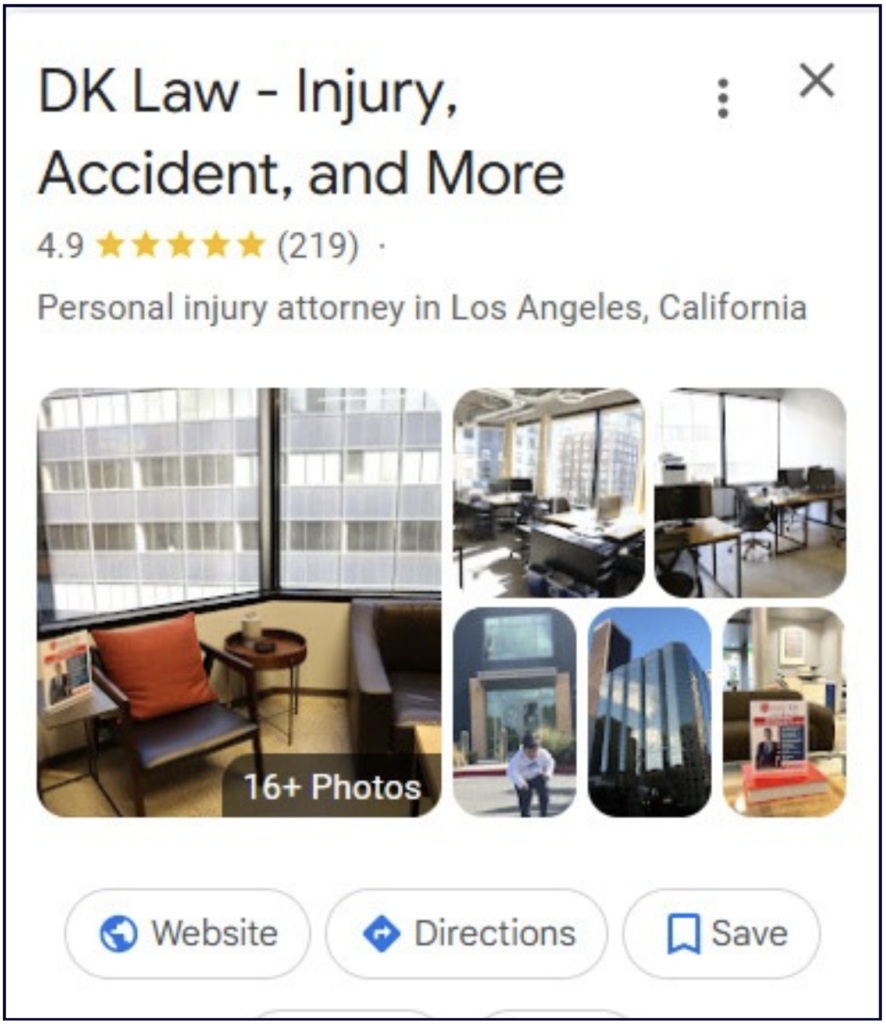
The Google Business Profile indicates that the name of this business is “DK Law – Injury, Accident, and More”. Given that the Guidelines for representing your business on Google require that this field must reflect the name of the business as it appears in the real world, let’s check real-world signage. This business appears to be located in a hi-rise, so we are left with looking at lobby signage, which does not appear to match the exact wording of the business title field of the Google Business Profile (GBP). We see a mention of “DK” on this signage, but not “DK Law” and certainly not the full wording in the GBP title:

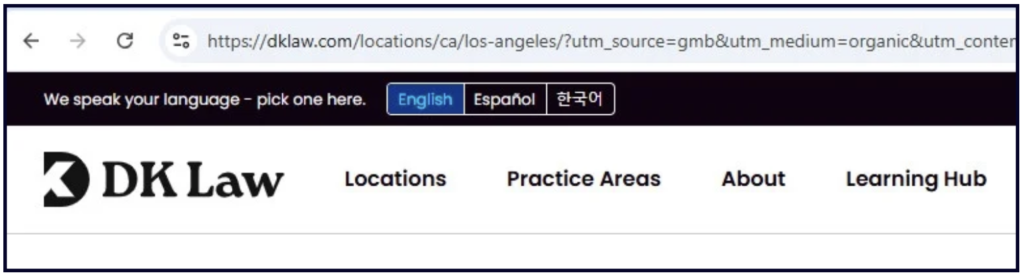
Let’s check the practice’s website. Again, we see DK Law here, but none of the other modifiers in the GBP title:
Let’s finish by looking up the business in Google’s organic results:
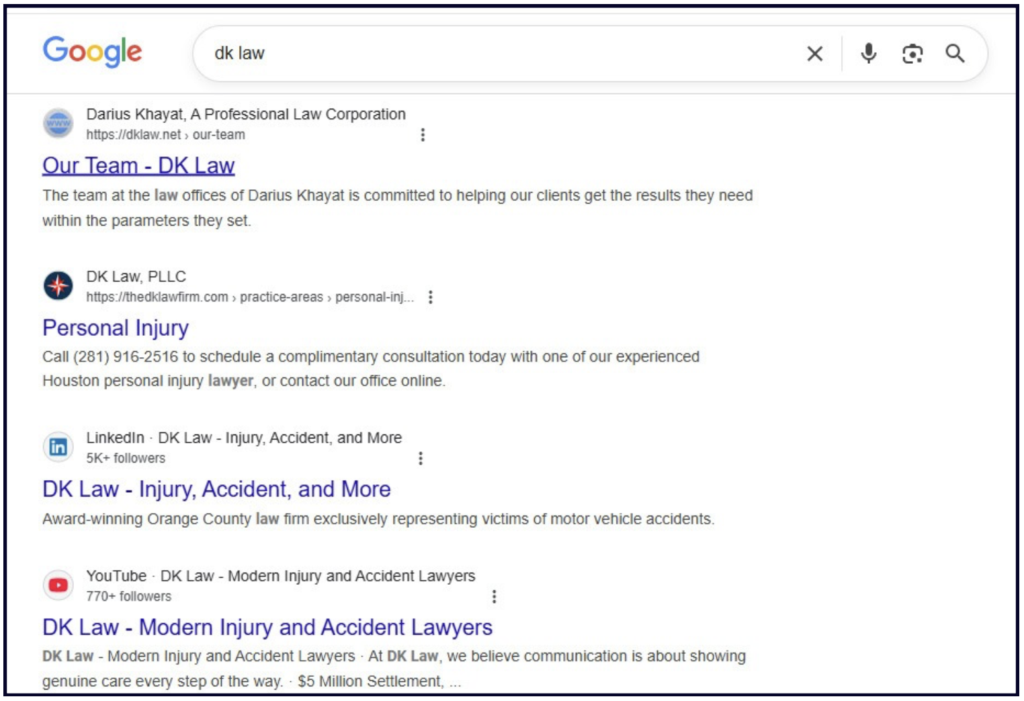
Which of these entries represents the same business? I don’t believe Darius Khayat is the same attorney as Daniel Kim. I also don’t think thedklawfirm.com is the same practice as dklaw.com. And neither of these URLs matches the web address on the lobby signage, which reads usaccidentlawyer.com.
Online impacts: Inconsistent branding can not only confuse online-to-offline customers who cannot match what they saw about your company on the web with what they are looking for in the real world, but can result in search engines like Google lacking confidence in the validity of your online business details.
As we saw in our example, this attorney practice is ranking at the top of Google’s local results for our search term. Unfortunately, they are at risk of having their listing suspended for violating Google’s guidelines by including extraneous keywords in their business title field unless they have acquired a legal DBA that exactly matches their GBP name. Google’s local algorithm is easily exploited by adding extra keywords to business titles, but it is also very easy for any member of the public to report these businesses.
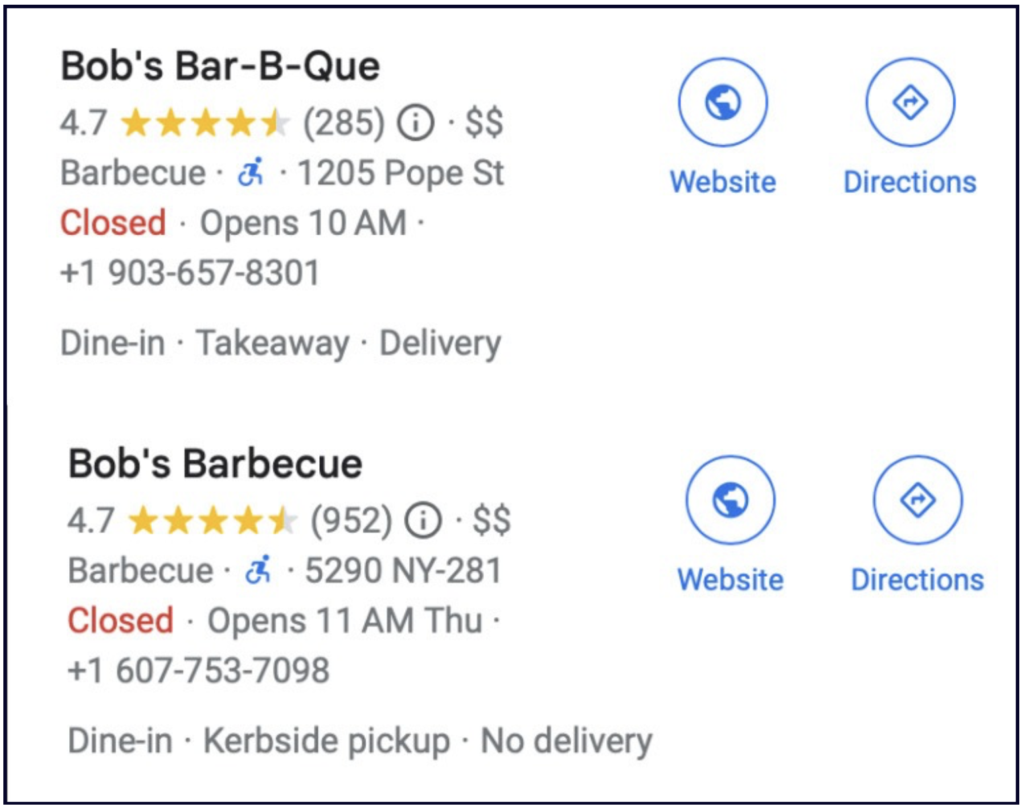
Branding mistakes are extremely common and tend to result from a lack of initial research. It’s essential to think about how your offline name will appear to search engines and consumers trying to understand what your business is and does, and to differentiate it from competitors. Without this research, you could end up like this:
Your business can prevent future headaches by picking an official name that will assist you on the web. Your name should:
Before you pick your name, do branding, keyword, and URL research to find a strong choice that will make your entity clear to both online/offline consumers and search engine bots. For a complete tutorial on this, read Everything That Can Go Right and Wrong with Your Local Business Name.
Your Google Business Profile is likely to drive more sales than any other third-party digital asset. It’s a marketing product that requires constant care and feeding, but before you can see the full benefits of your listing, you’ve got to claim it, and that can require substantial documentation.
GBP verification is notoriously troublesome, but preparation can minimize frustration. Doing business legally in your state or nation will have its own requirements, and while this guide can’t cover all geographies and rulings, we can tell you what Google accepts as appropriate documentation.
Online impacts are straightforward. Without the right proofs of the legitimacy of your business, your listing won’t be verified by Google and you won’t be able to fully control it for maximum discoverability, conversions, and sales.
Your business can have a more successful GBP verification journey if you start by reading Google’s own documentation about what they expect from your business during the claiming process. This will give you the basics, but Google’s requirements can vary based on your business model, particularly when it comes to video verification. I recently had the pleasure of interviewing Claudia Tomina who is a Platinum Product Expert in the Google Business Profile Help Community and she gave these business model-specific tips for video verification:
Brick and Mortar and Hybrid Brands should create a verification video that includes business documentation like registration papers, business licenses, and tax certificates. Your video should show you accessing employee-only areas and systems such as locked staff rooms or cash registers. Be sure to capture permanent store signage that matches the business name field of your Google Business Profile. It’s also a good idea to capture footage of your street sign, building address, and nearby businesses that prove your physical location.
Service Area Businesses must also show registration papers, licenses, and tax certificates. You should record yourself actively providing your services, focusing your camera on the work being undertaken rather than on people’s faces. Capture branded work vehicles, uniforms, invoices, and marketing materials. Film street signs, landmarks, or billboards advertising your business in your service area. Be sure all branding identically matches the business name on your GBP.
It’s a major achievement when you’ve done your market research, launched your brand, and verified your Google Business Profile, but it’s only the beginning of continuing to stay connected to trends in your community. Staying tuned in to changes in local consumer demand requires ongoing research. You should be constantly monitoring the nearby commercial landscape and consumer sentiment for both growth opportunities and risk mitigation.
Online impacts of failing to adapt to changes in consumer demand will cause your brand to fall behind and miss its chances to serve new needs. Your business acumen is essential to being able to differentiate between brief fads and new patterns that will last long enough to deserve incorporation into your company’s core offerings.
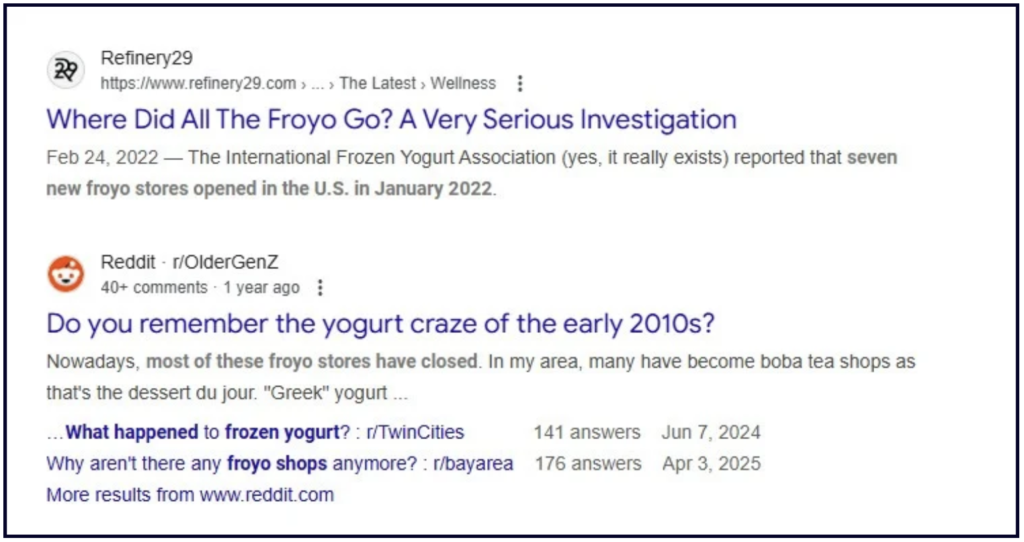
I’m old enough to remember the frozen yogurt trend of the 1980s (though I don’t believe we called it “froyo” then). It fit right in with a pop culture emphasis on fitness, based on the interesting proposition that it was better to eat lots of sugary yogurt instead of sugary ice cream. Quick-thinking brands profited, but only so long as this trend lasted. Then, after several decades of froyo-less-ness, new shops began opening in the 2010s, offering new opportunities. As we can see from the above articles and social media discussions, however, the second froyo bubble may now have burst. Restaurant and cafe owners who installed a froyo machine may be seeing declining ROI as a result.
As interest declines, so do online signals like reviews and social mentions. This then impacts discovery and lead opportunities, making it harder to remain profitable.
Your business will be continuously evaluating both product and service demand trends. You’ll need to cultivate your ability to assess whether the short-term gains of passing fads merit investment, as well as whether specific new trends may stand the test of time and deliver long-term profits. Some of the current consumer demand trends you’ll need to consider include:
Nothing can replace consistently communicating with your brand’s own customers to see what they want that isn’t already being offered in the community. This essential practice can be augmented by analyzing the sentiment of your online reviews and the reviews of your competitors, conducting formal polls and surveys, and starting informal conversations on local social media channels to gain additional insight into gaps, trends, and fads.
While the first step to offline/online success is being discovered by the public, the make-or-break dynamic of your brand’s longevity comes down to whether your business is liked and trusted. Here’s how to win:
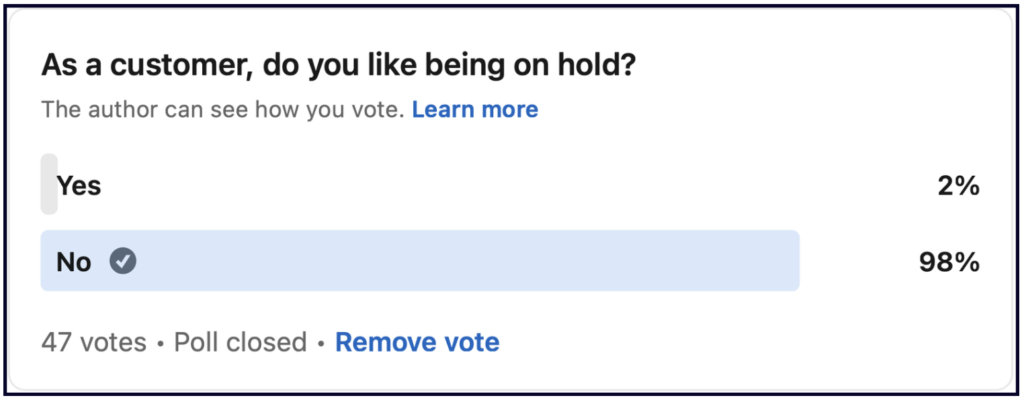
What do customers love about your business enough to review it online and recommend it to their friends? What do they hate enough to leave you negative reviews and want to stop transacting with you? My recent Linkedin poll offers the most obvious example I can give of a company policy that shows disregard for customers. 98% of my survey group does not like being put on hold when they call a business.
If your brand has made the decision to invest in something other than adequate human staff to answer phones promptly when potential patrons dedicate their free time to calling you, it’s a guarantee that you’re creating negative consumer sentiment. You’re probably also getting lots of hangups from people who could have become lifetime customers if someone at your business had simply picked up and signaled your brand’s readiness to serve.
Non-consumer-centric policies send a clear message that your brand doesn’t value its community. Policies that treat customers with disregard or suspicion when problems arise don’t result in reciprocal trust.
Online impacts of non-consumer-centric policies include a high rate of consumer churn, which is very costly because it is far more expensive to earn new customers than to keep existing patrons happy. Unhappy customers then publish negative reviews that erode online average star ratings. Low average star ratings then negatively affect both rankings and conversions, creating a downward spiral of reputation, visibility, and profitability for the business.
Your business can ground its reputation in the following consumer-centric policies:
The #1 reason people write local business reviews is to reward great customer service, and the #2 reason is to warn their communities about negative brand experiences, according to one of our industry’s major annual consumer behavioral surveys. In most cases, staff can only be as good as the training offered them in how your business treats customers and carries out its consumer-centric policies.
I’ve always remembered a somewhat humorous experience of going into a very cozy-looking tea shop which, when I opened the door, treated me to an extremely loud blast of heavy metal. Fine if that’s your personal music preference, but the cafe in the center of a busy little village shopping hub was starkly empty except for two young teenage boys who had been left in charge and who did not convey a friendly welcome. I rather suspect the owner had no idea this was what was happening in their absence, but I expect their lack of earnings might have eventually tipped them off that they needed to train their staff to create a different sort of atmosphere.
Online impacts of inadequate staff include negative reviews like this one:
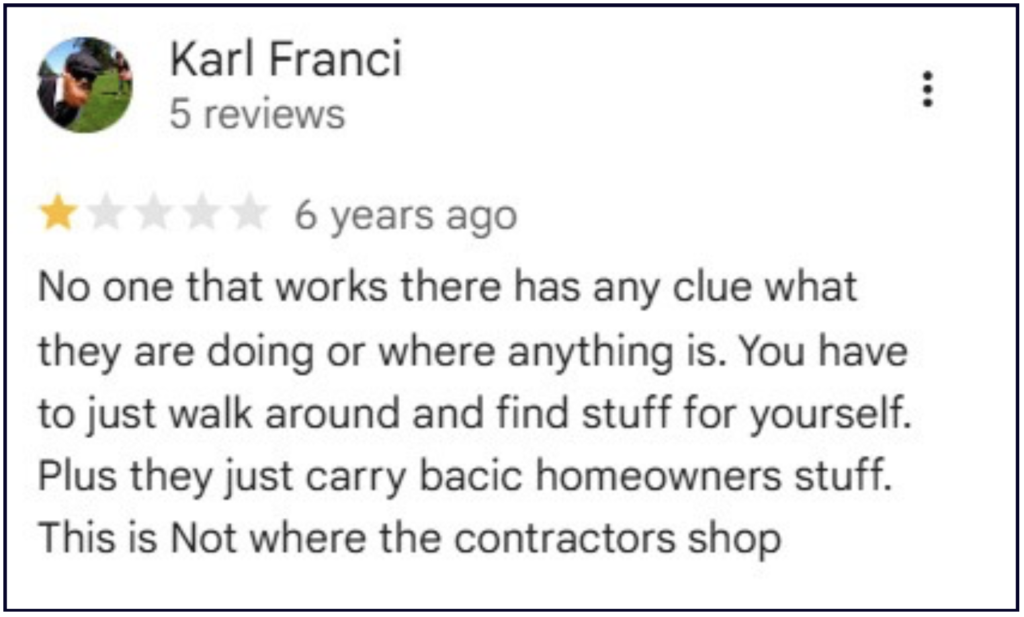
Over time, low ratings of this kind contribute to a poor average star rating on your Google Business Profile:
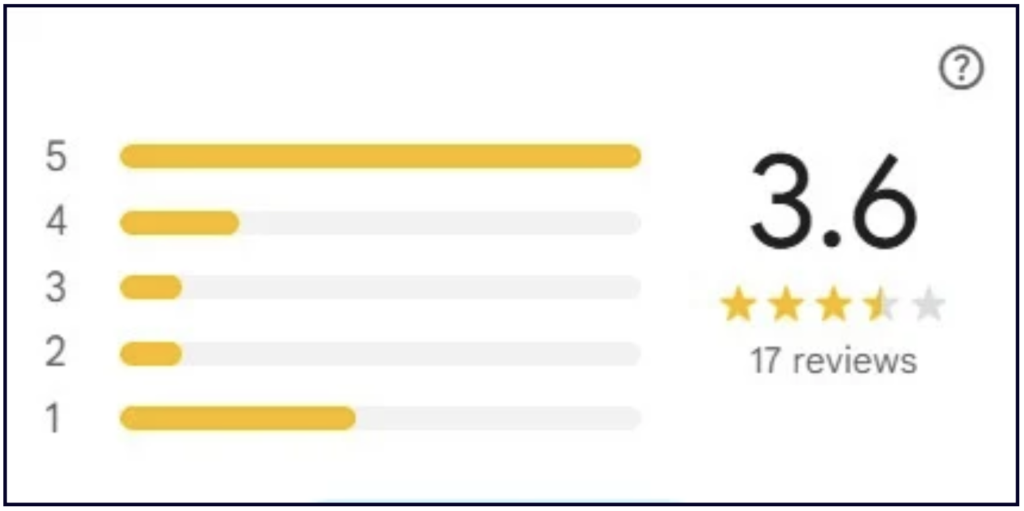
As your rating drops, so will your conversions. Just 3% of consumers will choose your business if its average rating drops below 3 stars, so a business like this is entering dangerous territory.
Your business can minimize negative reviews based on complaints about poor customer service by:
While staff training can significantly minimize online complaints, your brand can proactively maximize positive reviews and testimonials by the simple act of asking for them. The #1 reason people don’t write more reviews is because they forget to. Review requests should act as pleasant, positive reminders that your brand would be very grateful if the customer can find time to leave feedback. While online review requests via email and SMS are two very popular methodologies, the same survey shows that 47% of consumers prefer to be asked for reviews offline at the time of service.
Never pressure a customer to leave a review or have them leave reviews at a company kiosk, as this can get your business reported to Google for inappropriate conduct. Never offer incentives of any kind in exchange for a review, or insist that a customer leave positive feedback, as these activities violate Google’s prohibited & restricted content guidelines and can result in your business losing its reviews and having its listing stamped with a public warning. Don’t review your own business or ask your staff to. Review fraud of any kind is illegal in many nations.
Online impacts of active, in-person review requests include an increase in review velocity, recency, and overall volume on your Google Business Profile. Each of these factors may influence how your profile ranks in Google’s local packs and Maps. The more visible you are in these environments, the more discovery your brand will enjoy.
Your business can maximize offline review request outcomes by:
For further learning, read Whitespark’s Ultimate Guide to Local Business Reputation Management.
While responding to reviews via the owner response function is an online activity, it’s intimately linked to the offline realities of your customer service. In fact, the majority of consumers now consider owner responses to be part and parcel of modern customer service. Reviews have an incredible influence on consumer behavior, and so do your replies. They demonstrate to the online public how your business takes care of its patrons when things go wrong in your store or on the job.
Online outcomes of skilled complaint resolution are rooted in your offline consumer-centric policies. If you are dedicated to making things right whether customers are complaining face-to-face or via a review, you can significantly:
73% of customers are willing to give your business a second chance if you respond well to their negative reviews and 54% will update their initial review to reflect their improved opinion of your brand.
Your business can parlay its offline complaint resolution expertise by writing responses to negative reviews that are at least as good as this one, and you can go even further for the best possible outcomes:
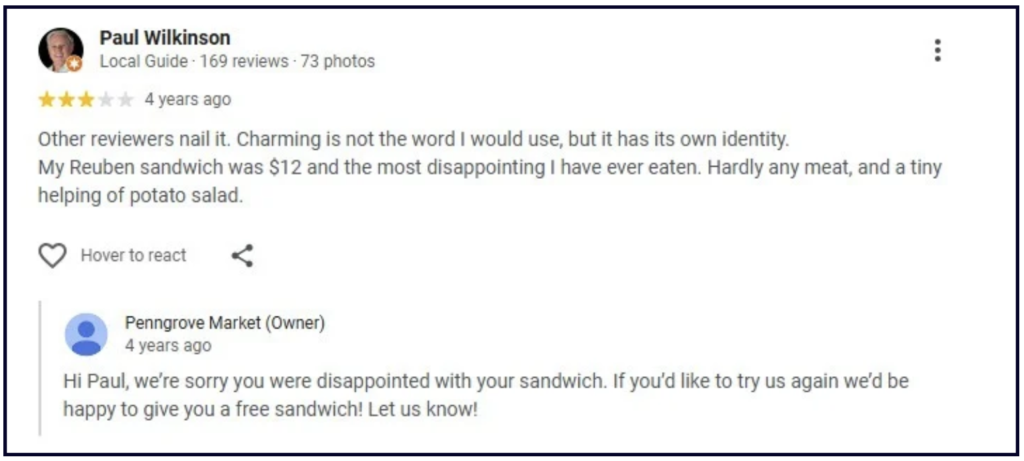
The ideal owner response to a negative review:
The long-range goal your local business is hoping to achieve is your brand name becoming synonymous with particular goods and services in your community. You want to be the company most of your neighbors think of each time a relevant need arises. This enviable status as a household word can take years to achieve.
The good news is that you can take a proactive approach to becoming prominent in your community. A combination of community involvement, PR, and paid local advertising can put you in front of as many potential customers as possible in a given town or city. A sustained outreach program over many years helps existing customers remember your business the next time they need it, and ensures that newcomers to town and travelers are also regularly exposed to your brand.
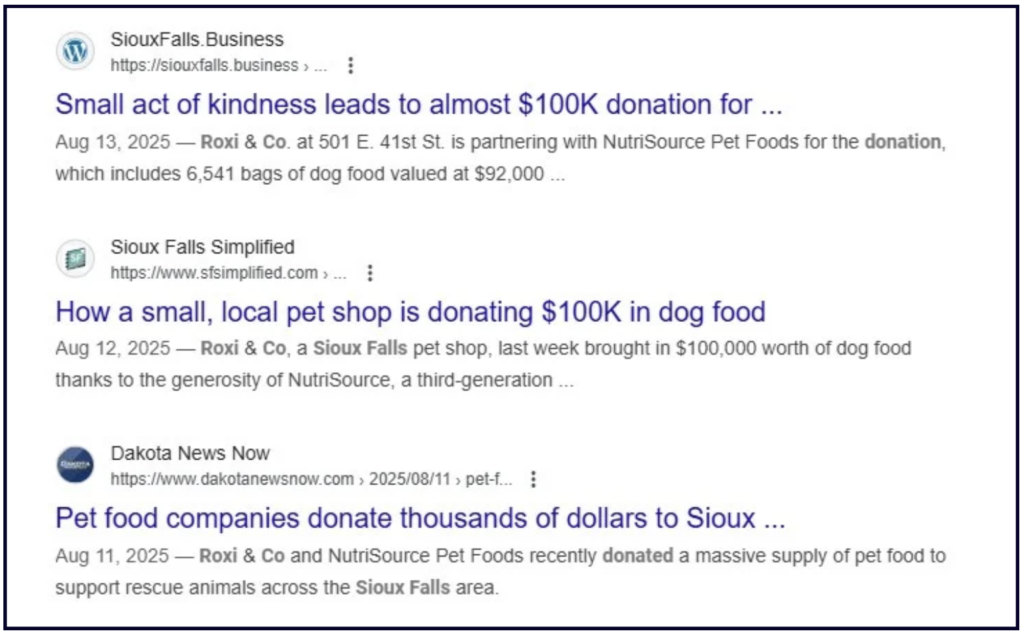
Online outcomes of offline community involvement are at their best when they result in “unstructured citations”. Unstructured citations are mentions of a local business on any online platform other than a formal local business directory. They can stem from online news sites, hyperlocal or industry blogs, online lifestyle and travel publications, podcasts, video channels, and social media platforms. A single notable activity on the part of a local business can earn a variety of unstructured citations that come up in the organic search results when people are looking for the brand:
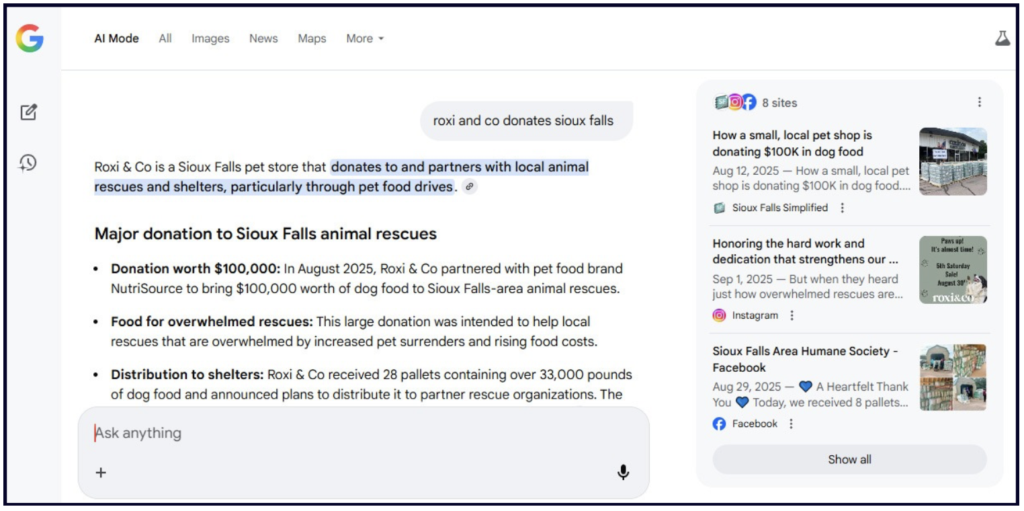
Unstructured citations are scraped by LLMs like Google AI Mode and ChatGPT when people prompt them for local business information:
Unstructured citations contribute to consumer discovery of your brand and, also, give Google good cause to believe that your business is legitimate and trustworthy local entity.
Your business can grow its online footprint of unstructured citations by actively researching opportunities to participate within your community. This could include:
These efforts can be coupled with paid advertising on billboards, in local publications like school newsletters or house of worship bulletins, local TV and radio spots, and print marketing to increase the frequency with which the community is encountering your brand.
Your existing customer base can become your strongest channel for repeat business and word-of-mouth recommendations when you formalize loyalty and referral programs. Forbes finds that 46% of US consumers are willing to spend more money if a business offers a good loyalty program. Meanwhile, just 31% of consumers trust online local business reviews as much as personal word-of-mouth (WOM) recommendations.
Online outcomes of offline loyalty programs can include extending customer retention time frames and decreasing costly customer churn. Good loyalty and WOM referral programs can also create social media mentions, increasing brand discoverability.
Your business will need to structure loyalty and referral programs on the basis of your resources. Large local enterprises can create apps that gamify earning perks for repeat business and referrals, but smaller local brands may lack the consumer base to justify investment in this sort of technology. Instead, small local businesses can:
The more competitive your local market, the more research your business should devote to discovering a unique value proposition (UVP) that sets you apart. The reasons local consumers choose your brand over a competitor can be incredibly diverse, including:
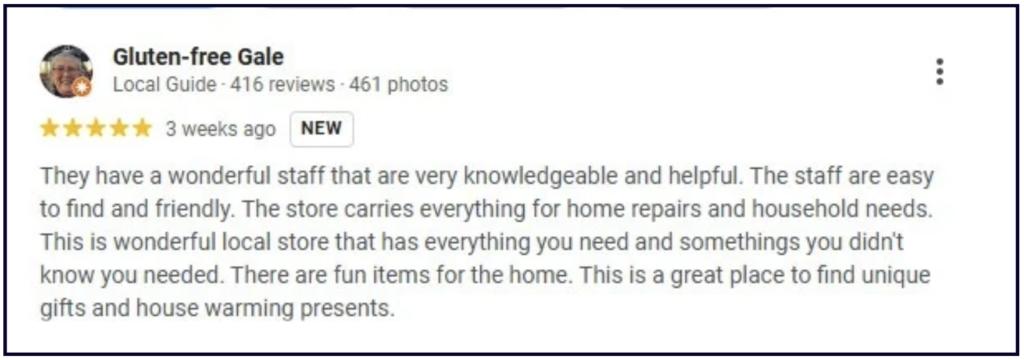
Online outcomes of creating a noteworthy UVP is that it will be mentioned in your reviews. One of the best examples of this you’ll find anywhere today stems from the Ace Hardware franchise that backs up its slogan of being the “place with the helpful hardware folks” by abundantly staffing its locations with friendly and knowledgeable employees. This sets it apart from warehouse-style home improvement stores with inadequate staffing and underwhelming customer service standards. Looking at the Google Business Profile for nearly any Ace Hardware will quickly turn up multiple reviews like this one, mentioning the high quality of the customer service:
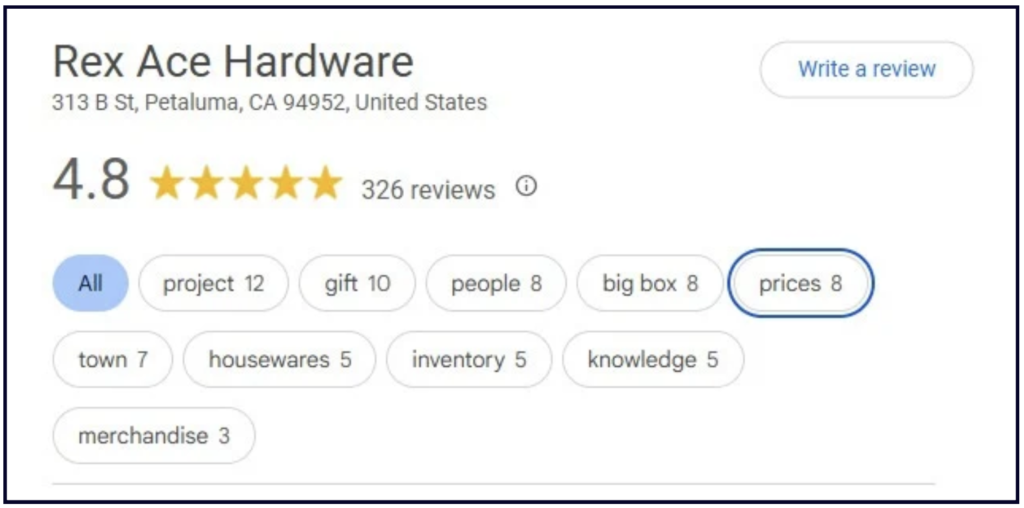
In fact, it’s very common for the Place Topics feature of GBP review sections to note that attributes like “people” and “knowledge” are some of the most frequently mentioned themes in this franchise’s reviews.
Your business can seek to replicate its own version of the Ace Hardware success story by:
At the outset of this guide, we discussed how local business listing spam and the inability of AI to sort trustworthy information from inaccuracies or fraud may make it increasingly difficult for consumers to trust online content.
A seminal report from The Transparency Company found that, in just the medical, legal, and home services sectors, US consumers are suffering $300 billion in annual economic harm due to review fraud. Now that fraudsters have access to AI tools that enable them to generate fake reviews at unprecedented scale, the trustworthiness of online local business information is expected to significantly degrade in the near future.
The onus is on brands like Google to defend their platforms from listing and review spam to avoid user abandonment. It would be sensible for them to develop more rigorous methodologies for assessing the legitimacy of local businesses and reputation content in their systems.
Given this, your local business can strengthen its position amid increased fraud by understanding how Google can collect proofs of offline validity. There are multiple signals Google can consult to verify that your location features a real business that real people are coming to for transactions. We’ll close out our guide with a few resources for further learning on this timely topic:
Creating positive consumer experiences offline delivers two kinds of victories for your local business:
A vibrant online local search marketing program is more important than ever, but even the best marketing can’t make up for offline consumer-centric policies and practices that earn real-world trust from your community. Local business profitability requires getting both sides of this coin right: offline success feeds online success and vice versa.
Eager to dive in even further? Learn how to make your Google Business Profile one of your most powerful digital assets by getting thoroughly grounded in business model-specific marketing. Read: Can your business be on Google? A guide to GBP eligibility by business type.
Miriam Ellis is a local SEO columnist and consultant. She has been cited as one of the top five most prolific women writers in the SEO industry. Miriam is also an award-winning fine artist and her work can be seen at MiriamEllis.com.

Whitespark provides powerful software and expert services to help businesses and agencies drive more leads through local search.
Founded in 2005 in Edmonton, Alberta, Canada, we initially offered web design and SEO services to local businesses. While we still work closely with many clients locally, we have successfully grown over the past 20 years to support over 100,000 enterprises, agencies, and small businesses globally with our cutting-edge software and services.