🤓 The 2026 Local Search Ranking Factors are here!! Check out the report!

Top Takeaways from the New Google Business Profile Playbooks

by Miriam Ellis
on April 9, 2026
Psst! Want us to do your local SEO for you? Click here!

Ranking grids your clients will love

Track rankings across 225 map points, spy on competitors, and send clients stunning white-label reports — starting at just $10/month.
No credit card needed to start.

If the millions of businesses with Google Business Profiles all clapped at once for Google’s new educational outreach in the form of GBP Playbooks, that would be some thunderous applause! While the Guidelines for representing your business on Google still remains square one for understanding how to list your local brand in Google’s local search system, these new Playbooks are a welcome addition.

You can read all of them in full by going to this edition of Lisa Landsman’s Small Business Bulletin and scrolling until you see these links to the 5 new playbooks:
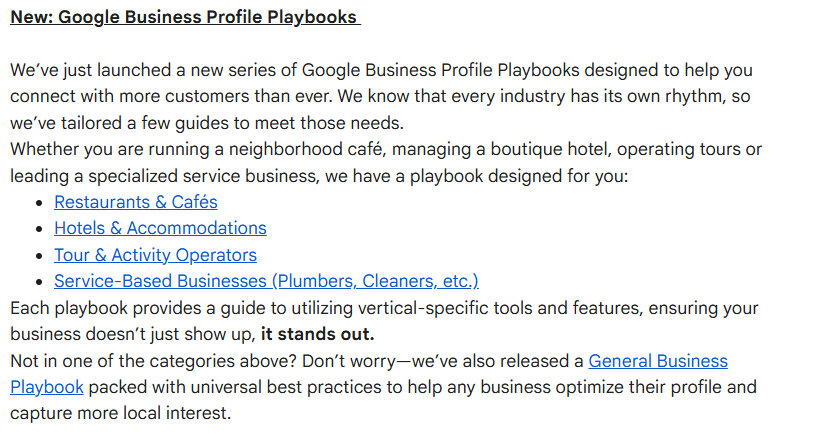
As you can see, there is a general playbook + 4 industry-based playbooks. That’s a lot to read through, so today, I’m going to summarize the top stats and tips across all 5 of these guides so you can get all the goodies quickly.

Let’s start with a motherload of Google stats, right from the horse’s mouth

Use these to understand the impacts of marketing your own local business or to educate agency clients on the importance of GBP optimization and management. Sometimes, Google stats and resources disappear, so bookmark this blog post for my summary of all the stats shared across all 5 playbooks:

  • Every month in 2024, Google helped drive more than 2B+ direct connections, including phone calls, requests for directions, messages, bookings, and reviews for 19M+ American businesses
  • Businesses with complete GBPs receive 7x more clicks
  • 29% of customers are more likely to consider purchasing from businesses with a detailed GBP
  • Regularly-updated GBPs earn 5x more reviews
  • 96% of customers are more likely to visit a business that displays hours of operation
  • 91% of consumers search online before visiting a local business
  • 1 out of 3 customers will check a business’ offerings (like a menu, list of services, or inventory) before visiting a business
  • 90% of people are more likely to visit you if you have photos of your business on Google Search and Maps
  • Businesses that add photos to their Business Profiles receive 42% more requests for directions on Google Maps
  • GBPs with photos earn 35% more clicks through to their websites than those without photos
  • 50% of customers look for promotions or discounts when searching for a business online 
  • In one study, by adding Google Posts to their GBP, Crate & Barrel saw a +31% increase in Google Map Views, a +6% increase in Google Search Views, increased foot traffic and increased conversions
  • In another study, when a brand called Painting With A Twist added social media links to their GBP, they saw +9% increase in GBP Impressions, +10% increase in web clicks and phone calls, and +14% increase in cross-platform discovery by Google-sourced users 
  • 67% of people prefer communicating by messaging a business to a call or email (side note from me – this makes it particularly irritating when Google refuses to show phone numbers on GBPs!)
  • 60% said WhatsApp is their preferred chat platform to interact with a store
  • 77% of consumers expect to be able to book services online
  • 91% of consumers use reviews to evaluate local businesses 
  • 65% of consumers say they are more likely to choose a business that responds to reviews 
  • 84% of users look up the menu online before deciding on a new restaurant 
  • 43% of final restaurant decisions are made after looking at the menu
  • 40% of people already have a dish in mind when they search for food
  • A user is 32% more likely to click on a menu item with a photo 
  • 82% of people buy a dish just because of how it looks in a picture
  • By adding dish images and attributes to their menu with Yext, Condado Tacos saw a +10% MoM increase in menu interactions, a +15% YoY increase in organic Search impressions for “Mexican Restaurants” and +134% YoY increase in organic Search impressions for “Vegetarian & Vegan Menu Options” 
  • 62% of of diners say they’re motivated to visit a restaurant with a limited time offering 
  • 48% of diners said a special offer would motivate them to revisit 
  • 20% of customers check social media pages before visiting a business 
  • 80% of US consumers expect to be able to book a table or place an order from a restaurant online
  • Searches for “unique things to do near me” have grown globally by over 100% YoY
  • 30% Incremental direct bookings via Free Booking Links for Hotels with over 100 organic clicks and 12+ Incremental bookings per month per Hotel from Free Booking Links for Hotels with over 100 organic clicks per month (I confess, I find the wording of these last two statistics a bit opaque but expect they are clear to hotel owners and marketers!)

Your takeaways: In many cases, Google is using identical stats and case studies across all 5 of the new playbooks, pointing out how basic best GBP optimization and management practices are notably similar across all industries. However, as you can see from the above list, there are a few industry-specific stats for verticals like restaurants and hotels. A good takeaway here is that if you’re working in one of the industries for which Google has now published a unique playbook, it’s definitely worth your time to read it instead of only reading the general playbook. 
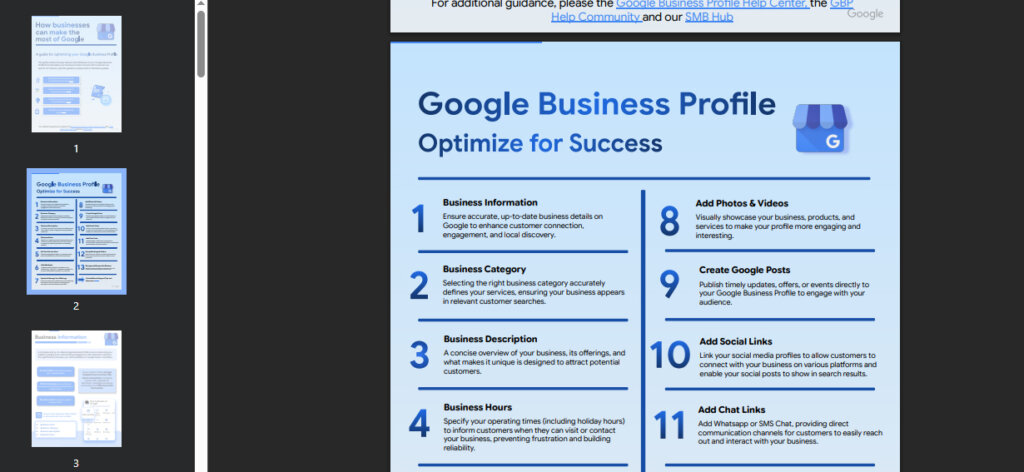
Next, let’s summarize Google’s own GBP optimization advice

In each of the 5 playbooks, Google offers some version of the above graphic detailing up to 13 things local businesses should do to optimize their profiles. I immediately noticed that these lists differed somewhat, based on category. I want to shorten your workload by summarizing what’s the same for all verticals and what’s different for individual industries.

Regardless of your industry, Google says you should optimize your GBP by:

  • Keeping business information up-to-date
  • Choosing the right business categories
  • Adding photos and videos
  • Creating Google Posts
  • Adding social links
  • Adding chat links
  • Managing and responding to reviews

If you’re marketing restaurants and cafes, you should also optimize by:

  • Writing a business description
  • Keeping business hours accurate
  • Adding attributes
  • Updating and managing your menu
  • Accepting online bookings and orders

If you’re marketing hotels and accommodations, you should also optimize by:

  • Connecting other businesses (*see my note below on this)
  • Adding hotel highlights
  • Accepting bookings with free booking links

*Note: I confess I was confused by both the heading and description of the first item on this list. I thought it might be AI-generated nonsense as I couldn’t understand how connecting with other businesses made a hotel more attractive to potential customers. See screenshot:
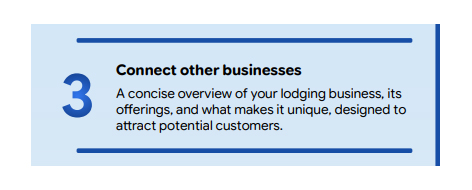
I think what this is referring to is Google’s Connectivity Partners program for hotels. If I’m wrong about that, please feel free to correct me, readers, as I found the wording of this in the playbook quite vague.

If you’re marketing tour and activity operators, you should also optimize by:

  • Writing a business description
  • Keeping business hours accurate
  • Setting your service area
  • Adding business attributes
  • Updating and managing activity and ticket details

If you’re marketing service-based businesses (like plumbers or HVAC brands, you should also optimize by:

  • Writing a business description
  • Keeping business hours accurate
  • Setting your service area
  • Adding business attributes
  • Updating and managing your service list
  • Accepting bookings and appointments

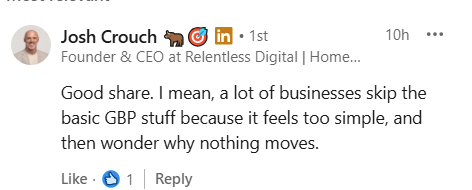
Your takeaways: There may not have been any surprises in these varying lists for you if you’re an old hand at GBP optimization, but I can guarantee there are countless businesses that aren’t meeting these local SEO minimum best practices. As Josh Crouch remarked on one of Darren Shaw’s recent LinkedIn posts

Be sure any business you’re marketing is getting the general and industry-specific basics right!

Bookmark these links for GBP troubleshooting

If only you could simply optimize your listing and go about your merry way afterwards, but the truth is, countless things can go wrong with your GBPs. Bookmark this article and these links Google’s playbooks offer to connect with the right support for the following issues:

IssueResolution
Lost access to GBP loginFile a ticket here
Google Business Profile verificationSupport article here
Duplicate listingFile a ticket here
GBP suspendedRaise a reinstatement request here
My profile has been hackedFile a ticket here
Incorrect phone number listed on GBPFile a ticket here
Fake reviews on your GBP listingBefore you flag a review, check our content policy and criteria specific to reviews. Reporting a review will not guarantee it will be removed from your listing. You can flag a review by following these steps in your Google Business Profile
Review extortionReport here

How Google’s new GBP playbooks add value

I think it’s excellent that Google has created these because:

  • They offer an illustrated workflow for local business owners who may not understand how to get started with Google Business Profiles; if all brands got the basics right, their listings would be far more useful to consumers.
  • The playbooks could minimize local business vulnerability to scammers who cold outreach to them, offering worthless “SEO services”. Business owners are constantly contacted by entities trying to sell them useless services by saying that things need to be fixed on their GBPs or that they can guarantee #1 rankings with X tactics. Any effort at education on Google’s part is welcome in this perilous scenario. 
  • It’s good to see Google acknowledging that their system has a problem with review fraud and extortion. While the playbooks don’t go far enough in accurately depicting the outrageous extent of Google’s review spam problem, at least they aren’t pretending it doesn’t exist. Local business owners need to be prepared for the reality that stepping into the GBP world unfortunately = wading into some pretty murky waters when it comes to both listing and review fraud.

How Google’s new GBP playbooks could be improved

If Google continues to refine its educational outreach efforts, it could go one better by:

  • Improving its editorial process; there are quite a few typos in the playbooks.
  • Increasing transparency surrounding its actual local pack/Maps ranking algorithms; Google is giving basic optimization tips, but is not being forthright enough about historic problems with issues like the actual impact of service area businesses hiding their addresses, or the undue weight Google appears to place on keywords in business titles. Issues like these make Google’s algorithms unnecessarily mysterious, and while the company has understandable motivations for keeping formulae proprietary, more transparency = more public trust.
  • Adhering to a strict separation of optimization vs. pay-to-play tips; the playbook for service-based businesses contains a very large section that is simply selling Google’s Local Services Ads program. SEO and paid advertising are two separate endeavors, and I don’t feel it’s a good fit for a guide about optimizing GBPs to suddenly be conflated with a pitch to purchase LSAs. 

I’ve spent years advocating for local search platform brands to show more empathy towards the business owners whose real-world information is at the core of these online environments. I applaud Lisa Landsman for spearheading the publication of these new educational materials and feel they can be improved over time to help both business owners and consumers have better experiences with Google’s local products. This is a good start.

There’s so much more to learn! Once you’ve read the basics in Google’s playbooks, take your local search marketing education to the next level with The Complete Guide to Small Business Local SEO.

Miriam Ellis is a local SEO columnist and consultant. She has been cited as one of the top five most prolific women writers in the SEO industry. Miriam is also an award-winning fine artist and her work can be seen at MiriamEllis.com.

Whitespark provides powerful software and expert services to help businesses and agencies drive more leads through local search.

Founded in 2005 in Edmonton, Alberta, Canada, we initially offered web design and SEO services to local businesses. While we still work closely with many clients locally, we have successfully grown over the past 20 years to support over 100,000 enterprises, agencies, and small businesses globally with our cutting-edge software and services.

WHITESPARK

DARREN SHAW

Never miss a beat

Join our list and get our best local SEO research and advice in your inbox.

© 2026 Whitespark Inc.

|

Made with ❤️ in Canada

|

CONTENTS