CONTENTS

🤓 The 2026 Local Search Ranking Factors are here!! Check out the report!

Honestly, my friends, so much happened in local SEO in the second quarter of 2026 that I had trouble pruning my list down to a mere 23 especially noteworthy entries. And I’d bet anything that this means you missed at least some of these very important developments in our sector. Grab a tall glass of iced tea to celebrate the coming of summer and to keep you hydrated while you make your way through this amazing set of emergent news and cool new opportunities for the local brands you market!
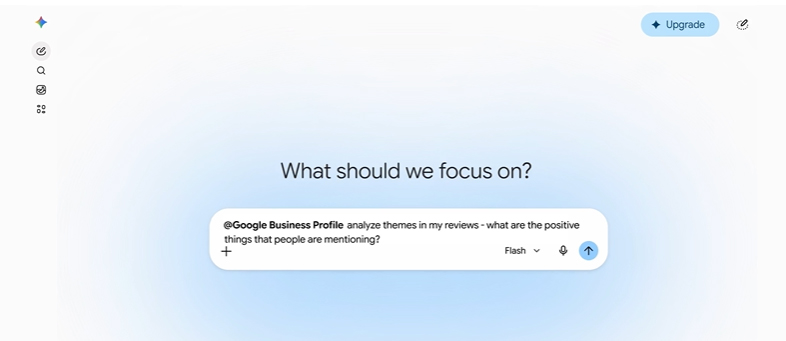
We begin with the major announcement from Google that they will be inviting business owners to connect their GBPs to Gemini. Rolling out in June, this capability will enable listing owners to interact with what is basically an AI assistant in the following ways:
It will give GBP owners a way to run reports, perform sentiment analysis, edit listing fields, and be alerted to missing information in a conversational mode instead of via the New Merchant Experience dashboard. The offer is currently limited to single GBP management.
Find time to watch this whole episode from my friends at NearMedia in which Mike Blumenthal and Greg Sterling sit down with our own Darren Shaw and with Claudia Tomina and Adam Dorfman to discuss:
There is so much to learn about the Ask Maps/Ask A Question feature, and it’s hard to imagine a smarter group of people to educate you, for free, via this free-ranging but expert conversation.
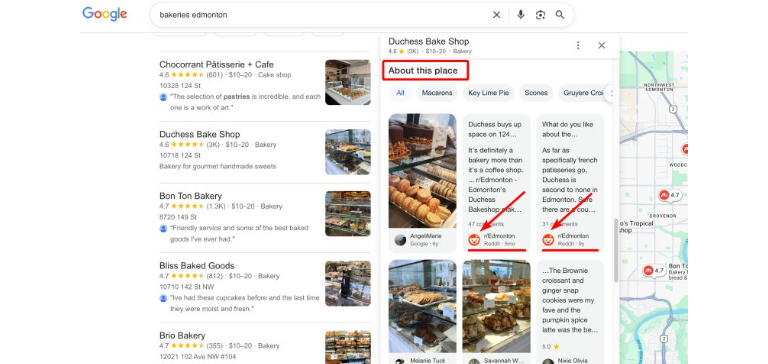
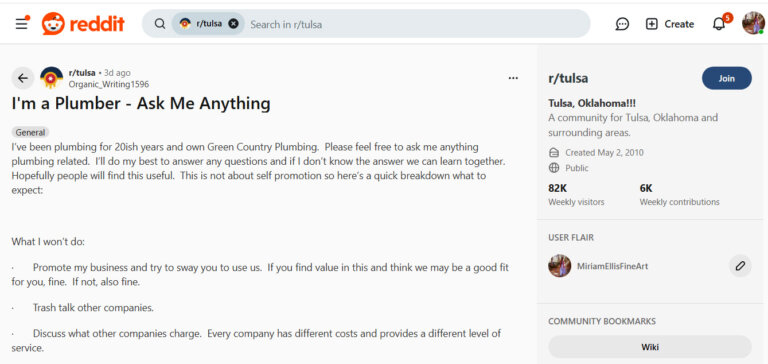
Did you think Google’s Reddit bubble would have imploded and blown away on the wind by now? Think again! Darren Shaw captured this fascinating example of Reddit threads being pulled directly into Google Business Profiles. Now, some local business owners will groan over this development because Reddit is a notoriously tricky environment to foster visibility in without being booed and booted out by communities. Whitespark can teach you how to find your Reddit sweet spot in our Ultimate Guide to Social Media for Local Businesses. Authentic and helpful contributions like this plumber AMA could really work for your brand:
And it’s not just Reddit that’s now influencing your GBPs and AI visibility; the new social media updates carousel is bringing in content from your connected social media profiles into your GBPs. Check this out:
It’s a development that feels like a new form of self-citation, offering credibility and freshness to your brand’s online presence.
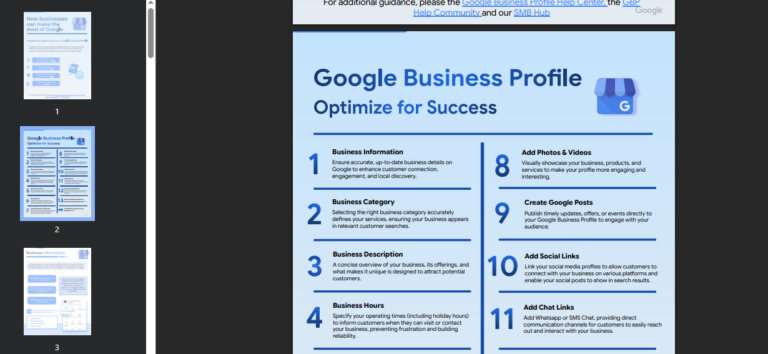
Under the leadership of Lisa Landsman, Google published 5 new Google Business Profile Playbooks in a praiseworthy effort to offer more education to local business owners. This was a lot of content to review, and so I did the work for you in Top Takeaways from the New Google Business Profile Playbooks here at Whitespark. My article gathers over two dozen eye-opening stats published across the playbooks into one simple list, and summarizes Google’s general and industry-specific GBP optimization advice.
There is a ton of information in these documents that you can use to improve your own GBP or to upsell GBP management services. Don’t have time to page through all the publications? Bookmark my piece and share it with clients and co-workers.
I want to particularly highlight how all of the guides emphasize the value of committing to a regular Google Posts publishing schedule. This GBP feature is chronically overlooked, and its value is still untapped by even major local brands. Read Google Posts Guide: 12 Ways to Drive More Customers to get a fantastic Google Posts strategy up and running for your business.
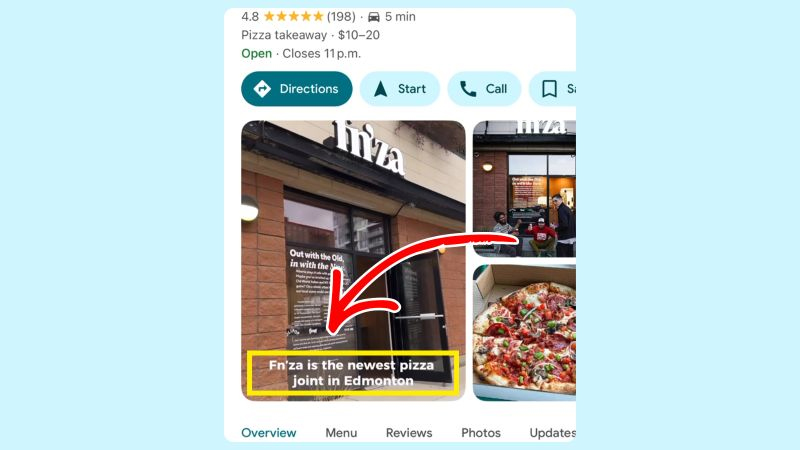
First, Darren Shaw shared this workflow on Linkedin for adding captions to your videos BEFORE you upload them to your GBP video section. Here are the steps:
Why do this? Because audio doesn’t play by default in Google Maps, and textual captions can provide missing context while also being eye-catching and helping AI better understand your video contents.
Second, Darren demos how to connect your YouTube channel to your GBP:
As Darren explains:
This will result in your videos showing a Google Maps button that connects directly to your GBP. It’s a chance to show up twice in Search (with your video and your GBP). What a great way to add credibility and context in AI environments, too!
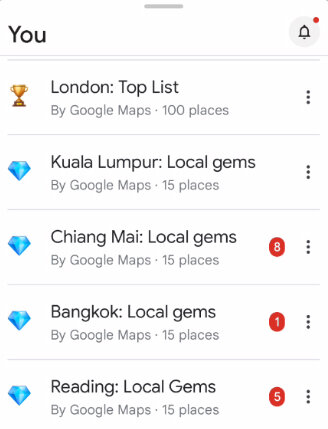
I was lucky enough to be one of the people Craig Burton sent early examples to of the new Google Maps lists prior to publishing his excellent study on this nascent array of Ask Maps features including:
Craig states,
“Ask Maps recommendations are weighted heavily by these generated lists. The lists themselves are built from user-generated content, blog-style articles in list format, highly detailed reviews, customer posts with photos and videos, and query-matching language like ‘atmosphere’.”
And he offers this fascinating infographic based on his research of how content feeds the creation of these lists, based on his research:
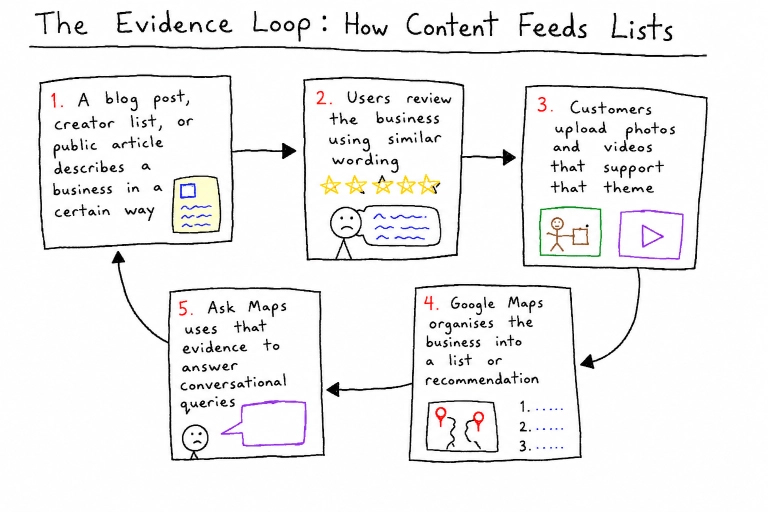
Craig notes that the appearance of these lists in response to Ask Maps questions is, at present, inconsistent, but certainly worth paying attention to. His article has a great checklist for auditing your business for list-readiness. Unsurprisingly, he also found concerning misinformation in lists, and this foible of AI is going to become a continuous headache for local brands and their marketers. It’s great that a feature like lists can provide a richer discovery experience for your potential customers, but the flip side of this coin is that outdated information and flat-out error can also drive people away from your business.
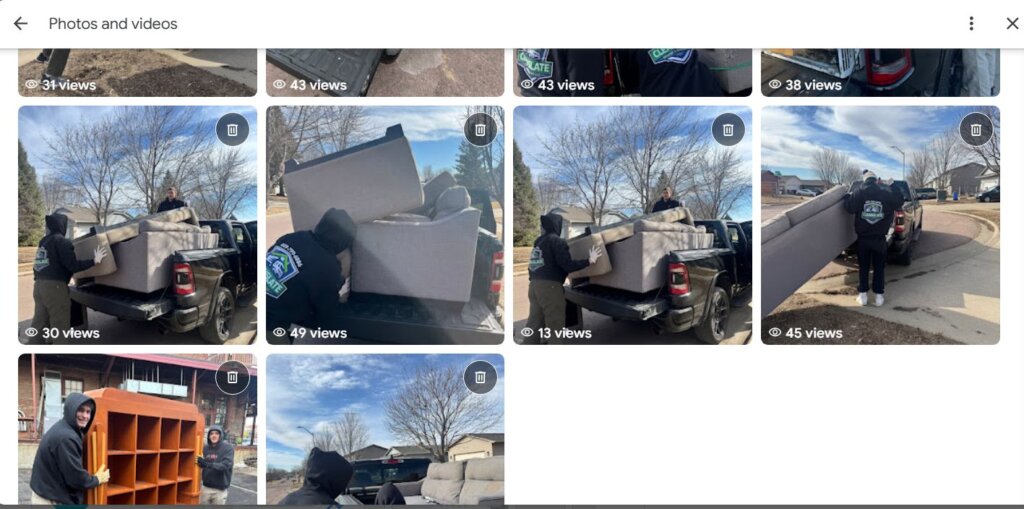
Here’s something quite cool caught by Muhammad Hussain in which your listing’s videos and photos have a view counter. I’ve not yet been able to replicate what Muhammad has seen, but think this is a great idea. It can help you analyze which forms of visual content are winning the most user engagement. Identify which assets have the highest number of views and publish more content that features similar topics, aesthetics, or offers.
Thanks to Ben Fisher for the first news of this long-awaited capability that will allow you to track GBP performance (including local interactions and website traffic) alongside calls, bookings, direction requests, and website clicks in your GA dashboard. This functionality is rolling out at present, and here’s how you can set it up:
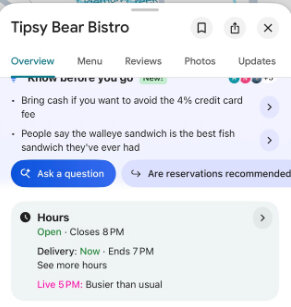
The always-brilliant Claudia Tomina has this round-up of how deeply Google is now embedding AI features into Maps, including:
Diamond Product Expert Hiroko Imai spotted an update to the Edit Your Business Profile help page that allows Google to reach out to you directly to confirm the accuracy of data they’ve collected about your business:
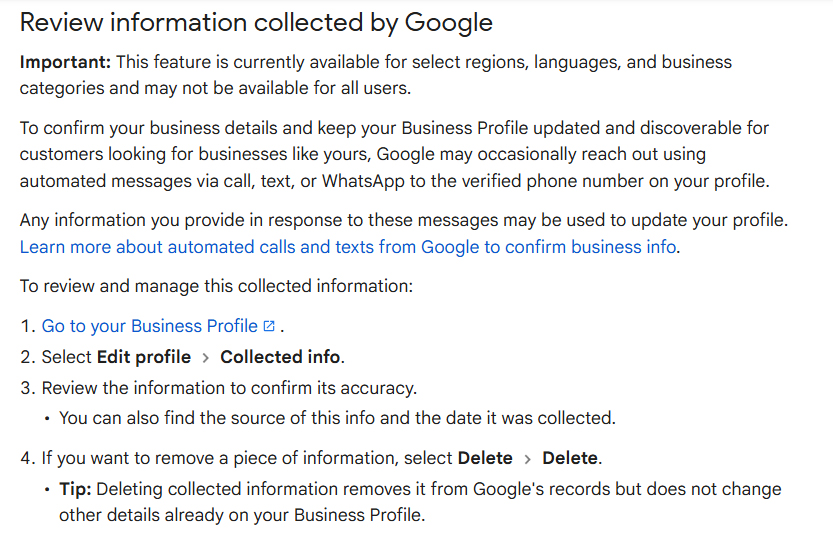
While this rollout is limited at the moment, Hiroko observes that if it becomes available in your region, it will have the following impacts:
“1. Not only to see the “collection date” of data modified by Google, but also to identify the exact source (“which calls or messages provided this information”) from which the data was obtained.
2. If automatic updates contain unintended content, business owners can now remove (reject) the collected information from the management interface.”
This quote from Claire Carlile in a recent episode of the Whitespark Local Update Podcast is drawn from Google’s I/O announcement of what may be the biggest news in Q2. NearMedia has a quick breakdown of the new “intelligent search box” deeply integrating AI into search and foregrounding agentic technology. The rollout of this seems very gradual, but it’s right in line with Google’s AI-first stance. Stay tuned on this one!
Darren wrote a guest piece for Search Engine Land that you can simply send over to any client as an introduction to the fact that they need a new playbook for localized AI optimization. Every agency is strategizing right now about how best to help clients at all levels of tech savvy cross this bridge from traditional SEO tactics to competing for AI visibility.
Have clients who are truly struggling to understand that their customers are experiencing something new on the internet and behaving in new ways because of it? I’ve heard from readers that the Whitespark Guide to Google’s AI Mode for Local Businesses is one of the clearest guides they’ve encountered on this timely topic. It explains to brands what their customers are now seeing and provides a checklist specifically for local businesses who need to shift successfully towards achieving AI prominence. Do your agency a good turn by sharing both of these pieces with your clients to earn buy-in for new or enhanced services.
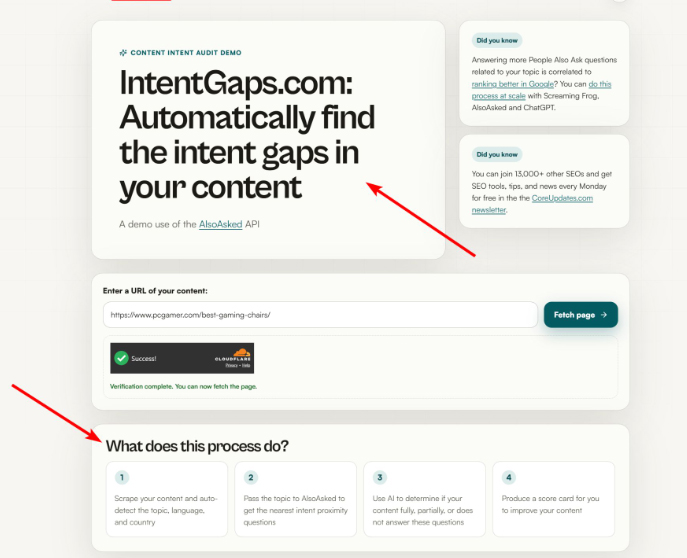
Mark Williams-Cook has released a free tool that enables you to plug in a URL and get a report that signals whether your content is answering core user questions or if you’ve got gaps. Given AI’s emphasis on answering questions, https://intentgaps.com/ is definitely a timely offering. How does it work?
Google introduced Gemini Personal Intelligence in Q1, but I am highlighting it in this Q2 roundup because of a must-watch 2-part video series NearMedia published in May in which they dive deeply into this technology with Garrett Sussman. I highly recommend making time to watch both part 1 and part 2. This discussion covers such topics as:
Claudia Tomina also published a useful piece on what PI means for local businesses.
If your customers widely adopt Google Personal Intelligence, your local brand needs to be studying its ramifications, and you should also be paying attention to the fact that many people find this type of offering to be pushy and weird or scary.
Something that really stood out to me in watching the NearMedia series is the number of times the speakers used phrases like “putting ethics aside” in discussing this extensive level of tracking. How does your brand feel about technology that requires you to sideline your ethics? How do your customers feel about it? Pope Leo XIV released his first encyclical letter, Magnifica Humanitas in Q2, codifying the Catholic Church’s position on AI for its 1.4 billion+ members. I spoke at a conference this quarter which banned the use of any AI in the presentations of all its speakers. I think there’s a danger of marketers getting stuck in bubbles of our own when it comes to AI and I am paying attention whenever I hear others quietly express the same concerns. What is your brand’s position?
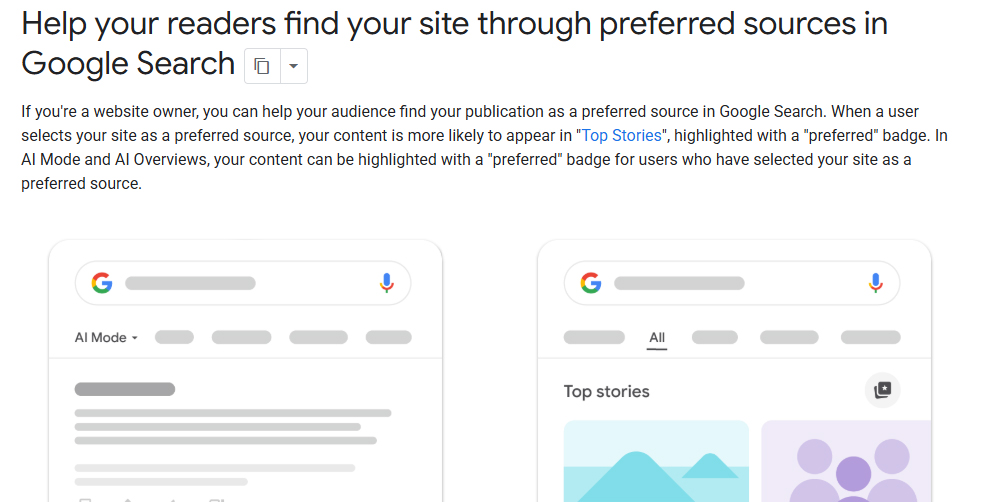
This Google Search Central document describes how your publication’s readers can mark your website as a “preferred source” so that it’s more visible as a “Top Story” in Google AI Mode and Google AI Overviews when these individuals search . It doesn’t require that the user be opted into Personal Intelligence, but it hinges on a similar concept of customizing results based on single user preferences. The document gives you the link formatting you need in hopes of encouraging your audience to make you a preferred source, and Google has also published this guide to how users can mark websites as preferred sources.
“One of the most surprising things we’ve learned about Google isn’t how it memorizes nearly everything users click on, but how much it relies on this data to produce its search results and AI answers.”
This quote from Cyrus Shepard’s article, How Google Click Signals Drive SEO Rankings and AI Answers may come as a surprise to anyone in our industry who is currently trying to understand SEO in the context of the new AI dynamics. If you’ve been hearing that “SEO is dead”, definitely read Cyrus’ explanation of how good old clicks are still driving visibility in AI context. The piece provides actionable takeaways on measuring CTR, engagement, and, importantly, satisfaction.
And while we’re in Cyrus’ territory, don’t miss his new study: 5 Data-backed Features of Websites Winning Google in 2026. See how factors like offering a product or service, allowing task completion, owning proprietary assets, having a tight topical focus and a strong brand correlate with website traffic gains or losses.
Jake Hundley published a fantastic peer-reviewed study of the impacts of schema on organic rank, Google Maps rank, and LLM recommendations. Over the course of 10 weeks, he tracked a control group against a test group in the lawn care industry, and discovered that LocalBusiness schema:
I recommend watching the Whitespark Local Update Podcast for further commentary on this unique study, and I would further add that I would like to see additional studies of this kind conducted regarding other types of schema, beyond simple local business schema.
Claudia Tomina sparked a ton of conversation this quarter surrounding her theory that linking QR codes directly to your GBP reviews can result in review filtering/loss. Why is this controversial? Because Google has long promoted the creation of QR codes as a means of earning reviews, causing unknown numbers of local businesses to happily incorporate this capability into their review acquisitions strategies. It’s quite frustrating if Google is, indeed, advising brands to do things that actually harm them, but fortunately, there is a workaround. As Claudia explains:
Watch the Whitespark Local Update’s full interview of Claudia for the complete story on this hot topic.
Hat tip to Amy Toman for reporting a significant update to Google’s Prohibited and Restricted Content Guidelines. Specifically, Google now forbids the following practices:
Be advised that you could lose reviews if your brand is currently engaging in internal campaigns that reward staff for something like getting the most mentions of their names in your GBP reviews. Of course, legitimate customers often do naturally mention staff by name, such as a diner writing something like “Our server, Jim, really went out of his way to create a memorable meal for us.” This new rule is a classic instance of Google labeling certain real-world behaviors as unacceptable in their system. It’s silly to think of restaurant owners worrying that they might have to urge reviewers not to mention hosts, waitstaff, or chefs by name to avoid review loss. In seeking to avoid artificial inflation of review counts, Google sometimes creates artificial circumstances.
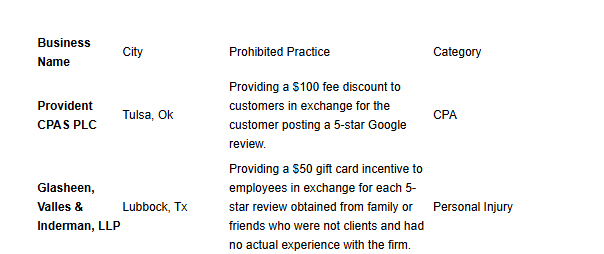
NearMedia has a good summary of brands who have recently received warning letters from the FTC citing alleged violations of its Consumer Review Rule. In reading through the list, all of the prohibited practices involve some form of incentive being offered in exchange for reviews. If you are concerned that your employer or a client of your digital marketing agency might be committing review fraud, share this content with decision-makers at the brand. No one wants to receive a letter like this one from the FTC.
Further kudos to Claudia Tomina for highlighting Google’s increased response to signs of potential review fraud. If Google’s system detects a suspicious spike in incoming reviews, Claudia notes that they will:
Of course, this raises concerns that something like a successful event at your business sparking an uptick in reviews could have the effect of pausing your ability to receive any reviews at all. Once again, Google’s concepts of authenticity run afoul of offline realities and brands should not have to fear that having a large sale that brings in lots of new customers and a spike in reviews would make them look suspicious to Google and negatively impact their review capabilities.
Meanwhile, Local Subject Matter Experts like Mike Blumenthal are unconvinced that Google is taking the necessary steps to address the astounding scope of review fraud in their system.
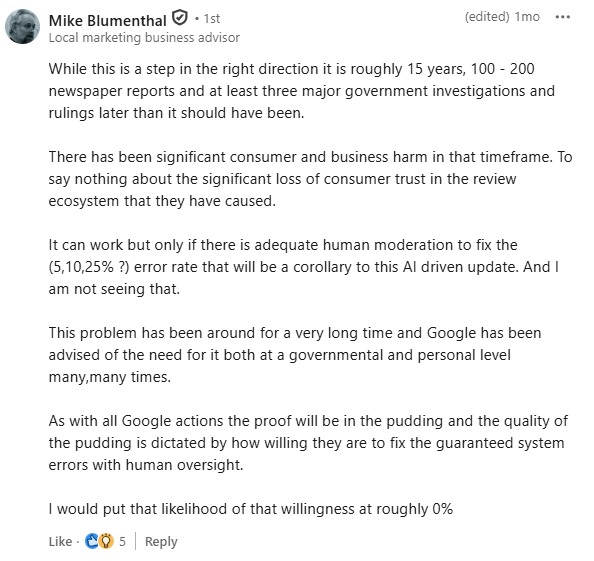
A basic takeaway from this development is that you need to be continuously monitoring your reviews for problems and problematic signals like a pause being put on your incoming sentiment. Whitespark’s Reputation Builder can help you stay on top of this core task of reputation management.
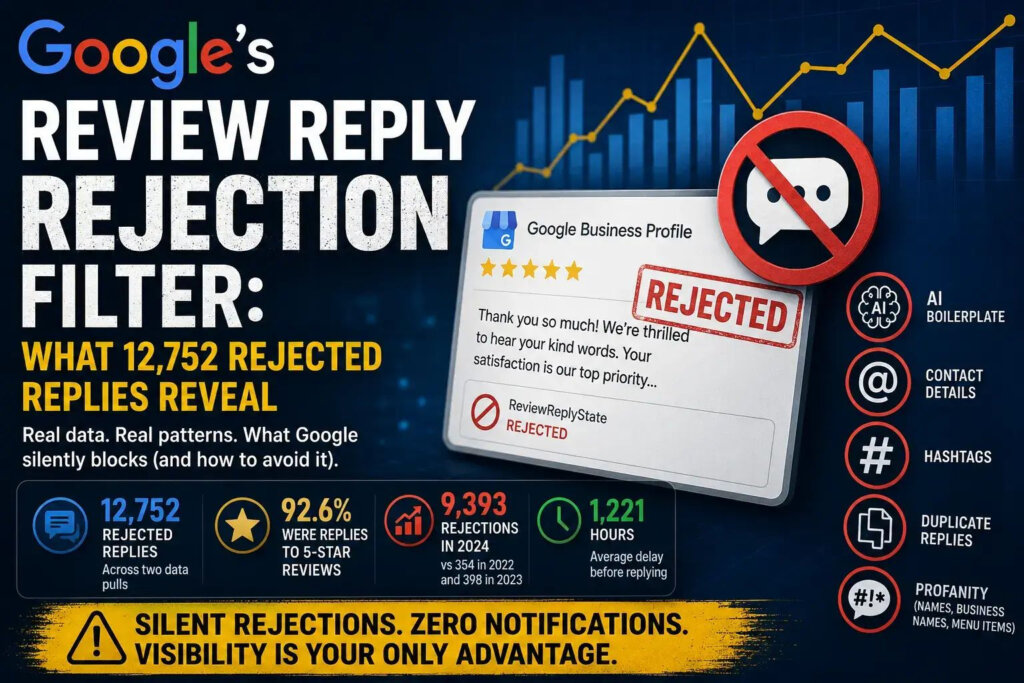
I would have completely missed this very unusual data if I wasn’t a devoted viewer of the Whitespark Local Update Podcast, which highlighted this infographic summarizing findings from a study by Michel van Luijtelaar of 12,752 rejected Google review replies.
Michel states,
“Most of the businesses in this dataset have no idea their replies were rejected (yet). No notification. No error. No explanation. The reply appears sent while sitting in a REJECTED state. The only way to know is through the API, and since yesterday, our GMBapi interface.”
This study raises significant questions about the use of AI automation in review responses, and I highly recommend reading all of Michel’s commentary as well as listening to Claire Carlile’s remarks in the Whitespark Local Update Podcast episode. While we’ve seen so much evidence of Google review removal, I feel we’re in less-charted territory when it comes to owner response rejections. Quite interesting!
The UK’s Competition and Markets Authority (CMA) has ruled that Google must adhere to new standards of conduct, including:
While it’s unlikely we’ll see the present administration in the US follow suit, Darren explains,
“If rules like this spread, Google updates could become much more transparent, and SEOs and business owners may finally get more warning before major ranking changes hit their traffic.”
Miriam Ellis is a local SEO columnist and consultant. She has been cited as one of the top five most prolific women writers in the SEO industry. Miriam is also an award-winning fine artist and her work can be seen at MiriamEllis.com.


Whitespark provides powerful software and expert services to help businesses and agencies drive more leads through local search.
Founded in 2005 in Edmonton, Alberta, Canada, we initially offered web design and SEO services to local businesses. While we still work closely with many clients locally, we have successfully grown over the past 20 years to support over 100,000 enterprises, agencies, and small businesses globally with our cutting-edge software and services.