CONTENTS

🤓 The 2026 Local Search Ranking Factors are here!! Check out the report!

💡 Key takeaways:
– Citations are back: AI tools increasingly rely on third-party sources to give local business recommendations.
– Both structured and unstructured citations matter: Directories, review sites, industry platforms, news, blogs, and other brand mentions can all influence AI visibility.
– Quality over quantity: Focus on sites that rank in traditional search results and get cited in AI answers. No need to build hundreds of listings.
– Do competitor research: Identify where your competitors are being cited and build listings on those sites.
– Keep your brand facts consistent: Accurate business information and clear descriptions of who you are, what you do, and whom you serve make it easier for both customers and AI systems to understand your brand.
It’s time for your brand or agency to take a quick refresher course on the hot topic of citations. Why? Because it’s AI o’clock and so much has changed as a result of the emergence of tools like ChatGPT, Google AI Mode, Google AI Overviews and Ask Maps!
Do citations matter? The answer is: more than ever, but you might not think so if you’ve not checked in on this subject in a few years. Here’s your chance to brush up and influence the visibility of the brands you’re marketing in AI-driven tools.
If you’re at all confused about the role of citations, it’s no surprise. They’ve had a long history with a couple of plot twists that were hard to follow. I’d break the timeline down like this:
It’s par for the course that industry nomenclature added to the confusion about citations across the decades. Most local SEOs, however, would agree with these two definitions:
I don’t think the narrative ever shifted so much that local SEOs devalued unstructured citations. It hasn’t been a subject of debate as to whether getting mentioned by relevant third-parties has a positive impact on visibility in search.
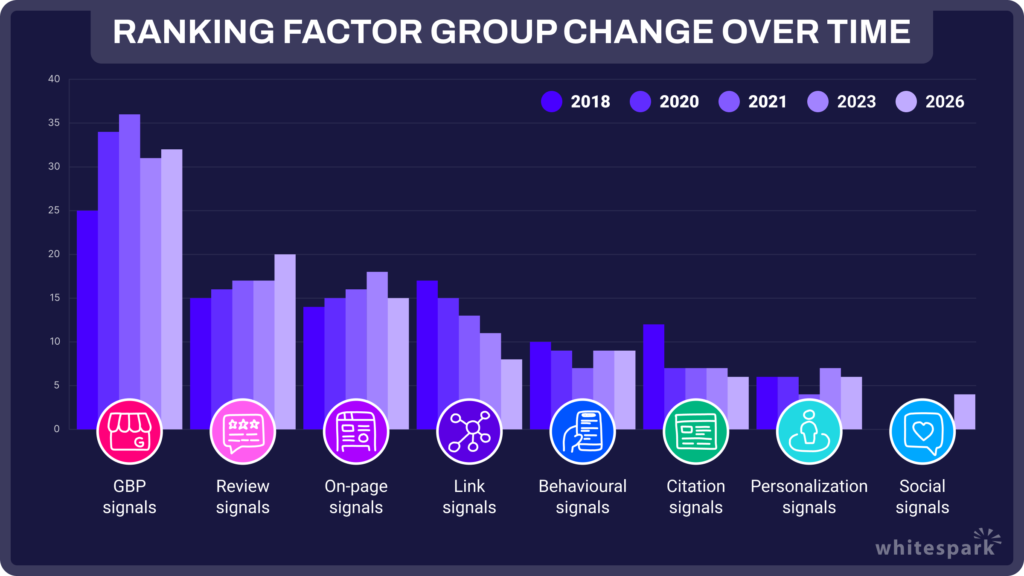
By contrast, you can see in this handy graph how citation signals were taking a sad walk down a stairway to the basement between 2018 and the present, as captured by the annual Whitespark Local Search Ranking Factors survey:
But now we’re in the AI era, and a new story surrounding citations as an AI visibility factor is emerging. Happily, Whitespark surveyed many of the world’s top local SEOs to capture early days’ data about the factors respondents believe have the greatest impact on AI prominence:
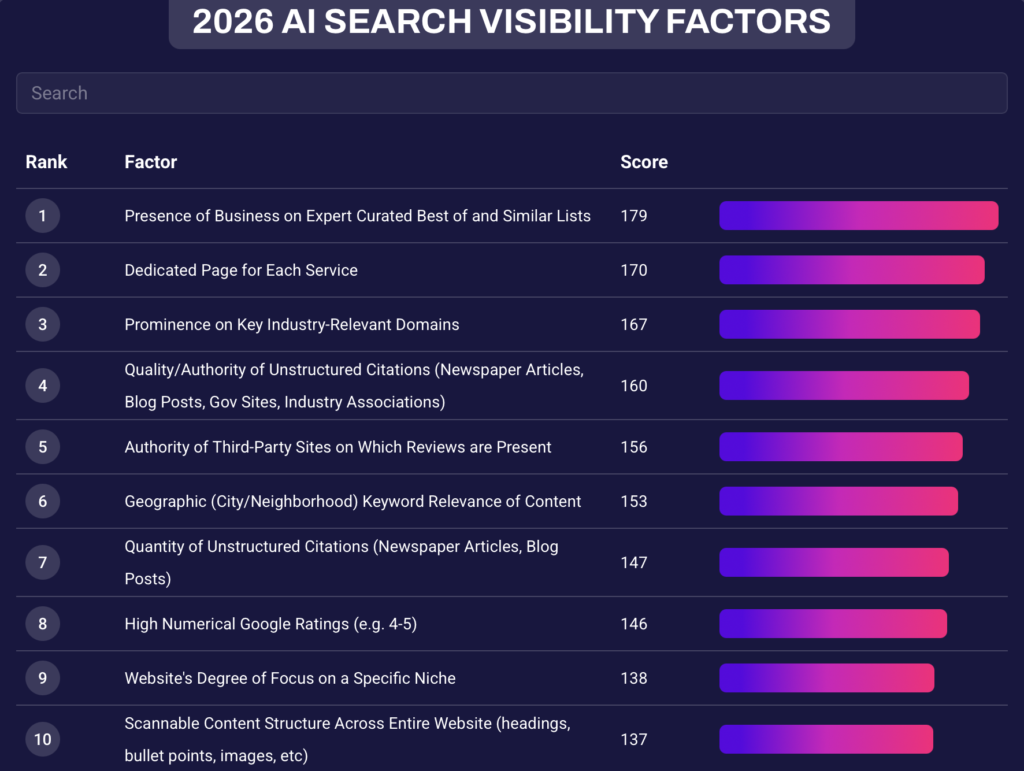
Here are the takeaways from this set of factors:
It doesn’t really matter that quality/authority of structured citations is only coming in at #26 out of 187 possible AI ranking factors. Both structured and unstructured citation sources dominate the entire top 20 in this list. In a nutshell, citations are back in a big way due to the rise of AI.
🤓☝️ Quick Sidebar on Citation History:
One confusing aspect of citation history is that local SEOs don’t universally agree as to whether Google’s own local business listings should be termed “structured citations”. Some feel they shouldn’t and that only non-Google business listings should be called structured citations because what we’re trying to track is their outside influence on Google’s local results. I’ve never been bullish about this definition, but it doesn’t really matter anymore. AI is now citing Google Business Profile data left and right, making GBPs undeniably a citation source. Or, at least I think so…Tell me if you disagree!
Given that citations of all kinds are so back, what should you be doing about them today for the local brands you market?
Here is your 5-step workflow for acing structured citations in the AI era. Create a simple doc or spreadsheet to record your findings from these tasks.
Task 1: Start with traditional search
Search for your brand name (or brand and city name if you’re marketing a multi location business) and note down which structured citation sources are ranking within the first five pages of Google’s organic results, like this:
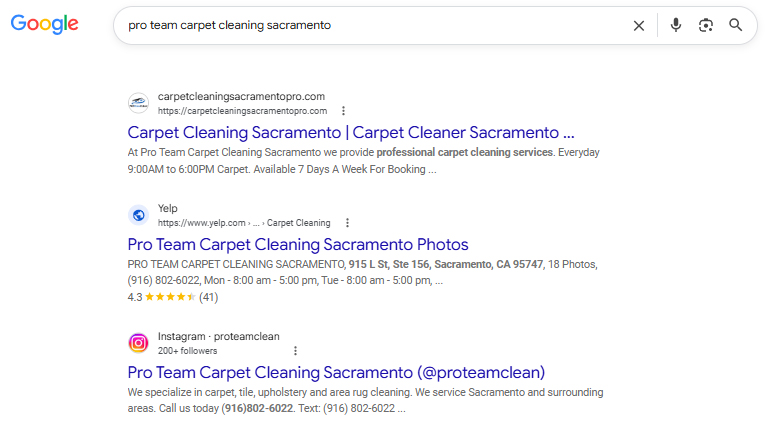
As you can see from the above screenshot, Yelp is a highly-ranked structured citation source for this carpet cleaning company that serves in Sacramento, California.
Follow up by searching for your core keyword phrases to see which structured citation platforms (if any) are ranking within the first five pages of Google’s organic results for these terms:
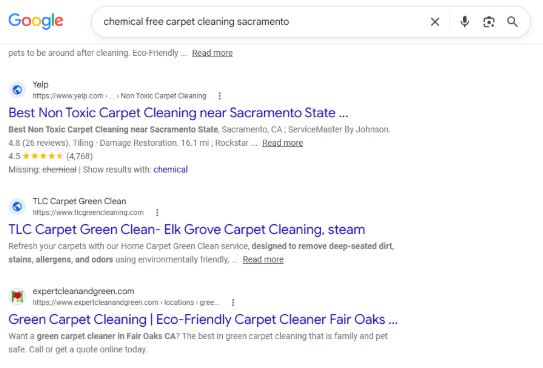
Again, we see a Yelp “Best of” list appearing for this keyword-oriented search. Note it down.
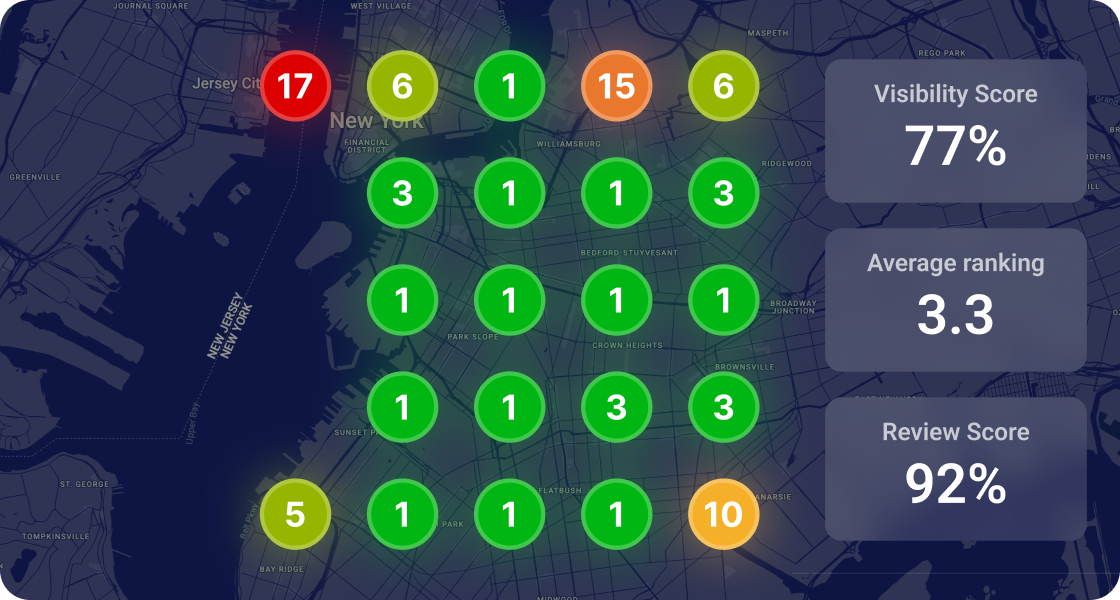
Finally, use a tool like Whitespark’s Local Ranking Grids to accurately identify your top local competitors:
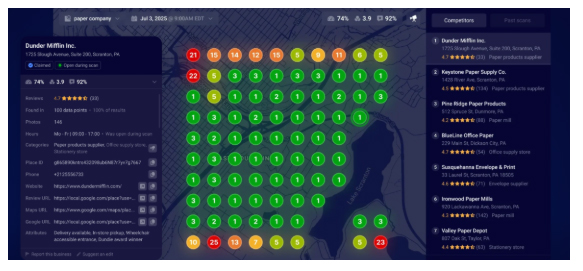
Do a branded search for each competitor of interest to see if citation sources are coming up for them in the first 5 pages of Google organic results. Note down any citation source they are listed on but that your brand is missing from.
Task 2: Fire up your conversational AI tools of choice
Little by little, you should be working to establish which AI tools are most popular with your consumer base. For the purpose of this playbook, we’ll look at Google AI Mode. Start by looking up your brand name (or brand + city if you’re marketing a multi-location business) to see which structured citations AI is surfacing.
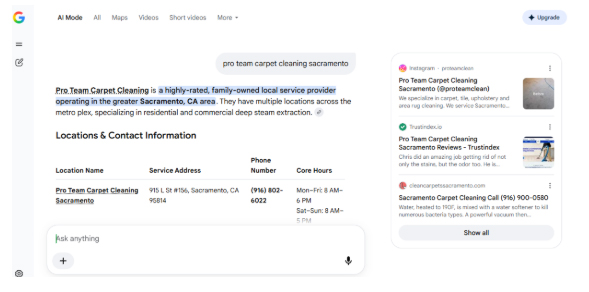
In the above screenshot, for example, the AI Mode sidebar is citing a source called TrustIndex.io. In addition to noting down familiar platforms coming up for your branded query, note down anything that comes up on a site where you are not managing your listings. You probably should be if AI is referencing them.
Next, write as many prompts as you’d like based on the queries you believe have the most important intents surrounding your business. Examples might be:
Whatever customers care about most in choosing a business like yours for a transaction, these attributes should form the basis of your prompts:
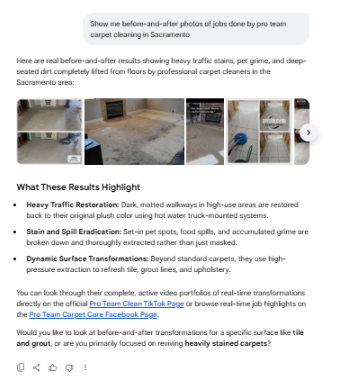
In the above screenshot, I’ve asked AI mode to show me before-and-after photos of this brand’s carpet cleaning jobs and it is citing the brand’s Facebook listing as an image source. Note down any citation platforms that come up as sources for your prompts.
Next, run branded and non-branded prompts for your nearby competitors, just as you did with traditional search. Note down any citation sources where they have a presence but the brand you’re marketing is absent.
You don’t need to limit your research to a single AI tool. You’ll get more information if you query more tools, like ChatGPT or Ask Maps.
💡 Pro Tip:
The most practical methodology I know of for measuring whether a citation source has value or not is to assess if it is ever encountered by the public. Now that you’ve completed tasks 1 and 2, you have turned up a variety of citation sources that are highly visible to traditional searchers and AI tool users. In my book, these are the platforms that matter most. However, consumers may search and prompt in ways that surprise you. Once you’ve identified the citation sources that are most visible for you and your top competitors, move onto task 3 for fuller coverage.
Task 3: Expand your citation horizons
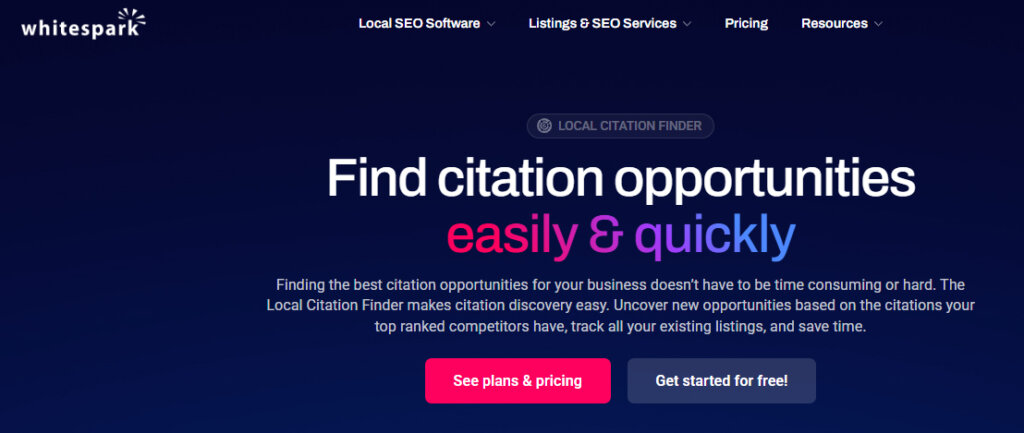
Because Whitespark is notable for having continued to invest in citations that contribute to local businesses’ digital footprints, I suggest using their Citation Finder tool for the next steps in your research. Go to: https://whitespark.ca/local-citation-finder/ and click the “Get started for free!” button:
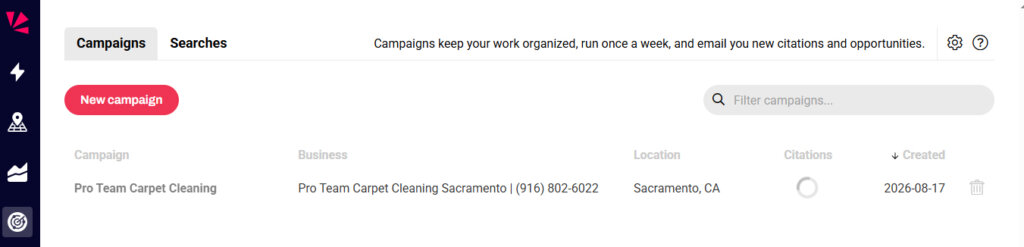
Create a campaign for the brand you want to research and it will appear in your dashboard like this:
The tool will then show you your existing citations and opportunities to build out listings where you lack them:
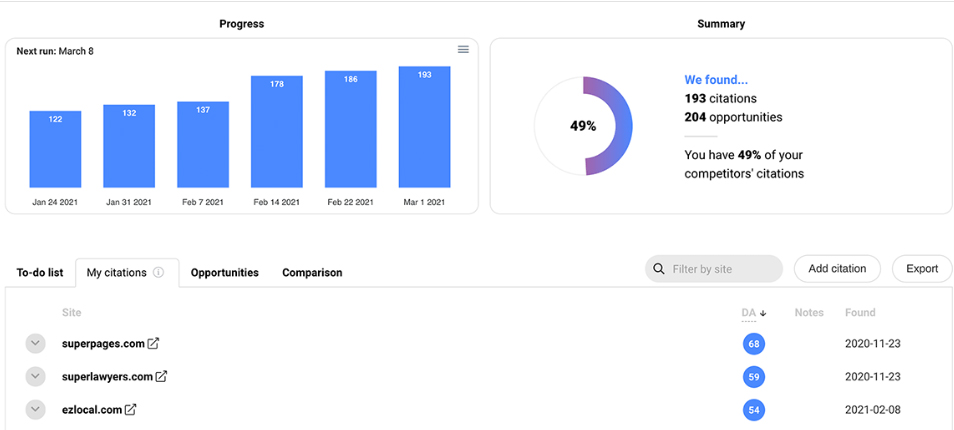
The tool will also stack your citations up against those of your competitors, revealing additional places you may want to list the business you’re marketing.
Based on your findings, you can then choose how you want to grow and manage your citations.
Task 4: Publish accurate citation information
Now that you’ve completed the research phase of this playbook, you have two options for developing a more powerful set of citations.
If the paid citation development tools you’re considering are missing a particular citation source you discovered during your research, you may need to combine options 1 and 2 for complete coverage.
The goal is simple: to ensure that accurate business information is being encountered by human searchers, traditional search engine bots, and AI retrieval systems.
Task 5: Managing your citations over time
If any location of your business experiences a change to its data (such as moving to a new location, altering hours of operation, or getting a new phone number), you will need to update your citations via manual or automated processes. This will reduce customer inconvenience by ensuring they are encountering accurate information instead of outdated data.
You may also want to re-engage in tasks 1-3 on a periodic basis to discover whether new citation sources are cropping up for the brand you’re marketing or its competitors.
The entire digital marketing industry is talking about citations right now because they are central to how AI tools are providing answers to users’ prompts. At the moment, there is a noteworthy chicken-or-egg discussion underway about whether building general citations/mentions influences AI recommendations or if recommendations are based on information that is already in the data models. Because the nuances of this narrative are a bit complex, I want to weigh in with two clarifications for local business owners and their marketers:
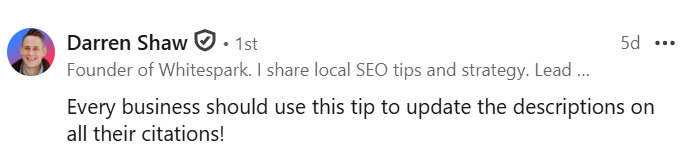
What has Whitespark founder Darren Shaw so excited? It’s the following advice from Zyppy founder Cyrus Shepard:
“Easy AI optimization tip: position your company by nailing your “brand facts”
Positioning helps tell AI systems:
As Darren points out, the business description field available to you on most local business listing platforms is the perfect place for answering all 5 of these questions to codify your “brand facts” for AI retrieval systems. The easier you make it for consumers, search engine bots, and AI tools to understand your brand no matter where they are looking for information across the web, the better your chances of proving that you are the right choice for the right customer.
Miriam Ellis is a local SEO columnist and consultant. She has been cited as one of the top five most prolific women writers in the SEO industry. Miriam is also an award-winning fine artist and her work can be seen at MiriamEllis.com.


Whitespark provides powerful software and expert services to help businesses and agencies drive more leads through local search.
Founded in 2005 in Edmonton, Alberta, Canada, we initially offered web design and SEO services to local businesses. While we still work closely with many clients locally, we have successfully grown over the past 20 years to support over 100,000 enterprises, agencies, and small businesses globally with our cutting-edge software and services.