CONTENTS

🤓 The 2026 Local Search Ranking Factors are here!! Check out the report!

Has your website got a historic Google indexing problem that no one has been able to troubleshoot or solve? You and I are in the same boat. And there’s something I recently realized that’s made the frustration of this serious issue a little bit easier to live with.
When I launched my Tolkien art website back in August of 2023, I began to suspect by year’s end that I had some kind of indexing mystery going on. I started documenting what Google’s tools were telling me about the indexing status of my site and embedded blog:
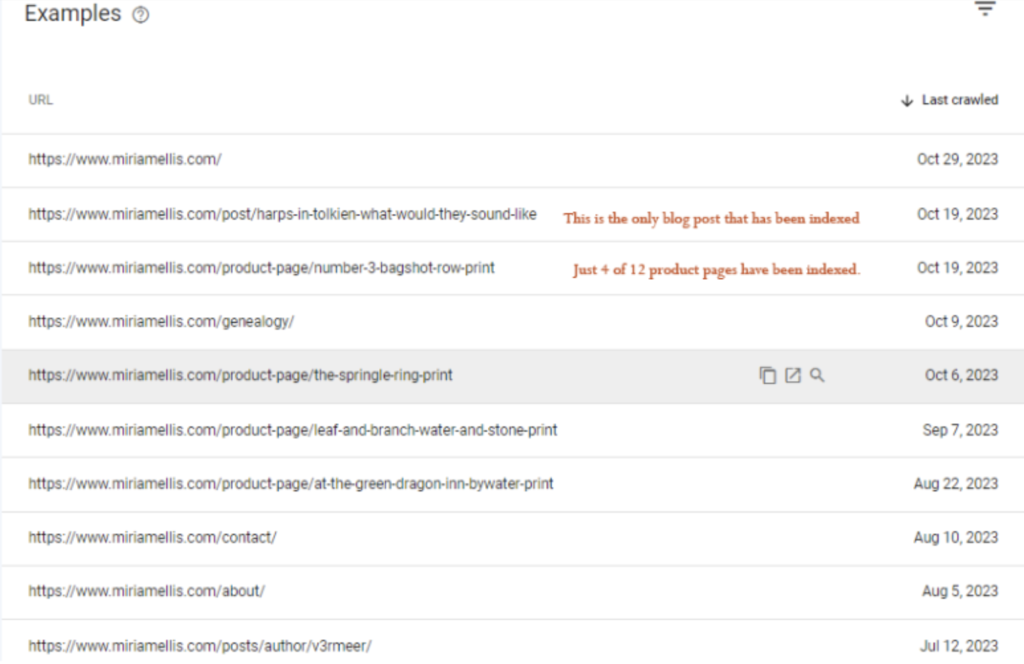
My site was new and small, but this pattern of Google indexing only a minor fraction of my product pages and blog posts continued with each passing year and seemed quite mysterious.
I’ve been working in SEO for 20+ years and built a ton of SMB websites in the early days of search, but I’ve never been a technical SEO expert. I was concerned that I might be overlooking some obvious mistake I’d made with my own site.
So, I started showing the indexing data to my friends in the SEO community, like Google’s John Mueller, my fellow Search Scientists at Moz, good programmers like Darren Shaw, and multiple folks at Wix including Mordy Oberstein. I was so grateful to everyone for taking a look, but in the end, all of these brilliant colleagues were as nonplussed as I was that Google was ignoring much of my highly niche publication.
The general feeling was that Google was trying to significantly pare down its index and that lots of other publishers were experiencing a similar phenomenon.
My field may be niche, but it’s also quite competitive. There are so many artists in this genre, and I was a total newcomer to the scene. I reasoned that maybe it made sense for Google to ignore so much of my writing and art until I had proved myself more worthy.
I hoped authority developed over time might influence Google to index all my unique products and blog posts. My inventory is literally one-of-a-kind and my posts are original, written with pretty good subject matter expertise (if I do say so myself) and a great deal of thought and care.
Since launching my site in 2023:
Yet the pattern has remained of Google either being extremely slow to index my fresh content or simply refusing to index it at all.
I invest in art supplies for each painting (canvas, paint, brushes, etc). I spend weeks researching and then executing each new painting. Then there is the investment of both time and money to create content surrounding it, including product page content, supporting blog post content, video content, and social content, plus the fees associated with my Wix domain and the hefty commission charged by my art printer, Gelato.
Doubtless you are similarly making serious investments in your digital assets, and can relate to the feeling of hitting a brick wall if Google refuses to show them to the public.
For me, what this looks like is that I offer an art print of a very specialized theme like “Galdriel and her weavers in the Golden Wood” and Google simply will not show my domain, product page, or blog post in their traditional search results:
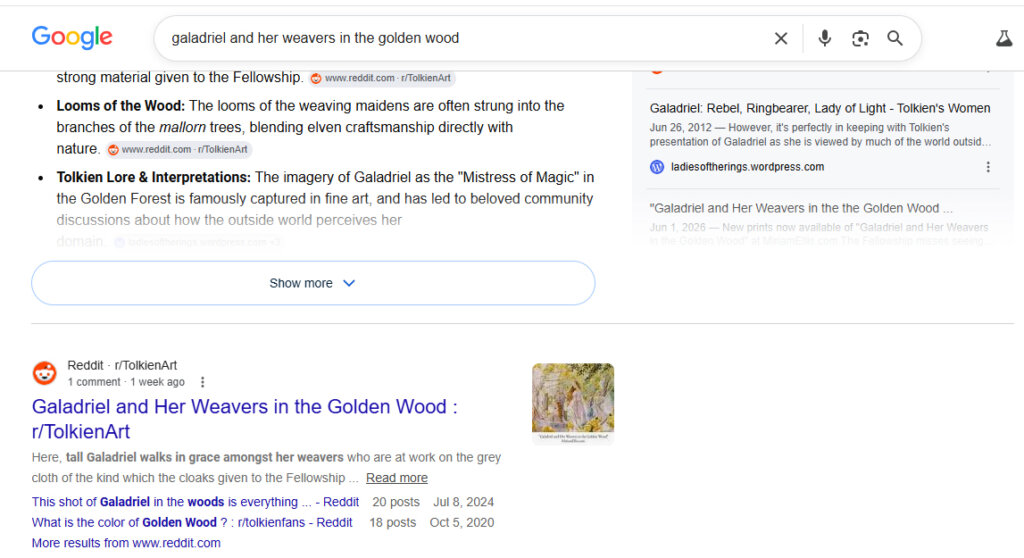
It will show social media references, and AI overviews, and other sources, but my website, which is the authoritative source for this query, is left out in the cold. If a potential patron were looking for an art print of this scene, Google would not send them to my site, even if I am one of the only artists to ever portray specific, niche material from Tolkien’s legendarium. I tend to specialize in underrepresented scenes, and this behavior on Google’s part is certainly frustrating.
It leads to questions like, “If someone wants a print of Galadriel and her weavers in the Golden Wood, would it not be a better Google user experience to show my product page instead of random pictures from Peter Jackson’s films which never portray this scene from The Lord of the Rings?”
I am so busy painting, writing, and engaging with the community that I have just had to repeatedly sideline questions like this and shrug at Google rather than carry around a big ball of angst about the whole thing (bad for one’s health!).
But recently, I had a small lightbulb moment that I hope might bring you some welcome relief if you, too, feel cursed by insoluble Google indexing woes.
It’s an open secret that I am not AI’s number one cheerleader. I’ve got serious ethical concerns about it. So do most of the artists, authors, and other creative folks I know.
But here’s something of note. If my potential patrons are using Google AI Mode, the fact that my site isn’t being properly indexed by Google becomes less of a problem because my art print of this topic is being served up as the main information by this tool:
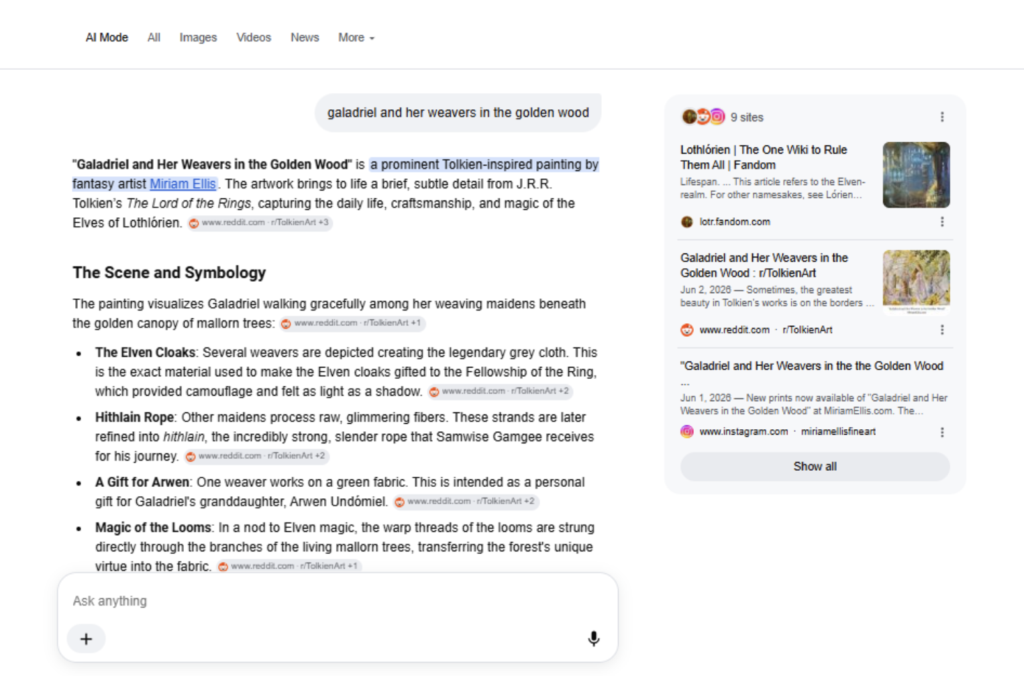
All of the data in the above screenshot (with the exception of one of the two thumbnails and one of the URLs cited) is stemming from my own social media posts.
AI Mode doesn’t care that all of this scraped content doesn’t reside on my website. It’s giving social media airspace that is equal or greater to that of traditional domains.
The pros of this are that nearly the entire answer to my prompt is creating visibility for my art print, despite my historic Google indexing problem. Moreover, this status is practically instantaneous. I have seen this level of visibility achieved within 1-2 days of publicizing my latest offerings.
The cons of this are that the only place a purchase can actually happen is on my website. The path to realizing that a print of a particular painting is available to buy requires the searcher to wend their way through a variety of social media paths. This is not ideal. Especially when coupled with the fact that many of the social communities I post in reject content that is overly promotional, meaning that I have to share my art without mentioning or linking to the page where prints can be purchased. That’s a significant barrier.
So, is this a perfect silver lining? No.
But is it a little bit of breathing room amid a frustrating indexation conundrum? Absolutely, because at least it is giving visibility to my work almost instantly for searchers encountering AI Overviews or users of AI tools like Google AI Mode.
In my case, heading to a different AI offers a user experience that is both better and worse for my business. Better because ChatGPT is linking directly to my own website as the first response to my query:
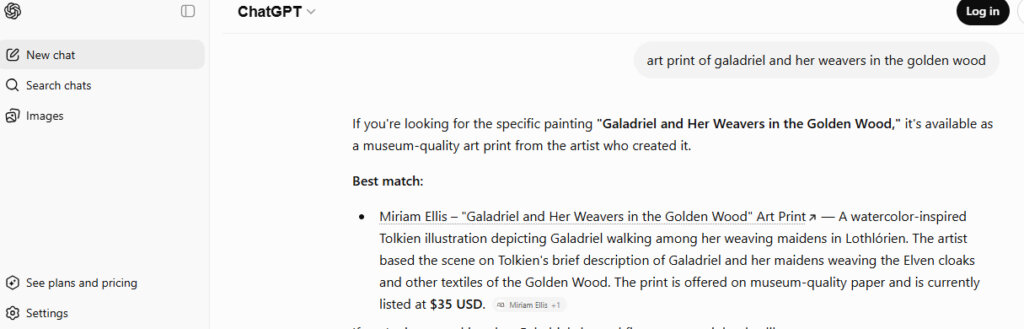
Worse because ChatGPT refuses to show me an image of the print in question, for this reason:
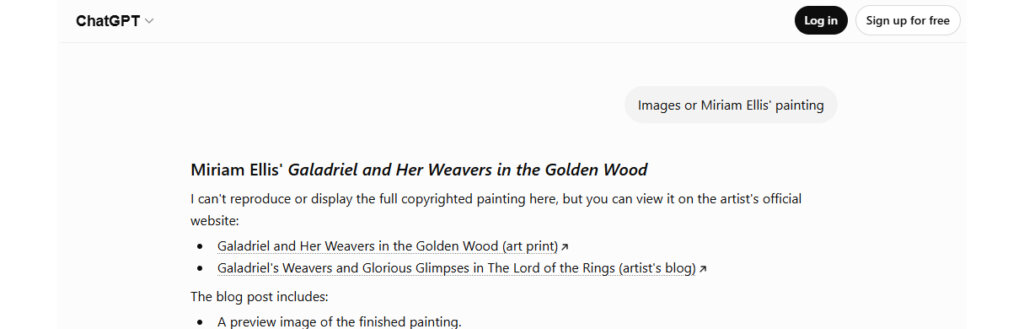
I’d like ChatGPT users to be able to see the painting, because this is what will sell prints of it, but I’m not actually that worried about it because the tool is linking to both my product page and my supporting blog post for the product. I like this thoroughness.
I also think it’s worth noting that ChatGPT seems less social-dependent than AI Mode, at least for this query. I had to write an additional prompt to get some social media citations to appear, like this:
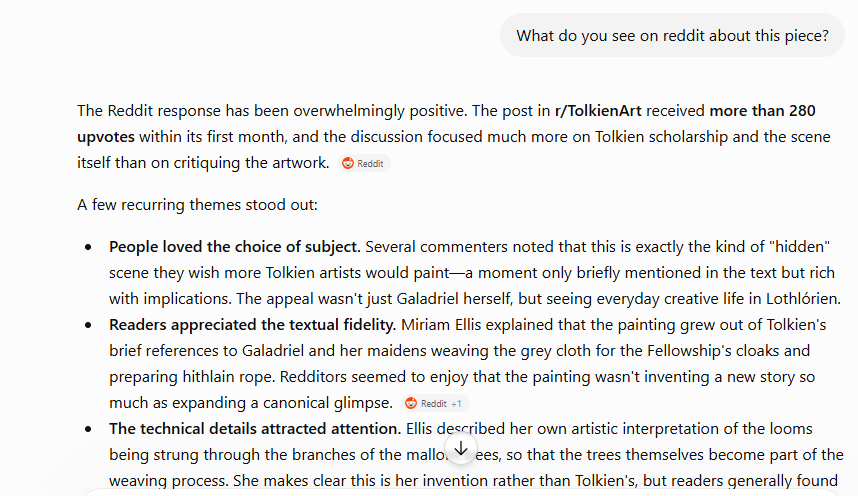
My scenario is definitely not art-specific.
You could be marketing a virtual startup selling beard care kits, an established hybrid brand selling window blinds via both remote delivery and in-person consultation, a single location dental practice, or a multi-location plumbing enterprise. If you’ve exhausted all avenues of trying to troubleshoot why Google is refusing to index much or even most of your website, here’s my suggested seven-step workflow:
I’d also suggest running your queries over on ChatGPT. As you saw in my case, my page and post had actually been found by this tool (unlike in AI Mode) and so that could give you a sense of relief.
But the main point here is, if Google won’t link directly to your site, you may still be able to build out a strong network of roads that lead to you, via social media.
I do so want to be delivering a silver lining with this piece to anyone who has agonized over Google indexing issues, but I also need to be sure to prepare you for two significant pitfalls of turning social media into a stand-in for your website in the AI era.

Note the language I have underlined in red in the above screenshot. What on earth does “watercolor-inspired” even mean? That I saw someone’s watercolor and was inspired by it? That watercolor, in general, inspires me? The painting in question is not a watercolor (it’s acrylic on canvas) and it was not inspired by a watercolor. This is a classic example of AI slop, mimicking human speech that seems authoritative but is actually nonsensical, fact-free, and just plain wrong.
This really can be a serious problem when it comes to brand representation and consumer protections. Nothing bad is going to happen to anyone if AI mistakes my acrylic painting for a watercolor and generates language about it that no human would ever use, but what if it gets the chemical content of two bathroom cleaning products your plumbing franchise is vending wrong, causing a consumer to use them on the same job and suffer skin burns, lung irritation, or eye damage?
I’m professionally astonished by the degree of misinformation in both AI Mode and ChatGPT, and your brand needs to be aware that consumer use of these tools is almost certainly resulting in some degree of misrepresentation of your brand, its products/services, policies, certifications, safety information, etc. Ethically speaking, AI is not a substitute for the authoritative information on your website, and that’s something I hope the public will become increasingly hip to.
Let’s say your plumbing franchise has been in operation since 1985. You have a real-world track record of hundreds of thousands of well-executed jobs across decades, and you’ve worked very hard to earn a good name and consumer loyalty across multiple geographic markets.
One day, you do a job for a client that goes wrong. Perhaps there was a hidden problem with their septic tank underlying a simpler issue that your technicians fixed, and the customer had a washing machine back up three days after your staff believed they had remedied the initial issue. The disgruntled customer then takes to Reddit and begins telling the world that your business ripped them off.
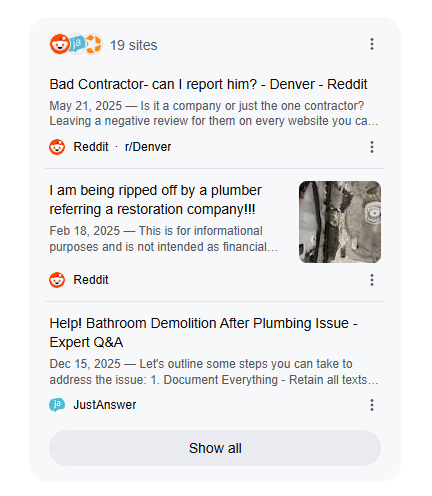
The problem with Google AI Mode giving so much precedence to a social platform like Reddit is that unverified negative public sentiment about your brand looks authoritative. If Google is refusing to index much of your website, but is giving a massive microphone to random people on social media, then this is a major brand reputation management challenge.
My general advice to local business owners has always been to see customer service as their top priority, as this then builds a strong and broad digital footprint of positive consumer sentiment. But the truth is, no one has any really good solution to the fact that Google is giving social media this much prominence in AI results.
It’s as if they decided to make YouTube comments (notorious for their bizarre qualities) the authoritative source of traditional search results. It doesn’t quite seem like good horse sense, at least to me.
My best counsel in this scenario is similar to my proviso number one: we have to hope that the public will gradually become more aware of the fact that Reddit content may not be as authoritative as Google seems to think it is.
Right now, the only way for people to order my art prints is through my website. This makes my indexing issue painful.
But what if my website becomes only one path to purchase, due to the projected rise of agentic products that carry out actions? Let’s take the example of Reserve with Google:
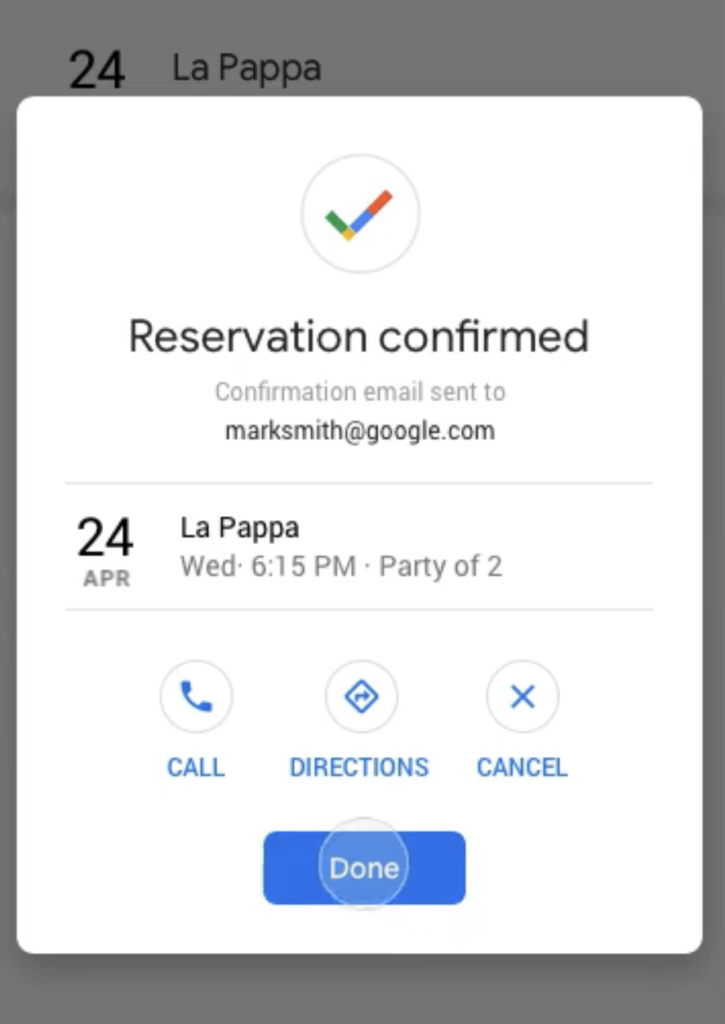
This opt-in program obviates the need for a website booking system because the potential patron can book a restaurant reservation right in search, Maps, or via an Assistant. The consumer never interacts with the website, and it’s possible to imagine a future in which they don’t even look at a screen. Picture someone telling a voice assistant “find me a 24-hour plumber who specializes in getting wedding rings out of drains and book my appointment this afternoon and pay for the service.” The website could be completely unnecessary to the brand if they are opted into whatever programs are relevant to agents carrying out research and transactional tasks.
Now, for me, I’m going to expect that most people will need to see my art before buying it, but I can imagine countless local business transactions in which that visual confirmation step isn’t necessary, and in which the whole concept of Google indexing could recede further and further into the rearview mirror.
I’m not making any promises, but it’s something worth speculating about in 2026.
Looking for more outside-the-box marketing suggestions to help you cope with Google’s features and foibles? Subscribe to the Whitespark Local Update Podcast for creative and timely strategic advice.
Miriam Ellis is a local SEO columnist and consultant. She has been cited as one of the top five most prolific women writers in the SEO industry. Miriam is also an award-winning fine artist and her work can be seen at MiriamEllis.com.


Whitespark provides powerful software and expert services to help businesses and agencies drive more leads through local search.
Founded in 2005 in Edmonton, Alberta, Canada, we initially offered web design and SEO services to local businesses. While we still work closely with many clients locally, we have successfully grown over the past 20 years to support over 100,000 enterprises, agencies, and small businesses globally with our cutting-edge software and services.