🤓 The 2026 Local Search Ranking Factors are here!! Check out the report!

🤓 The 2026 Local Search Ranking Factors are here!! Check out the report!


Happy 2026 to all the local business owners and marketers riding the rough seas of this first quarter. I can’t recall another start to a new year with quite this much disruption to keep pace with. If you’ve been finding it challenging to take in all the latest local SEO developments, we’ve got you covered. Let’s hit those waves!
If you’re feeling a bit jaded by overblown claims on AI usage, watch Darren Shaw’s quick summary of some of the brilliant findings from Rand Fishkin’s post New Research: Search Happens Everywhere; an Analysis of 41 Websites with Significant Search Activity. Using DATOS’ 2025 Desktop Panel of millions of devices across the US and EU, SparkToro analyzed 41 websites to discover current search behaviors, including:
Definitely read Rand’s full report for further settle-down takeaways and stay critical of AI-oriented claims that seem fantastical.
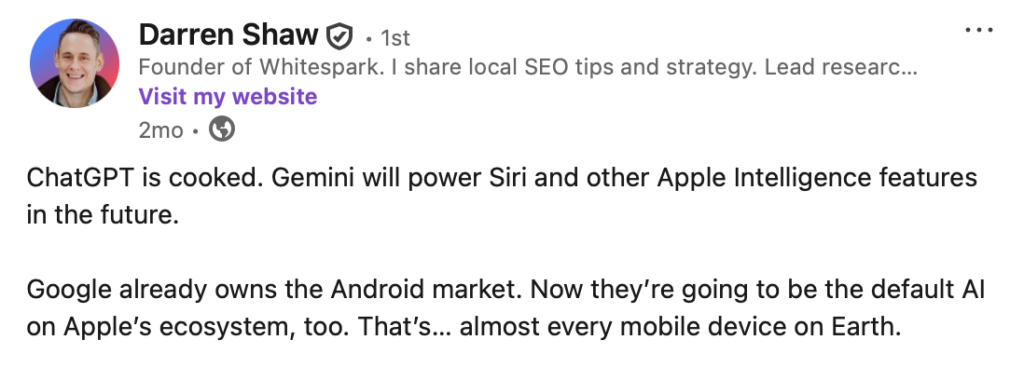
If you’ve been rooting for a Google challenger, it’s hard to see ChatGPT emerging as a new champion following the joint announcement from Google and Apple that Apple Intelligence will be fueled by Google’s Gemini. Looks like Google wins again, and in the current political climate, the powers that be do not seem to consider “monopoly” to be a dirty word.
The above video shares research conducted by Sterling Sky + Jepto revealing that:
Sterling Sky’s advice is to open more locations to garner more visibility in AI-driven local packs and to invest in paid advertising. Unfortunately, both suggestions paint a picture of a local search future ruled by large multi-location enterprises with big advertising budgets instead of the small brands that give distinct communities unique flavor. One can see how a pay-to-play model benefits Google, but it may not benefit your neighborhood coffee shop, bookseller, or clothing boutique.
Motivated local businesses and their marketers are eager for answers about earning AI visibility. Foundational to this goal is getting a handle on query fan out, which is an AI process that takes a single user prompt/query and breaks it into multiple sub-queries. The purpose of understanding this AI behavior is to inform your content and marketing strategy, and I have four links for you here that will get you up to speed:
Set time aside to watch all 3 of those videos, and you will be well ahead of many local competitors who are not investing in educating themselves about this timely topic. I also want to include one extra link here.
Our friends at NearMedia did a very good interview with Rand that goes deep on the ongoing narrative about zero-click SERPs, and I’d like to specifically highlight a quote from him:
“Just because we live in a zero-click world more and more does not mean sales are going away. At the end of the day… a shoe or several will still be purchased. A Volvo dealership in LA will still get someone’s business…That’s not going away. I don’t think commerce is ending.
I think the discovery, the attention earning, the audience influencing, the audience building, all of those phases which happened historically on your website are being disintermediated and will now happen on platforms you don’t own and control. And so that old advice of not building on rented land, which I gave on stage for 20 years, that’s now dead wrong. You must build on the rented land where your audience’s attention exists or you will lose.”
I’ve learned that Rand’s industry reads are always worth my attention, but here, I’d like to add one extra bit of advice, specifically for local business owners: the more you have to market on rented land online, the more you should be investing in direct communications with your offline community. Cut out the intermediaries wherever you can and build one-one-one relationships with your neighbors for repeat business and referrals. Go hard on this!
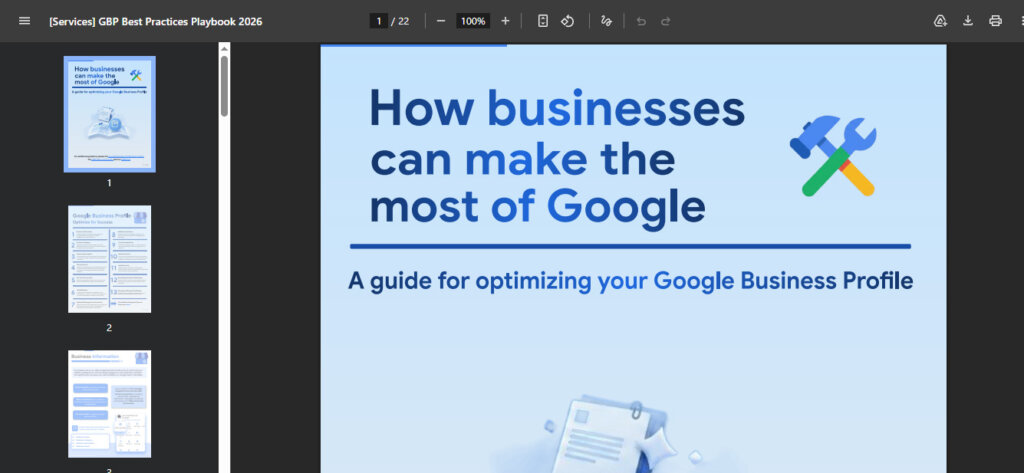
Hat tip to Amy Toman for being the first person I saw mentioning that Google has now published an in-house document called How Business Can Make the Most of Google: A Guide for Optimizing Your Google Business Profile. I’m hoping to do a full write-up of this shortly, and for now, I recommend bookmarking this new resource. There are some interesting stats in the guide, such as:
I’ll always be the first to applaud Google making a strong effort to outreach to the business owners whose information is the basis of their local business product.
Stefan Somborac has a great little post over at the Local Search Forum outlining current means of contacting Google support for most common problems. He covers problems with reviews, verification, suspension, and more. Bookmark this one, because you’re bound to need it.
If you’re working in automotive marketing, Greg Gifford warns not to act on specious advice that seems to be making the rounds claiming that you can create separate GBP department listings for separate services like oil changes and tire rotation. You are not supposed to do this. You are likely to end up penalized if you violate this area of the Guidelines for representing your business on Google.
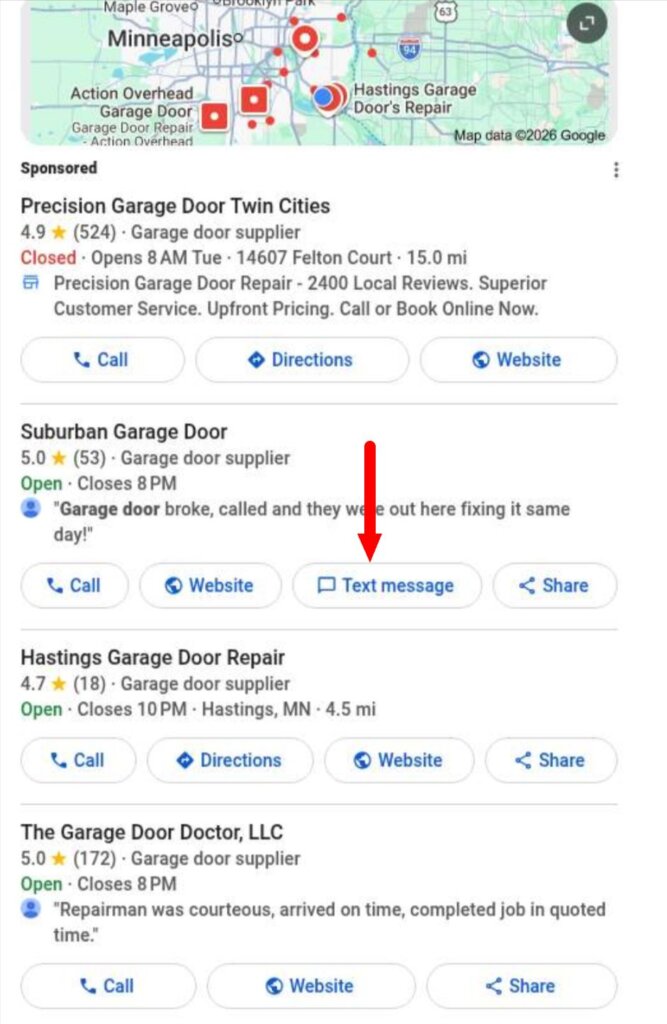
Mobile local packs are certainly Google’s biggest testing ground in our industry, and look at this possible test Joy Hawkins spotted in one of a “text message” button. Anything that actually connects a customer to a business instead of to something else in Google’s pocketbook is a win these days, particularly given how phone numbers are simply vanishing right and left from this interface. Why is it that I sometimes don’t quite believe that Google is living up to its ideals of creating content for humans? But, the text button looks hopeful.
This very thorough but easy-to-follow guide will level up the education of any client or team member on:
Whitespark’s guides are authored by real human beings and we put a lot of thought and care into creating educational materials that are thoughtful and actionable. Bookmark this guide.
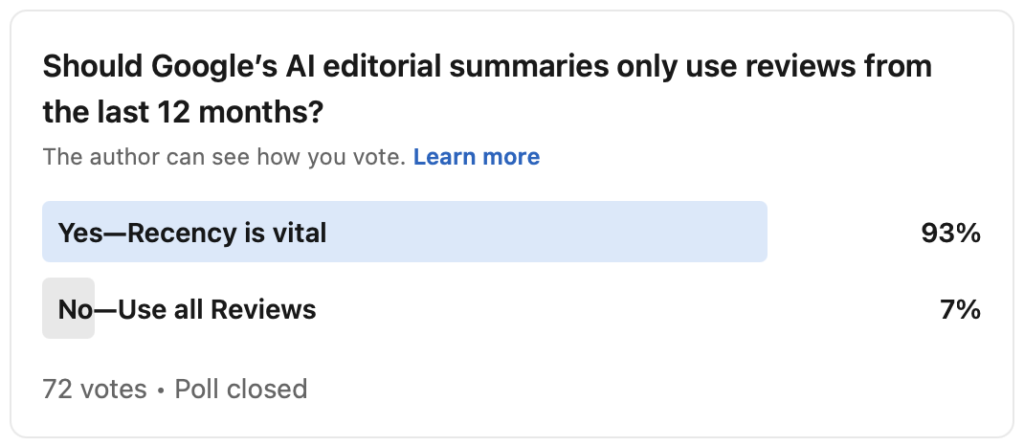
The always-savvy Claudia Tomina took the above poll and shared it on Linkedin in conjunction with an anecdote about one of her clients who is being misrepresented in a GBP AI summary as serving liquor when they don’t. Claudia’s sleuthing revealed that though neither the GBP attributes nor the client’s website make any mention of this offering, 3-year-old reviews do, making them the likely source of this misinformation.
Claudia notes, “The problem is I cannot get Google support to act on it. I’ve contacted them 3 times and get a no-reply response each time. Seems like too much effort for a business to deal with.”
This definitely belongs in the “what-could-possibly-go-wrong-with-AI” file. The capacity for spinning up misinformation and making it look authoritative has real world impacts on local brands. Frustrating.
I’d also like to recommend reading Claudia’s more comprehensive piece: Star Ratings Are for Humans: AI Reads the Text. In it, she codifies the shift from thinking solely about sentiment (in the form of earning high star ratings) to thinking about how review text drives semantic extraction by AI tools. Don’t reach the wrong conclusion that your ratings don’t matter anymore! But, the extent that AI is seeping into local consumer journeys, it’s the text of both reviews and owner responses that will fuel multiple AI-based features and functions.
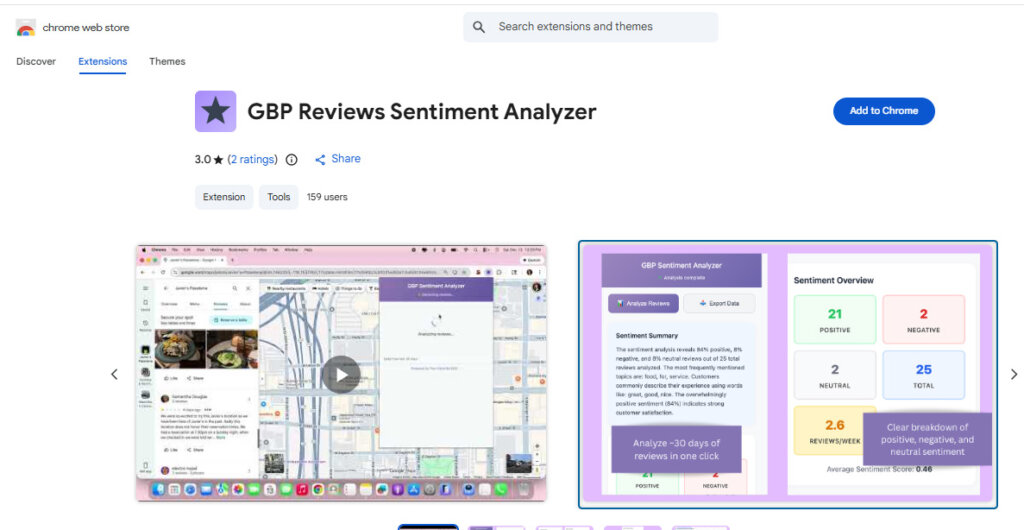
Celeste Gonzales has a video walk-through on Linkedin of her very cool new Chrome extension: GBP Reviews Sentiment Analyzer. Data the widget provides can be exported as a .CSV and includes:
This would be great to fire up in a prospective meeting for a mini reputation audit of their reputation, as well as that of nearby competitors.
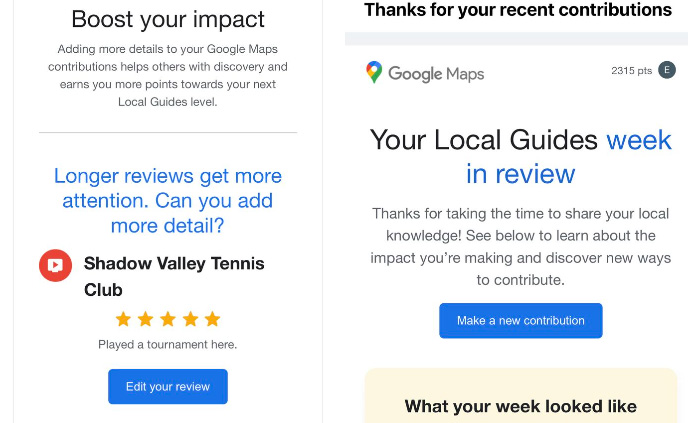
Seeing more “edited” tags on the existing reviews of GBPs you manage? We have another great catch from Claudia Tomina who noticed that Google is actively emailing Local Guides and other reviewers encouraging them to leave longer, more detailed reviews. Now why do you suppose Google would want more granular review content?
Claudia says:
“It’s not just for the benefit of other consumers. It’s about training data. Think about the direction of Search. AI Overviews and conversational results require rich, natural language to function. A five-star rating with zero context is a dead end for an LLM. Google needs specific details, descriptions of the atmosphere, the staff’s expertise, or the exact problem you solved to power the next generation of generative search results. They are effectively crowdsourcing their AI training via the Local Guides program.”
Makes sense!
Watch this video in which Joy Hawkins tells Colan Nielsen how she contacted a member of one of the large review extortion networks that Google simply isn’t cracking down on. Unsurprisingly, they demanded she “make a deal” with them to have their fake negative reviews removed. Joy offers some steps her team has been using to report these scammers, including use of the new Google Merchant Extortion Form, and it’s good to hear they’ve been seeing success.
It’s truly awful that local business owners are being swindled and blackmailed like this, and given Claudia’s earlier study on where AI is getting misinformation from, I’d like to know how long it takes after review fraud is removed for it not to be shown as valid information to AI users. I am seeing such incredibly old info in mobile AI-driven GBP features. In a recent blog post on the topic of getting better restaurant reviews, I shared this screenshot of Google going all the way back to a 2014 professional review to tell me whether a restroom was clean in 2026:
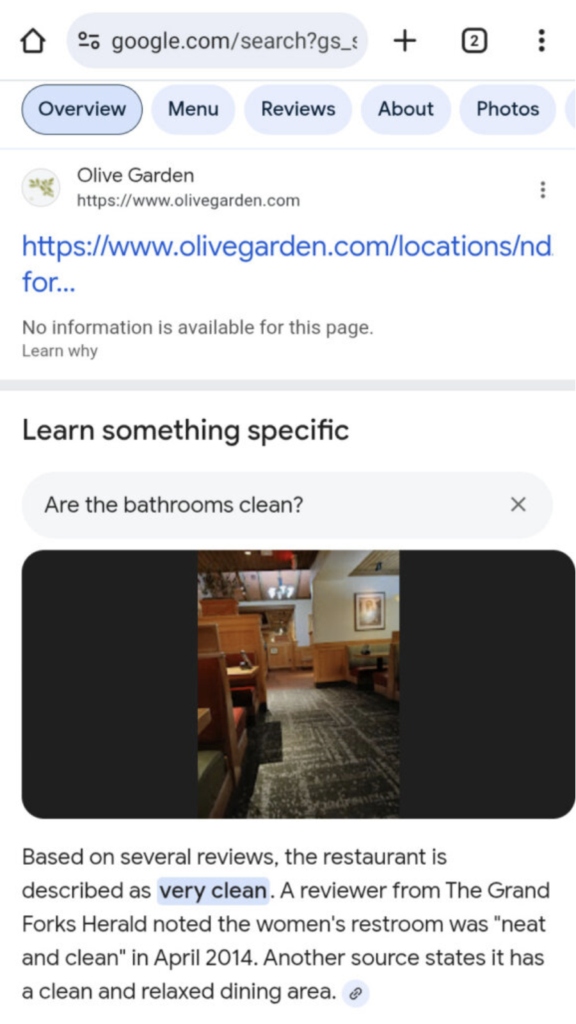
So, if review fraud gets scraped, does it stay in the system even years after it has been removed? Something I’d like to know from Google!
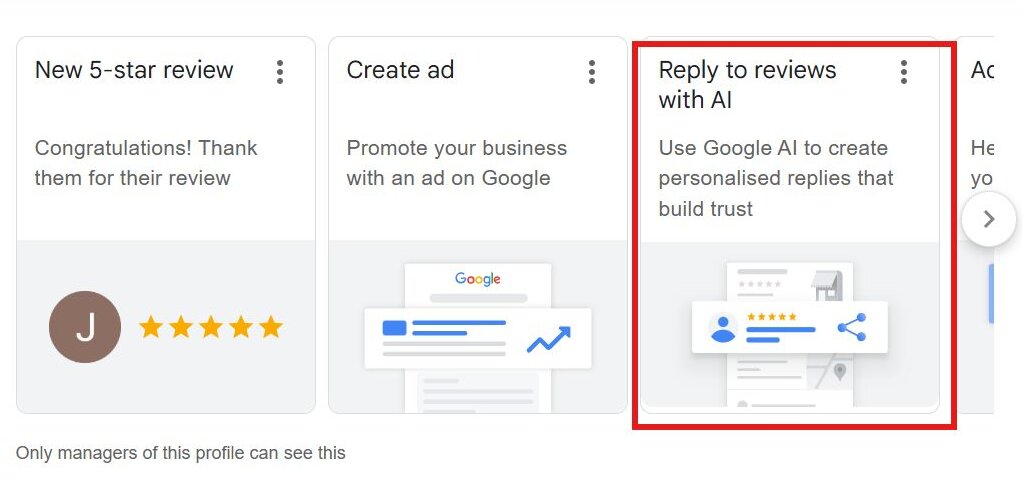
Chandan Mishra spotted this test prompt to businesses to respond to their reviews with AI. As you can see from the screenshot, this function states that business owners should “Use Google AI to create personalized responses that build trust,” and Chandan mentions that this came up for an older 1-star review but was apparently not yet available on his newer reviews. I find it quite interesting that Google would bill this as a trust-instilling practice, because in the most recent large-scale consumer behavior study I conducted with GatherUp, 70% of respondents stated they would lose trust in a business if they realize it’s using AI to respond to reviews. Yikes! So, let’s see how this plays out.
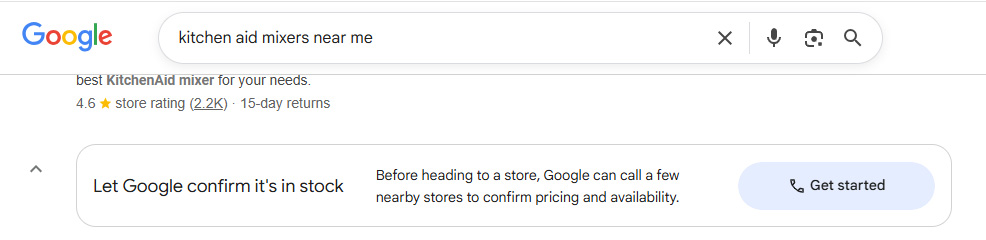
Are you starting to see the CTAs on more and more searches, with Google offering to have robots call stores and restaurants for things like inventory checks and open tables? This is a basic picture of what agentic commerce looks like. Google is making big announcements about how we’re entering an “agentic shopping era” it wants to be the leader in, and I absolutely recommend following Brodie Clark on Linkedin to see him experimenting with agentic features in Google Merchant Center.
For the sake of balanced commentary, I also recommend reading Greg Sterling’s short piece on this topic, in which he states,
“…while marketers need to understand and prepare for these technologies (e.g., UCP, ACP), user behavior may take much longer to change. I’m happy to let AI do a bunch of tedious research. But when it comes to buying decisions, I’m unlikely to turn that over to a machine, however personalized. I might allow an AI agent to identify flight options to New York, or the best-rated portable iPhone chargers, or hotels in a neighborhood in a defined price range. But I’m much less inclined to let AI ultimately choose or pay for things, except in low-risk scenarios (e.g., reordering past purchases). Predictions about transactional autonomy are way premature.”
Think press releases are old hat? What if they could do this to your local rankings?
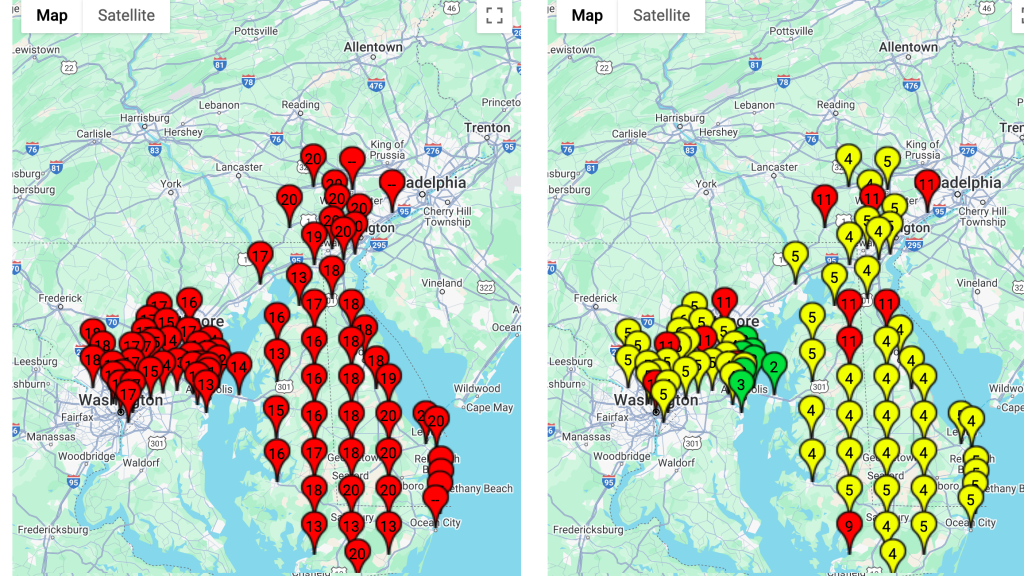
Don’t miss this fascinating study from Sterling Sky in which they are seeing client results like the above from devoting some resources to publishing press releases. Check out the impacts they are reporting on local and organic rankings as well as AI inclusion. Why not give press releases a second look this month?
Here’s a good video from Conrad Saam expressing delight in discovering that Google is now reporting on how much you are paying for direct business search visibility (being visible to people who are already searching for your business by brand name) vs. lower funnel searches. If you’re deep in the weeds of Local Services Ads, this remedies an historic problem with budget transparency and is very good news.
I’m honored that we’ve gotten so much good feedback on our new resource: Whitespark’s Ultimate Guide to Social Media for Local Businesses. What makes this guide different?
I think you’ll find this to be a very practical and straightforward guide you can share with clients and teams to earn more buy-in for social campaigns.
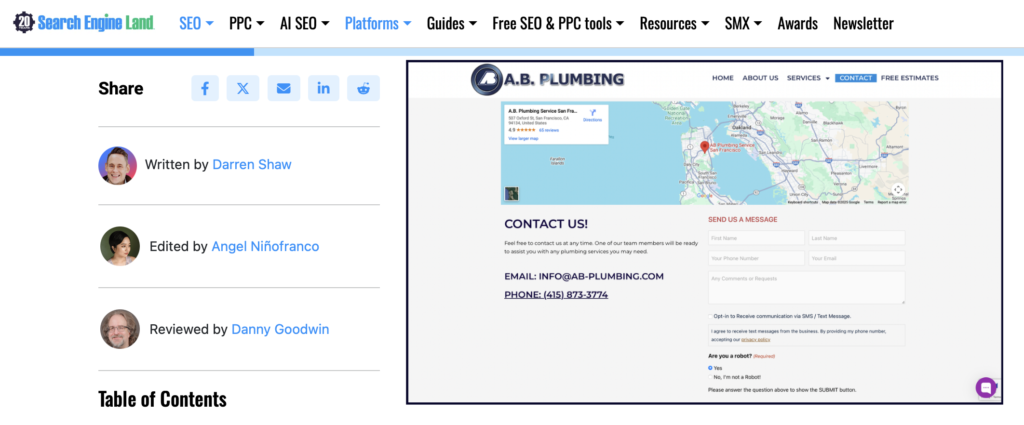
Google pays special attention to your local business’ contact page and Darren Shaw has an amazing tutorial over on Search Engine Land on building this page in a way that will please consumers + bots and scrapers. Establish business identity, trust, hyperlocality and more on this type of page that is too often underoptimized and overlooked.
If you’re having to pay Google for visibility, make sure you’re getting the most out of your investment with this all-star meet-up NearMedia put on. Eric Levine (Leadwise HQ, former Google LSA team), Claudia Tomina (Reputation Arm), Matt Casady (Sterling Sky), and Crystal Horton (Google Business Profile Platinum Product Expert) show up with current, practical advice about LSA ranking factors, pricing, fraud, and so much more!
Come back again at the end of Q2 for our next installment, but if you’re craving local news on a weekly basis, you can’t do better than start following the Whitespark Local Update Podcast where Darren Shaw and Claire Carlile make industry learning both deep and fun.
And thanks to all of the local SEOs and marketers who shared their insights this quarter – your work matters!
Miriam Ellis is a local SEO columnist and consultant. She has been cited as one of the top five most prolific women writers in the SEO industry. Miriam is also an award-winning fine artist and her work can be seen at MiriamEllis.com.

Whitespark provides powerful software and expert services to help businesses and agencies drive more leads through local search.
Founded in 2005 in Edmonton, Alberta, Canada, we initially offered web design and SEO services to local businesses. While we still work closely with many clients locally, we have successfully grown over the past 20 years to support over 100,000 enterprises, agencies, and small businesses globally with our cutting-edge software and services.