
🤓 The 2026 Local Search Ranking Factors are here!! Check out the report!


What do you really need reviewers to write about if you’re marketing a restaurant and need to earn the business of new diners? Does it feel like you’re chasing Google, chasing AI, chasing SEO advice, chasing social media fame, and twisting yourself into a kind of pretzel to meet online ideals that sometimes seem unattainable?
Then take a coffee break with me today and with award-winning restaurant reviewer, Marilyn Hagerty, whose book Grand Forks offers some really practical examples of what customers need to know in order to patronize an eatery. It can be calming to remember that reviews are actually just a path to what you really want: a chance to please the public in person.
What you’ll find in today’s blog post are some tips culled from Hagerty’s decades of writing restaurant reviews for The Grand Forks Herald in North Dakota. I hope you find them as refreshing and useful as I did.
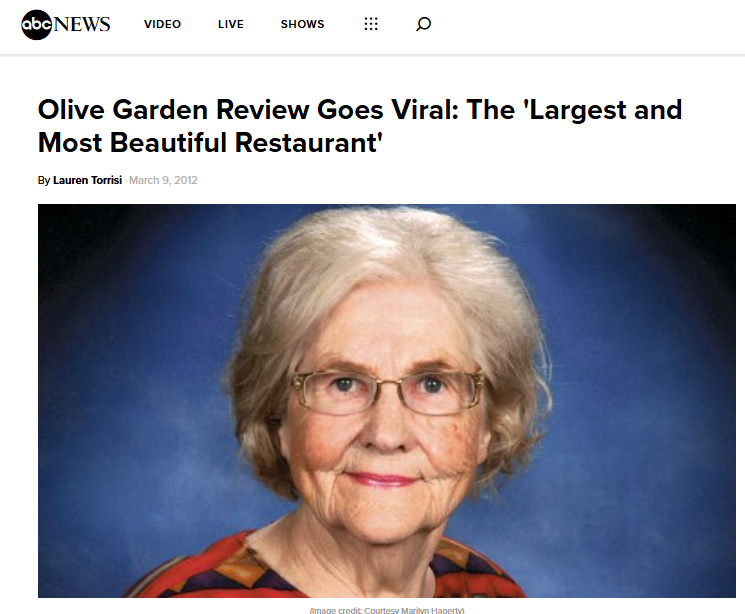
I have a bit of an odd story about how this book finally ended up in my hands. Seven years ago, I asked my favorite local bookstore to special order a copy for me after I saw it mentioned. I’m very fond of food history. But the book never arrived. I followed up a few times and they told me that new copies were almost non-existent due to the sad loss of the book’s publisher, late celebrity chef, Anthony Bourdain, who had championed Marilyn Hagerty after her review of an Olive Garden went viral. A portion of the public mocked her earnestness in reviewing a pedestrian chain eatery, but this was followed by a backlash from those who found Hagerty’s content wholesome and relatable.
When my neighborhood bookseller simply couldn’t acquire Grand Forks for me, I forgot about it, years went by, and then, just last month, they phoned me to say it had finally arrived (talk about good customer service from a local business!). I read the volume from cover to cover, fascinated by how it chronicles one woman’s experience of dining in and around a small American town across a quarter of a century.
What I came to respect about the author was her integrity and the modesty of her expectations. She explains that she didn’t see the appeal of restaurant reviews being treated like an elite sport in which entitled-sounding critics wrote harshly after dining at trendy establishments charging hundreds or thousands of dollars for dinner. Instead, she cared about communicating what she liked when eating out at middle-of-the-road restaurants, figuring this is what most people actually wanted to read in order to make their own dining decisions. If she had a very bad experience at a local spot, she didn’t review it, preferring to try it again another time rather than use her voice to destroy the livelihood of a neighbor who might simply have been having a bad day at work.
As someone who has run some of the largest consumer review surveys in the local SEO industry, I found myself intrigued by Marilyn Hagerty’s philosophy, which underpinned her very long career in journalism. And now I’d like to tell you what I learned from her book.
Creating user personae is popular in some marketing circles as a way of emulating average consumer likes and dislikes. What we get from Marilyn Hagerty is authentic criteria, rather than a simulation. Having now read all 128 of the reviews in her book, this is a list of what made her happy/unhappy when dining out:
Every patron of your restaurant is a Marilyn, with a unique set of likes and dislikes. Both owner and waitstaff at your business have the opportunity to speak directly to customers every day to find out, in person, what pleases/displeases them. While some members of the public will be reticent about giving their honest opinion face-to-face, those who will speak up are real treasures. Why not start simply asking questions like “Is there anything new you’d like to see us do here?”, “Is there something we can do better?”, or “What would you like to see the next time you come?”
Marilyn began reviewing restaurants in 1976, and something that really stood out to me in reading Grand Forks is how little things have changed since then in terms of what people want when they eat out in order to recommend an establishment to others. Here are 3 areas to focus on in your quest to earn more reviews that have the power to persuade new patrons to give your business a try:
It’s influential when a diner raves about the amazing time they had at your restaurant. In the most recent consumer review study I conducted with GatherUp, we found that 98% of the public reads local business reviews before engaging in local transactions and that the #1 motivation for review writers is to reward a great experience. I hope these statistics create a positive picture for you of a community that puts a lot of trust in review content and is eager to publicly praise your business if you take good care of them.
Every one of Marilyn’s reviews hit on these topics:
If these attributes sound familiar, lo and behold – they are some of the key elements featured on restaurant Google Business Profiles in modern times:
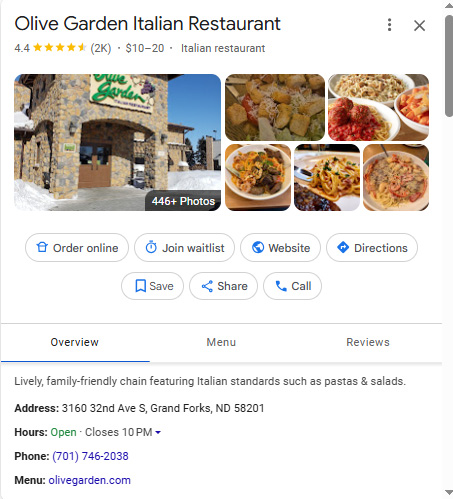
In fact, this is exactly the kind of content Google is now scraping in its effort to promote its new AI-driven “Ask a Question” feature on mobile Google Business Profiles. Check out this example of the GBP for the Olive Garden in Grand Forks:
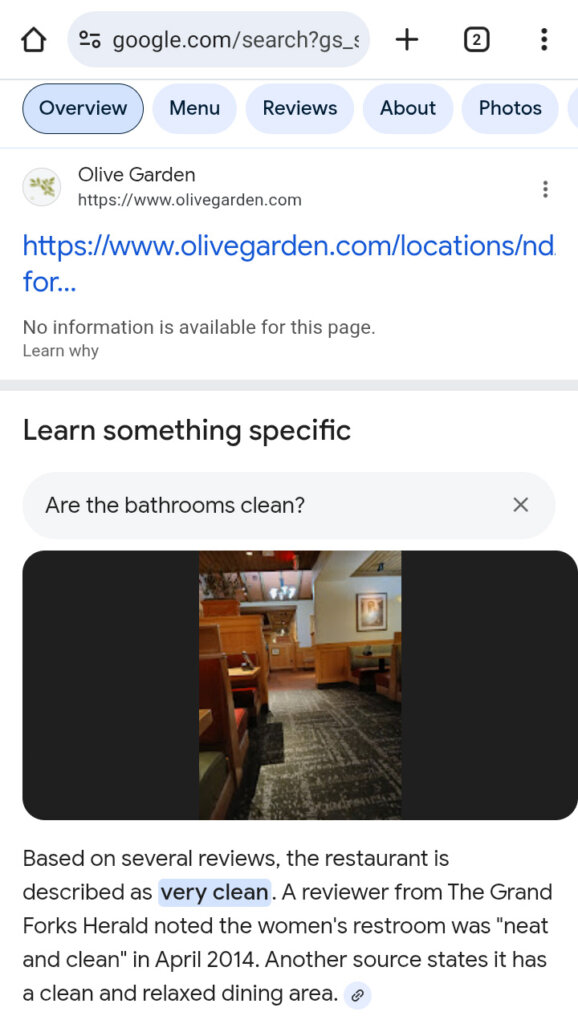
The AAQ is not exactly doing a great job here. The AI-generated answer is saying that the restaurant is described as “very clean” based on reviews, but its only source on clean restrooms dates all the way back to (surprise!) Marylin Hagerty’s review of the eatery in 2014. If I were marketing this branch of Olive Garden, I’d advise them to begin a campaign of asking diners to evaluate bathroom cleanliness in their reviews. This same customization of review request language can be applied to any attribute you’ve identified as mattering to your diners, whether that’s the deliciousness of a certain dish, the existence of a pet-friendly patio, or the level of noise facilitating diner conversation.
Apply what you learned about your patrons’ priorities from tip #1 to how you ask for reviews. It’s perfectly fine to request feedback on specific aspects of your business. This should yield a more detailed array of content for potential customers to read, Google to feature in various GBP attributes, and AI to scrape as fuel for its generated answers.
Another good tip for today’s online environment is to strongly encourage customers to photograph or film their experience on your premises and to include this influential media in their reviews.
Answers to restaurant AAQs may improve over time as a result of Google asking diners an increasing number of questions, as shown in this video short:
Because online assets like reviews are so very influential, safeguarding your reputation is a top priority. Marilyn never accepted free meals or discounts when she was reviewing restaurants because she felt it would hinder her ability to write honestly about her experiences. By that same token, avoid the following practices which are either forbidden by review platform guidelines, illegal in multiple countries, or both:
It can take years to build up a trusted reputation in a community and pair it with a persuasive online reputation, but you can lose it all so quickly if you engage in fishy or illegal practices. The risk is never worth it, even if you see competitors trying to get ahead with spam.
If these lists of do’s and don’ts seem overwhelming, Whitespark can help you organize reputation management tasks into a system that works for you, your budget, and your available time.
There are a few last things I learned from reading Marilyn Hagerty’s reviews that I want to share with restaurant owners, and that I’d love to see review platforms like Google Business Profile mulling over as they continue to develop their systems.
Marilyn was inundated with emails, social comments, and news coverage when her Olive Garden review went viral, some of which were filled with vicious language. The incident is almost like a metaphor for the slanted and extreme picture the internet presents of reality. In the real world, and in her home town, locals found Marilyn’s review column to be trustworthy and useful for decades.
When I see brands engaging in obvious review spam, I understand the economic pressures that are driving them, but what they are creating is a mirage of a good reputation instead of the ultimate goal of earned consumer trust. Something I learned from the author is that you don’t actually need to look flashy for everyday folk to come eat with you – you need to look honest and treat people well.
When a dining establishment managed to stay in business across several decades, Marilyn reviewed it more than once. In part, this was due to the small size of her community supporting only a limited number of restaurants, but what it made me think about is that some diners eat at the same places year after year. Technically, they could re-locate their 2016 review of the Olive Garden near them and re-write it for 2026, but wouldn’t it be interesting if Google offered a journal-like feature via which longtime patrons of a local business could periodically add new serial content to their documentation of their experiences with a single business?
Perhaps Google is reading my mind on this, because in the midst of writing this piece, my friend Claudia Tomina posted this screenshot to Linkedin of Google prompting its Local Guides and other reviewers to update their review content with more details:
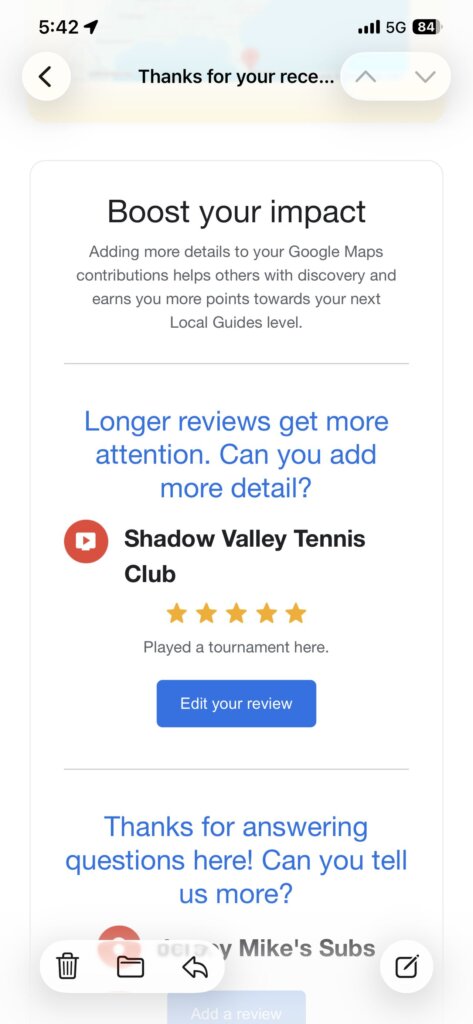
Claudia’s take on why Google is doing this is a good one:
“It’s not just for the benefit of other consumers. It’s about training data. Think about the direction of Search. AI Overviews and conversational results require rich, natural language to function. A five-star rating with zero context is a dead end for an LLM. Google needs specific details, descriptions of the atmosphere, the staff’s expertise, or the exact problem you solved to power the next generation of generative search results. They are effectively crowdsourcing their AI training via the Local Guides program.”
While Google’s prompts are a bit different than my suggested solution, they could still help your business if reviewers act on them. After all, every good marketer will tell you that trust is the ultimate prize you are trying to win, because it underpins great reviews, repeat business, and referrals. What could be more trustworthy than seeing that your neighbors have been “eating at Joe’s” for 20 years and have made the effort to keep reviewing it from time to time because the quality of experiences there is either going up or down. Perhaps, in addition to Google’s prompts, restaurants with longtime regulars could personally encourage them to update their existing reviews with new photos, videos, and sentiment.
3. Reviews really can reflect real life
At their worst, review platforms can become hives of spam, deserving trust from no one. This is a serious problem tech brands need to confront for the sake of their own longevity. But at their best, the reviews that exist in a local community can become a fascinating chronicle of town life. I found it very poignant that Marilyn Hagerty’s reviews suddenly began reflecting that a major disaster had hit her home town – the Red River flood of 1997 that caused $3.5 billion in damages to the area, including the destruction of multiple restaurants. The event was so devastating that, for several years after, Marilyn’s reviews continuously mention that a restaurant closed or relocated or was trying to get back on its feet following the flood.
Living, as I do, in Northern California, in a community that has repeatedly been scorched by runaway wildfire, these accounts of the Red River flood hit home with me, emphasizing the vulnerability of local businesses and the communities they serve. These are real-world realities, and this is the understanding I bring to the subjects of local search marketing and reputation management. I would encourage technology brands to understand that something precious is at stake when the visibility and health of local businesses is involved. They are the lifeline of both small villages and big cities, and their needs deserve lots of support and respect. I would strongly encourage review platforms to invest all they can in being accessible to the local businesses around whose data they built their interfaces, and to offer them an abundance of support.
Something that Whitespark can offer to essential local brands is free education. There is so much more to learn about the nuances of earning and responding to reviews, and analyzing them for signs of how your business is performing. If you’re ready to learn more, read Whitespark’s Ultimate Guide to Local Business Reputation Management. And you might like to pick up a copy of Grand Forks, too, if your own favorite local bookstore can track it down for you. It’s a resonant read for anyone involved in local business marketing.
Miriam Ellis is a local SEO columnist and consultant. She has been cited as one of the top five most prolific women writers in the SEO industry. Miriam is also an award-winning fine artist and her work can be seen at MiriamEllis.com.


Whitespark provides powerful software and expert services to help businesses and agencies drive more leads through local search.
Founded in 2005 in Edmonton, Alberta, Canada, we initially offered web design and SEO services to local businesses. While we still work closely with many clients locally, we have successfully grown over the past 20 years to support over 100,000 enterprises, agencies, and small businesses globally with our cutting-edge software and services.