
🤓 The 2026 Local Search Ranking Factors are here!! Check out the report!

Thank you to everybody who has joined us each quarter for these roundups this year, and especially for liking and sharing them. In Q4, it definitely feels like we’re on the edge of an AI feature blizzard and it’s also been a hailstorm of local business review news. Please put on your cozy sweater, grab a cup of hot chocolate, and come sledding with us through the new local search conditions you’ll be seeing as we head into the new year!
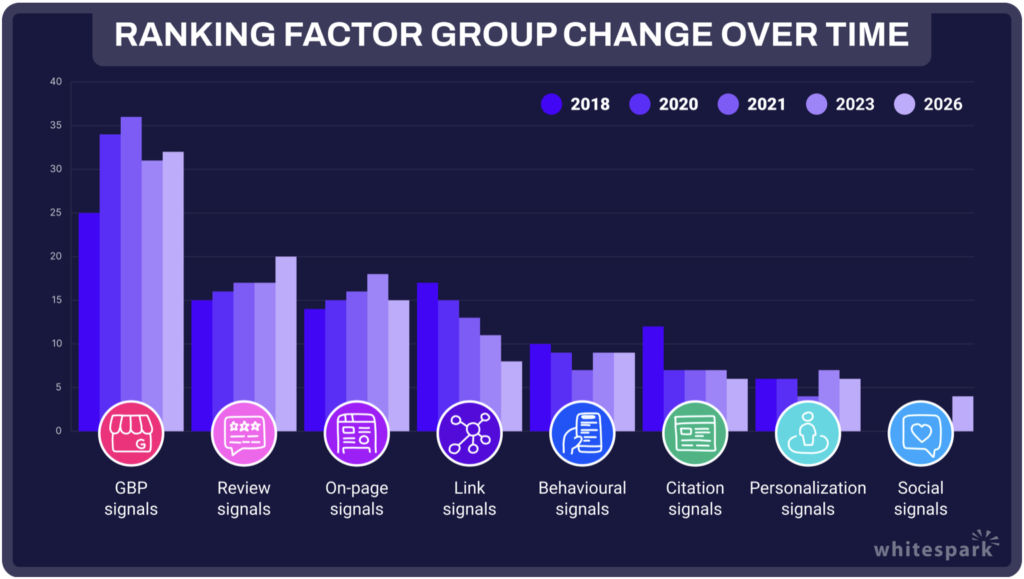
There’s no other local SEO expert survey quite like it in our industry, and this year’s Local Search Ranking Factors report is absolutely loaded with novel takeaways you’ll want to work into your 2026 marketing strategy. As just one example, look at the above graphic showing how the perceived importance of different ranking signal groups has changed over time. GBP signals keep going strong, and review signals are a clear YOY winner, but look at link signals walking down some steep stairs into a dark basement!
Don’t miss all the expert commentary in the report, and you might also like to read my own take on 7 Local Search Ranking Factors That May Challenge Your Current Thinking.
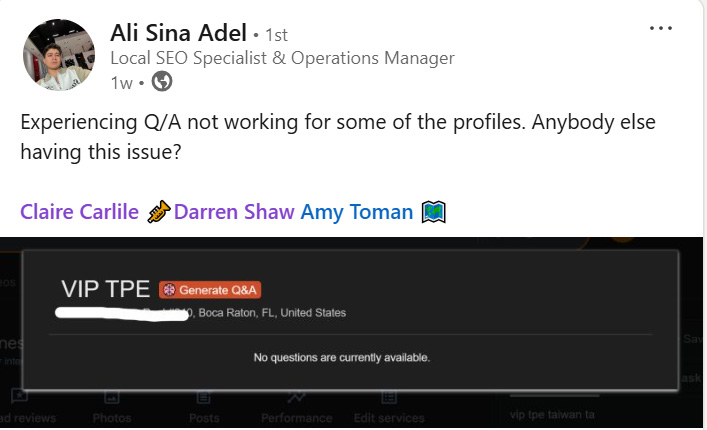
You may be seeing a lot of posts like this one from Ali Sina Adel asking why Q&A is no longer functional on some Google Business Profiles. Google Diamond Product Expert Amy Toman explains:
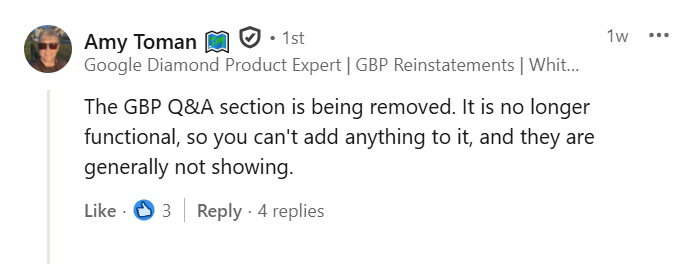
It’s rather a shame that this feature, launched in 2017, never experienced robust adoption. Instead, it frequently contained either unanswered consumer questions (making businesses look negligent) or useless answers (like “I don’t know the answer”) from random members of the public. I strongly suspect that Google thinks it can do a better job with AI-based features, and we’ll see how that goes.
💡 Takeaway: Never become too dependent on any single Google Business Profile (GBP) feature, because they come and go all the time.
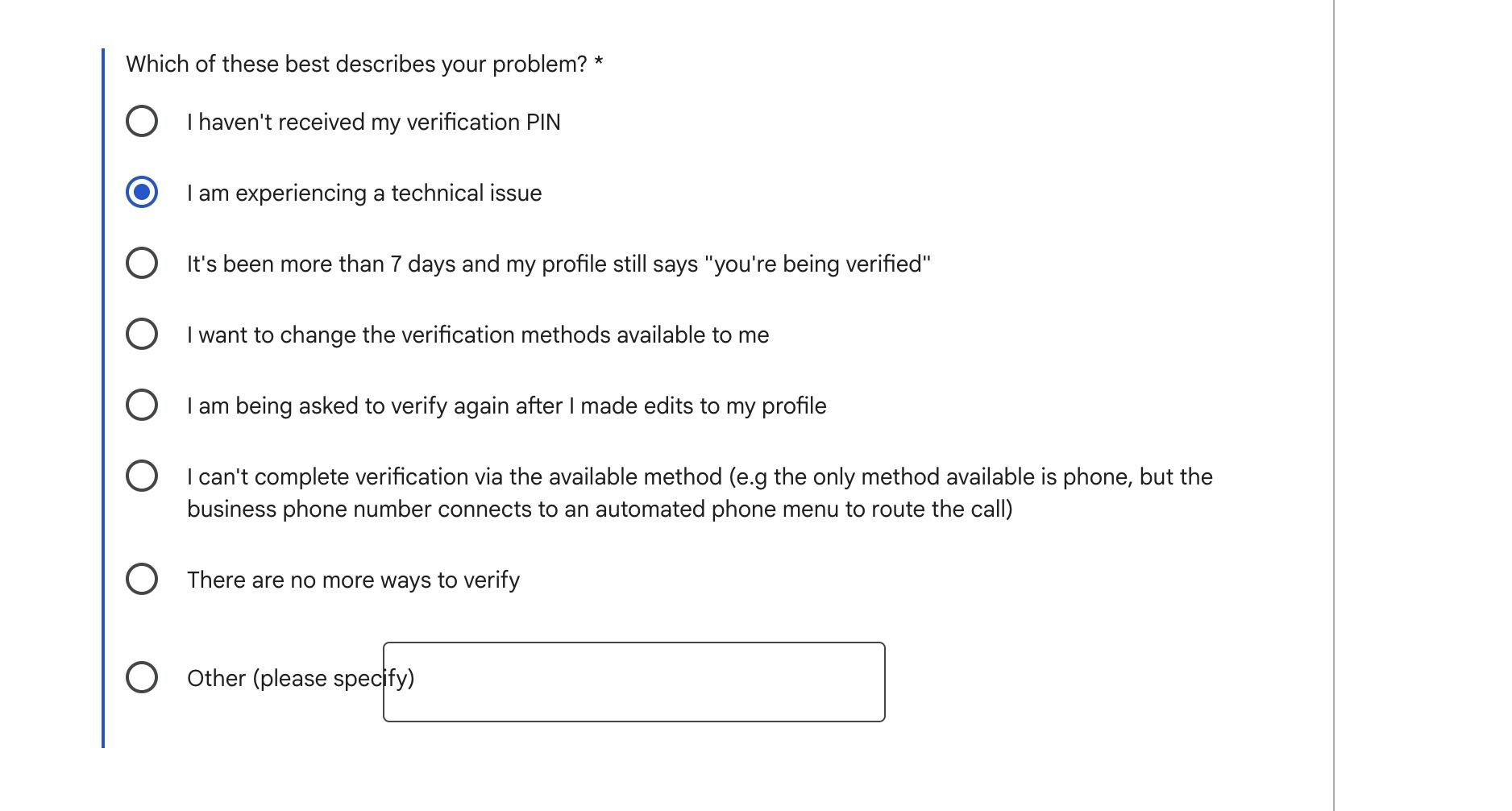
“The form finally reflects the actual problems businesses run into instead of forcing everyone into the same generic bucket. For anyone managing Google Business Profiles at scale, this is a welcome and long overdue upgrade. With these new, specific issue types, Google can finally see what’s causing verification failures across the board. Better data and (hopefully) fewer broken verification loops in the long run.”
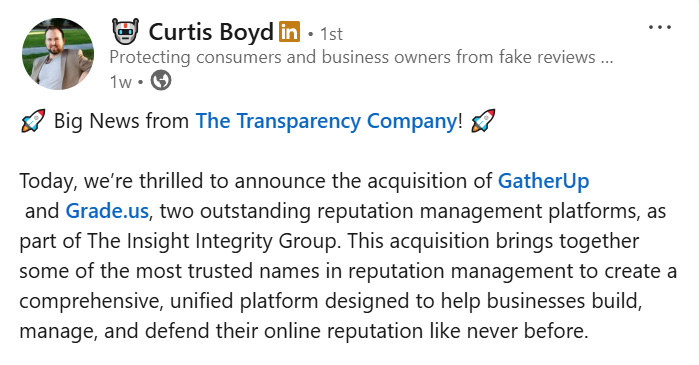
Curtis Boyd celebrates The Transparency Company’s acquisition of two of the best-known reputation management brands, and it’s likely to come as good news to GatherUp and Grade.Us customers.
Earlier this year, I interviewed Curtis and Greg Sterling for the Whitespark blog regarding their landmark research into review fraud and how AI is likely to make it exponentially worse. Local businesses are going to need a stronger defensive strategy than ever in 2026 for review spam awareness and reporting, and this acquisition puts some of the best tools for full reputation management under one roof.
Head to minute 3:15 in the above edition of the Whitespark Local Update to get the scoop on the new Report business conduct form Google has released to enable consumers to report being incentivized or pressured to leave reviews. Hat tip to Claudia Tomina for first reporting on this new form, and Darren Shaw and Claire Carlile explain how this raises questions about whether or not it’s still okay to ask for reviews at the time of service.
This has long been a standard review acquisition best practice, but Claire asks if removal of reviews acquired in this way could relate to IP addresses rather than businesses pressuring customers. Watch the video and stay tuned in on this developing issue.
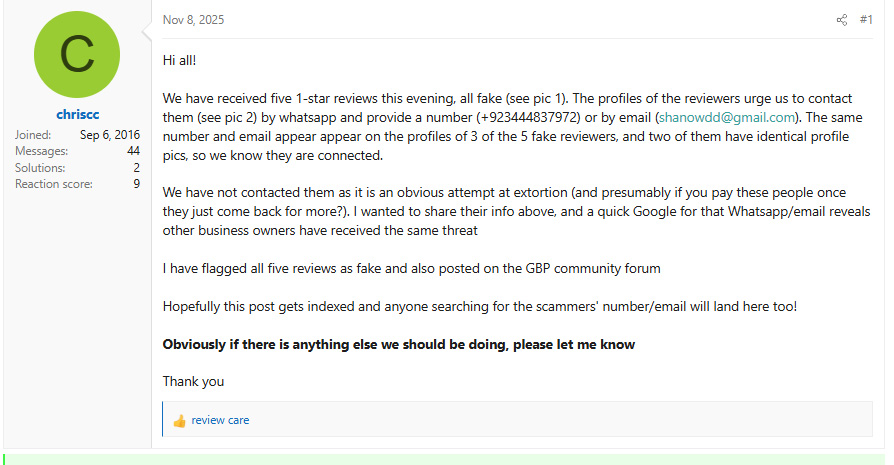
Review extortion is the darkest corner of reputation management. The above Local Search Forum thread is just one of countless examples of business owners and marketers asking what to do when a company is spammed with negative reviews followed up by a demand for money to remove them. Google now has standalone guidelines for how to proceed in a case of review extortion.
Definitely bookmark that link and read through the guidelines. I sincerely hope you never need them, but if you do, the OP on the forum thread has pointed out a flaw in Google’s policy that you should not engage with extortionists. The poster, “Chriscc”, remarks:
“The ‘extortion reporting tool’ requires you to submit evidence of extortion (emails, DMs). This is tricky because it means you need to engage with the attacker, to the point where he clearly asks for money in exchange for removal of the reviews. That will be your “smoking gun” to submit to Google, but also means that the attacker has your details, and to him you appeared willing to pay. The only easy part is that he will be in a hurry to get paid because he knows that the regular spam reports might only take 48hrs, so can’t be too coy about trying to extort you. Bit of a messed up system but here we are!”
Murky waters, and I’d suggest consulting with an attorney well-versed in the internet if you are targeted by an extortionist.
If reading about all these seedy review behaviors makes you feel like you want a shower, I hope you’ve got a bar of extra-strength soap, because Google has just made the rather astounding decision to enable anonymous reviews on GBPs. Darren Shaw and Claire Carlile explain the problems this could cause:
The main concerns surround two long-standing review spam detection tactics, namely:
Darren and Claire do identify a silver lining to this change in that businesses in sensitive verticals (like legal) might see an increase in reviews if patrons can be anonymous, but given the state of review fraud in Google’s products, I’m pretty much shaking my head at this development. As a consumer, I am not going to trust review content more if it stems from “Fluffy Bunny”.
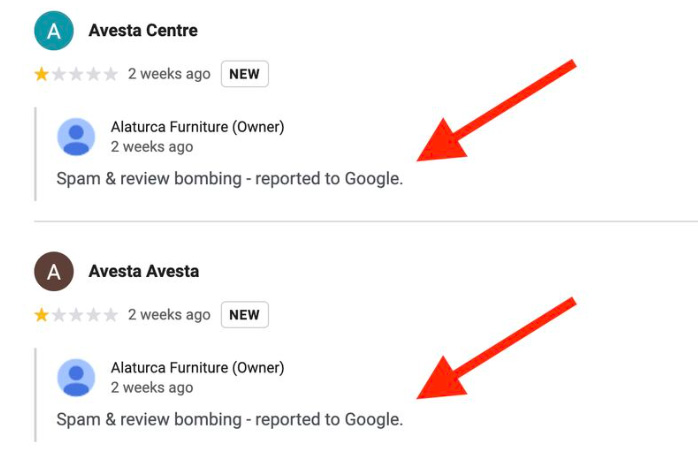
Elizabeth Rule captured the first screenshot I’ve seen of reviews being tagged with this “Spam & review bombing – reported to Google” label following a business owner reporting the reviews as spam. It’s interesting that this feature is being implemented as a sign that Google is investigating, but curious that they are willing to place this public warning on review content instead of simply removing it.
UPDATE: It has been determined that this was just a business owner responding to his reviews with that copy, and so many people missed it 🤦🏻♂️. Whoops! We are sorry for the fake news
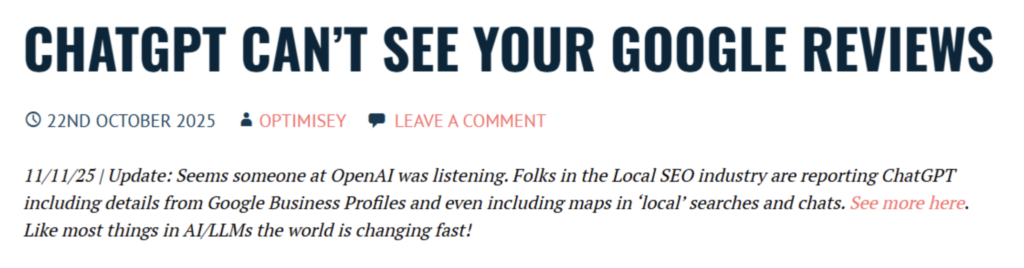
On October 22nd, I made a note about this article from Optimisey documenting ChatGPT’s inability to scrape Google Business Profile review content. However, as you can see from the above screenshot, only a couple of weeks went by before this changed. Matt McGee weighed in with this post, demonstrating that ChatGPT is apparently picking up Google star ratings.
I wanted to surface this example, not necessarily for your tactical purposes, but to illustrate just how shifty a place we’ve entered with conversational AI. Its behaviors change from day to day, and that’s a problem for local search marketers who have built careers on identifying sticky best practices that work for at least a year or two before a major change occurs. Where we’re at right now is different. It truly is challenging to establish a reliable strategy in such an experimental environment. Be sure you’re educating clients about this to decrease churn.
Fortunately, many practical review acquisition tactics are still working, and I really appreciate the good sense behind this one from Darren Shaw:
In brief, this is an especially good tip for service area businesses to follow up after appointments to be sure customers are satisfied. If you encounter a complaint, you have a golden opportunity to make things right for the customer while you are talking to them in person. If they’re happy with the service, why not ask for a review? Just be sure you don’t automate this process, or you’ll be wandering into the territory of review gating, which is illegal in multiple countries.
In his piece, Google Reminds Websites to Use One Review Target, Matt G. Southern notes:
“In the updated review snippet docs, Google advises against using multiple different “things” as the target of the same review or aggregate rating. In practice, that means Google wants one clear relationship between a review or rating and the thing it describes.”
If you’re using Review schema on your website, I recommend looking at the examples of problems and best practices in Matt’s piece.
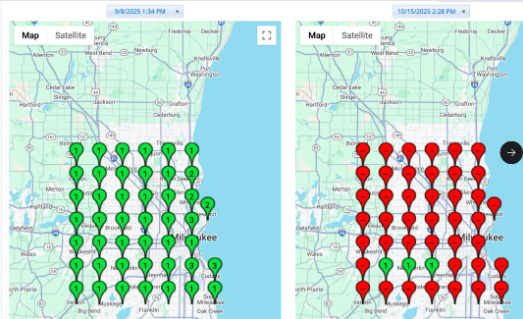
Red and green may be a festive holiday color palette, but few local SEOs would celebrate seeing a client’s rankings shift like this as a result of traditional mobile Maps results being replaced by AI-powered results, as documented by Joy Hawkins.
A good study from Juris Digital finds that:
If your agency specializes in a particular niche, now is the time to do your own research and publish your findings for your vertical.
You already suspect it, but Search/Atlas did a great heat map study of how open/closed hours cause ranking shifts. If this is a phenomenon you’re needing to explain to clients who phone you after hours in a panic about ranking drops, the screenshots from this study will help you illustrate what is happening and calm nerves.
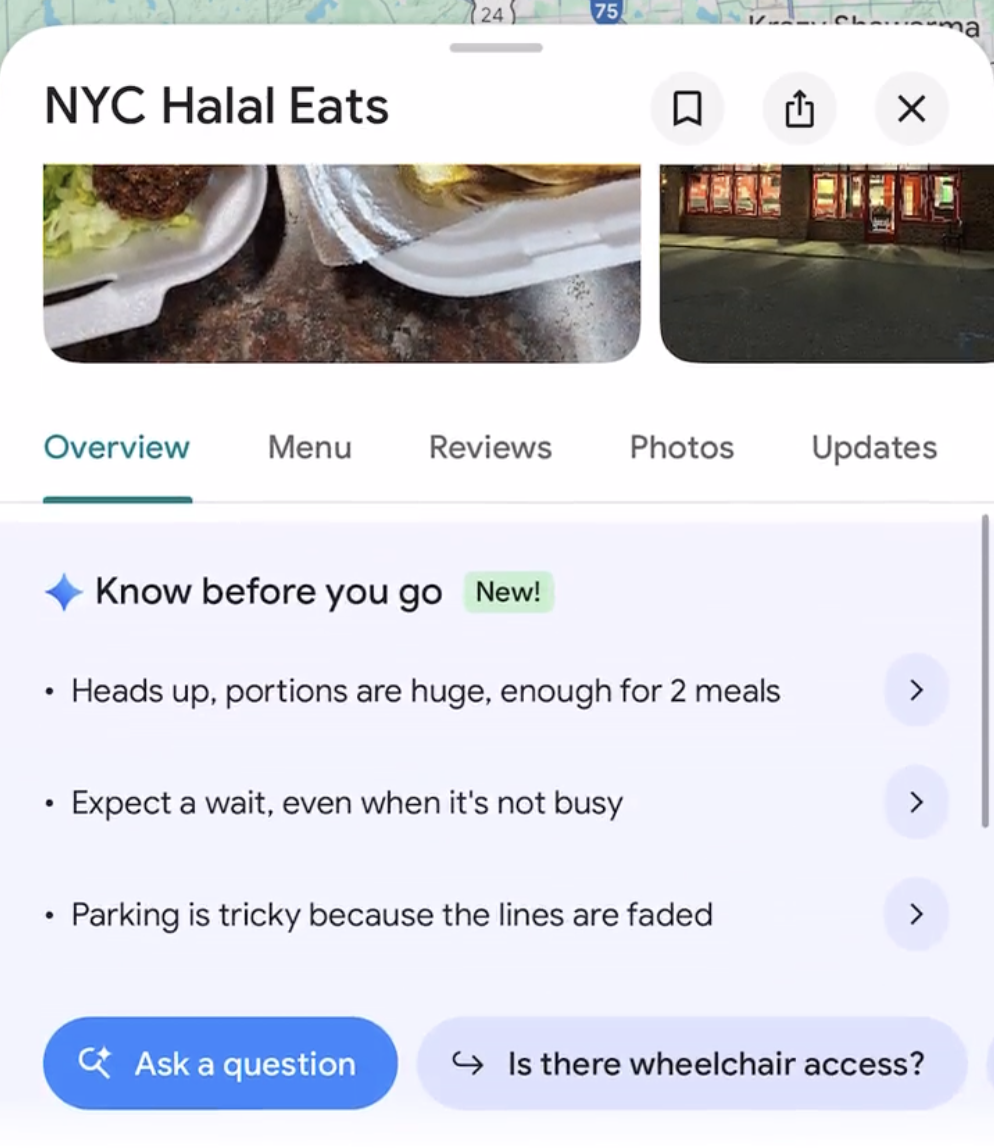
While this AI-powered feature isn’t new, Claudia Tomina noticed that it’s gotten a UI refresh and is frequently prominently displayed near the top of mobile Maps-based listings. Google appears to be pulling many of these details directly from reviews. Take this as your quarterly reminder from me that reviews are the main entree on your plate – not a side dish!
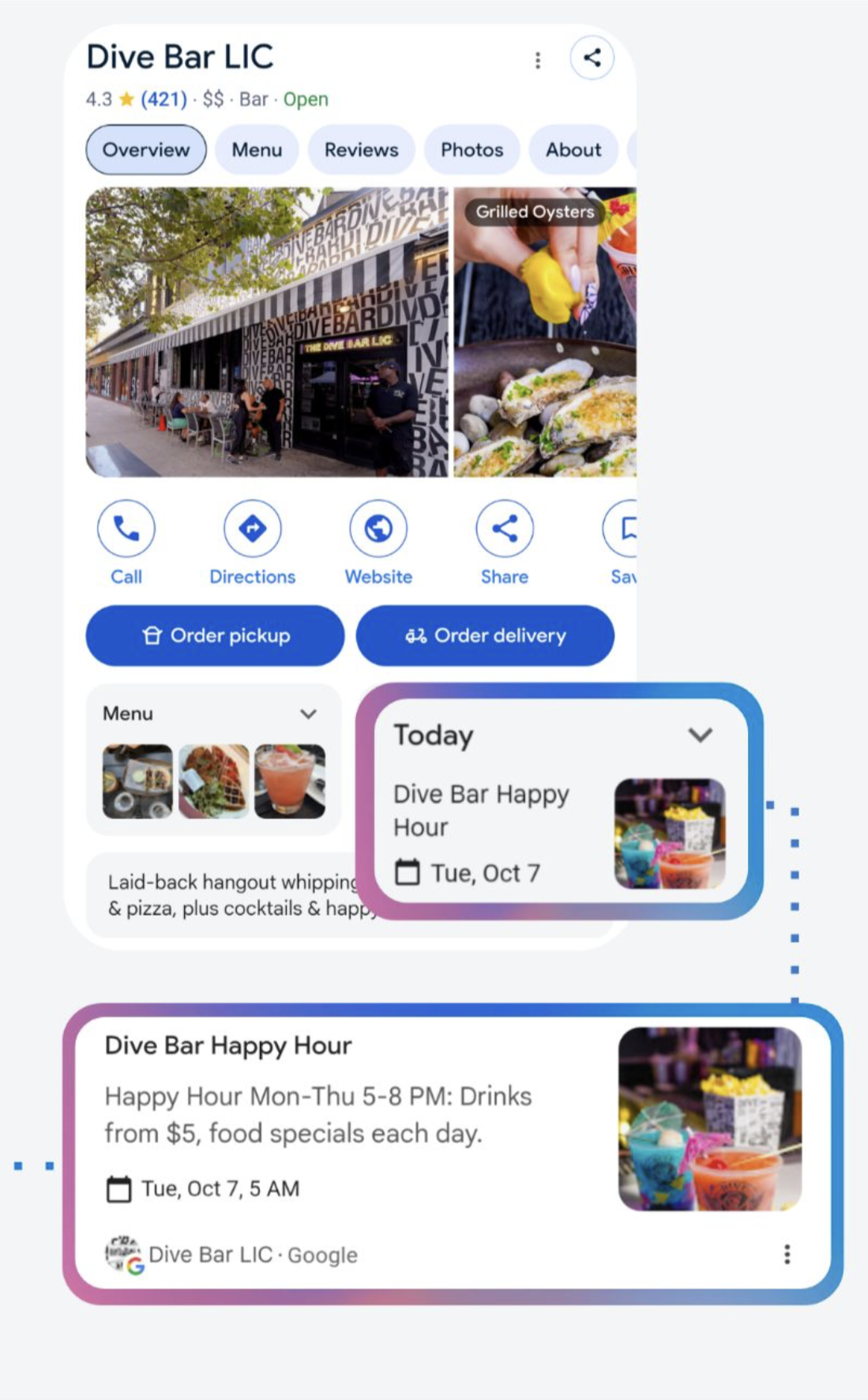
Claudia Tomina brings us another development, this time in regards to Google Posts:
“Until recently, the Posts section in Google Business Profiles mainly surfaced events. But now, Google started featuring offers and not just for single-location restaurants. Multi-location chains can get their promos highlighted directly under the business name in mobile search results.”
With Q&A going away, no one can feel too confident about how long Google Posts will be with us. For now, anyway, it seems like a good sign that Google is investing in evolving this feature.
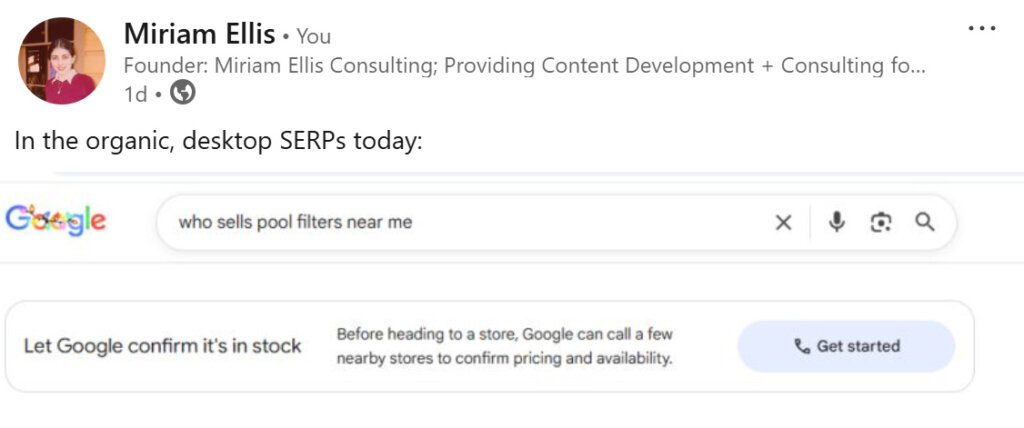
AI features will not be confined to mobile Maps. The above screenshot is from desktop, offering to have robots call businesses for me to confirm whether a product is in stock. I’ve been hearing rumors of things like this for a bit, but it’s the first time I’ve actually seen a feature like this live.
Meanwhile, Claudia Tomina spotted this automated booking feature within Google AI Mode in response to her prompt to book a restaurant for her:
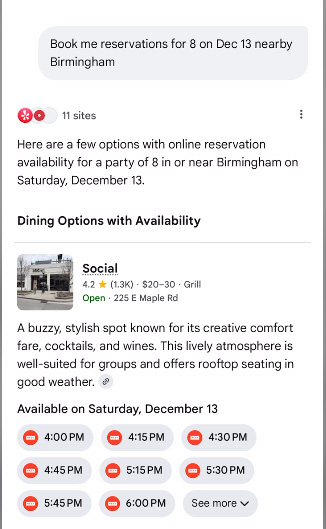
Never heard of an AI agent before? NearMedia did a good interview with Jes Scholz on how to prepare your business and website, ushering in a mindset of having to think about Google+agents+humans in all your digital publishing.
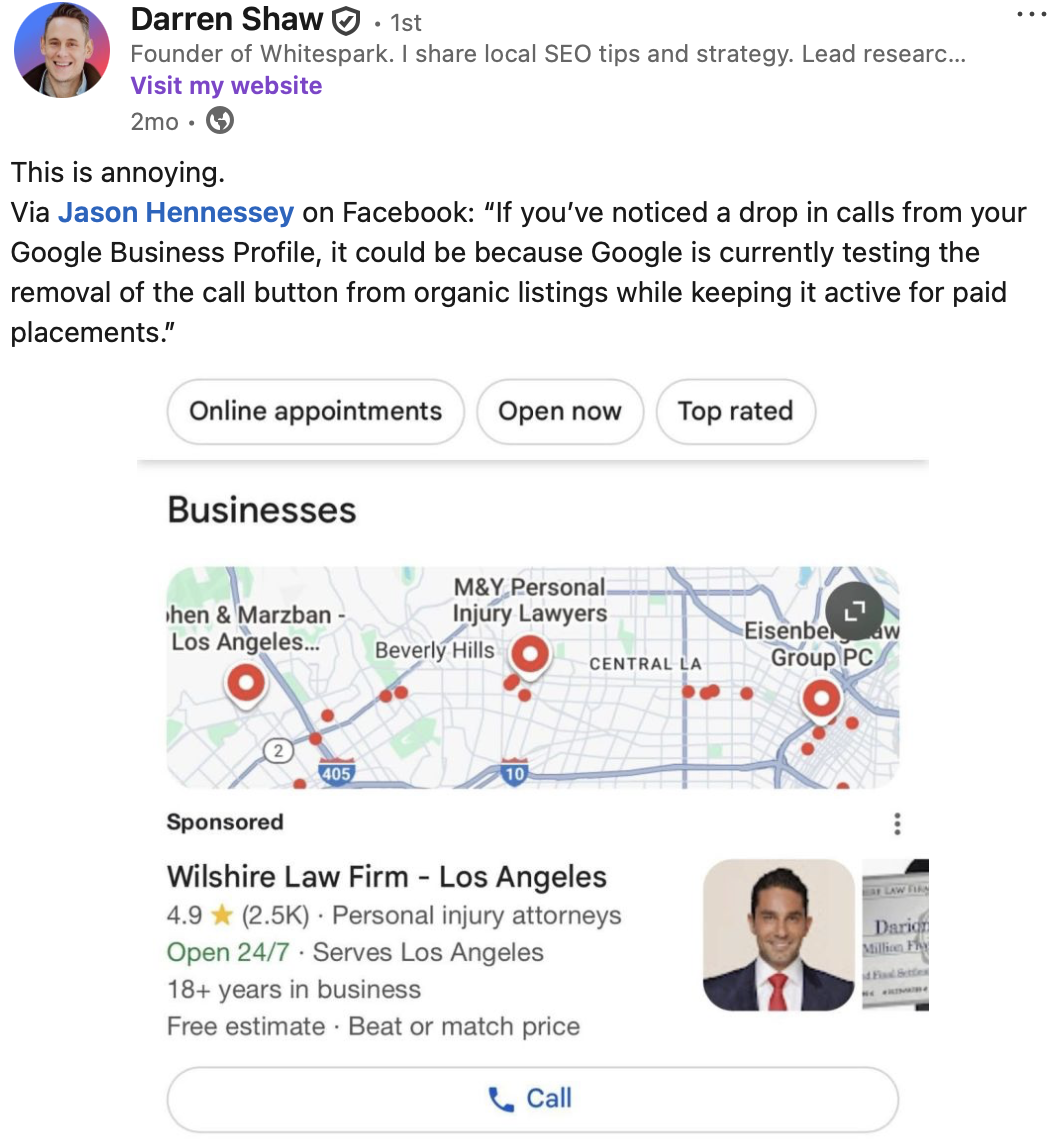
If you’ve been doing local SEO long enough to remember when most local business listings featured a phone number or at least a call button, you are not imaging things if you’ve noticed that these useful elements seem to be decreasing. Darren Shaw has an example from Jason Hennessey of Google only showing call buttons on sponsored placements while they are totally absent from the local pack. The local businesses you’re marketing may be experiencing a drop in calls as a result.
Taken in tandem with AI agents, as discussed above, it’s clear that tech titans dream of a robotic future in which human endeavor and interaction is kept to a bare minimum. Is everyone excited about an AI future? Ask McDonald’s, who just had to pull down their AI-generated Christmas ad due to public disgust over its “creepy” depiction of humans suffering harms at the holidays.
Something to think about: regardless of how technology evolves in 2026, local SEOs possess a kernel of wisdom about how local businesses succeed. We know from decades of assisting clients that excellent customer service is a competitive-difference-maker. Automations and agents may have a use case for many scenarios, but your clients who are doubling down on providing exceptional human service while competitors wander off on AI misadventures are taking the high road in a season of change. I’m looking forward to seeing who wins.
Wishing you all success in the new year!
Miriam Ellis is a local SEO columnist and consultant. She has been cited as one of the top five most prolific women writers in the SEO industry. Miriam is also an award-winning fine artist and her work can be seen at MiriamEllis.com.


Whitespark provides powerful software and expert services to help businesses and agencies drive more leads through local search.
Founded in 2005 in Edmonton, Alberta, Canada, we initially offered web design and SEO services to local businesses. While we still work closely with many clients locally, we have successfully grown over the past 20 years to support over 100,000 enterprises, agencies, and small businesses globally with our cutting-edge software and services.