CONTENTS

🤓 The 2026 Local Search Ranking Factors are here!! Check out the report!

How you name your company or organization is one of the most important business decisions you will ever make. The presence of either exact or partial-match keywords in your Google Business Profile business title field has a demonstrable correlation with local pack rankings.
Whitespark has run the numbers on this to get a clear picture of the present impact of keywords in business names on visibility in Google’s local results.
Our data will help you understand 2 important factors:
This information can help you determine whether it’s okay to go with non-keyword-oriented branding in naming your business, or if you need to either rethink a new name or rebrand your business to increase your ability to compete for visibility.
We’ll also consider related topics, like local search industry knowledge on keywords in business titles and whether it makes sense to keep thinking in terms of keywords in the AI era.
Whitespark analyzed 1.4+ million local business listings across 17 major industries to determine whether exact- and partial-match keywords in business titles correlate with visibility in Google’s top 3 local pack results, compared with listings without any keywords in their titles.
The term “business title” simply means the name of the business as it appears in the business title field of the Google Business Profile. Here is how we are defining our keyword-related terms in this study:
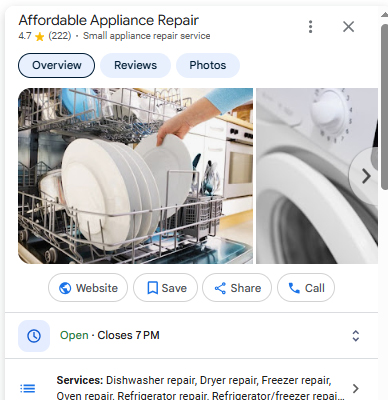
Think of an appliance repair brand in the home services industry. This business, Affordable Appliance Repair, features the full keyword phrase “appliance repair” in its Google Business Profile title:
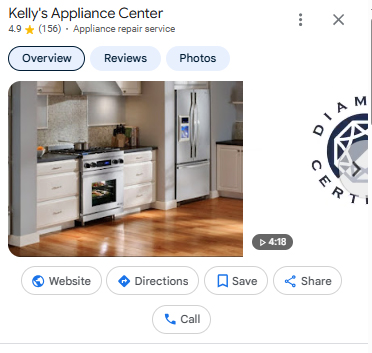
This business, Kelly’s Appliance Center, features the keyword “appliance” in its title, but not the full phrase, “appliance repair”:
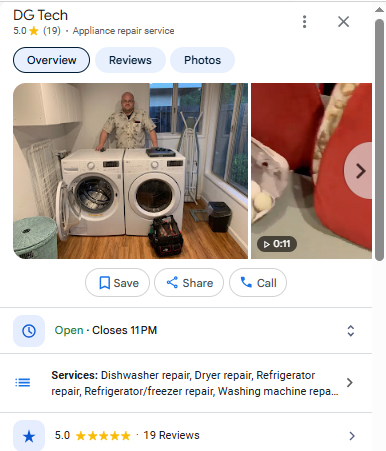
This business, DG tech, is in the appliance repair category, but its business title contains zero keywords:
The following table displays the business industry and the % of times businesses earned top 3 local pack visibility when their titles contained exact-match keywords, partial-match keywords, or no keywords at all. What you are looking at here is whether having keywords in your business titles correlates with higher visibility, and whether there is any evident advantage to having exact vs. partial-match keywords in your title.
| Industry | Exact-match keywords | Partial-match keywords | Zero-match keywords |
|---|---|---|---|
| Automotive | 3.30% | 3.95% | 1.95% |
| Beauty and personal care | 15.59% | 3.69% | 2.50% |
| Education | 5.85% | 5.25% | 2.92% |
| Entertainment and leisure | 15.07% | 8.77% | 5.39% |
| Financial services | 6.17% | 3.27% | 2.79% |
| Food and drink | 6.09% | 5.46% | 2.97% |
| Home services | 4.57% | 4.71% | 2.21% |
| Legal | 7.53% | 7.37% | 2.51% |
| Medical and health | 9.63% | 4.96% | 2.86% |
| Personal services | 6.76% | 6% | 3.33% |
| Pets and animal care | 10.08% | 4.71% | 2.85% |
| Professional services | 6.73% | 5.26% | 2.82% |
| Real estate | 3.92% | 3.71% | 2.31% |
| Retail | 15.11% | 6.59% | 3.05% |
| Sports and fitness | 9.62% | 6.39% | 1.95% |
| Transportation & logistics | 8.48% | 4.73% | 2.53% |
| Travel & tourism | 29.54% | 8.68% | 6.05% |
As you saw in the above table, results vary widely by industry. The percentages may look statistically insignificant in some of the industries, but bear in mind that Whitespark was looking at well over a million local business listings. Here’s what we learned about the correlation between keywords and rankings in each industry:
Automotive
Having any keywords in the name roughly doubles the top-3 rate versus having none (3.30% and 3.95% vs 1.95%). Also, unusually, partial beats exact-match keywords in this industry.
Beauty and personal care
The exact-match phrase wins decisively with over 6x the no-keyword rate (15.59% vs 2.50%), while a partial match barely helps.
Education
Having any keywords in the name roughly doubles the top-3 rate versus none (5.85% and 5.25% vs 2.92%), with little difference between exact and partial-match.
Entertainment and leisure
There’s a clean gradient in this industry. The exact-match nearly triples the no-keyword rate (15.07% vs 5.39%), with partial-match landing in between.
Financial services
The full phrase roughly doubles the no-keyword rate (6.17% vs 2.79%), while just part of the keyword offers only a slight edge.
Food and drink
Having any keywords in the name roughly doubles the top-3 rate versus none (6.09% and 5.46% vs 2.97%).
Home services
Having any keywords in the name roughly doubles the top-3 rate versus none (4.57% and 4.71% vs 2.21%), with exact and partial-match performing about the same.
Legal
Having any keywords in the name roughly triples the top-3 rate versus none (7.53% and 7.37% vs 2.51%), with exact and partial nearly tied.
Medical and health
There’s a clear gradient in this industry: the exact-match more than triples the no-keyword rate (9.63% vs 2.86%), with partial-match roughly doubling it.
Personal services
Having any keywords in the name roughly doubles the top-3 rate versus none (6.76% and 6.00% vs 3.33%).
Pets and animal care
The full keyphrase more than triples the no-keyword rate (10.08% vs 2.85%), while partial-match roughly doubles it.
Professional services
Having any keywords in the name doubles-to-triples the top-3 rate versus none (6.73% and 5.26% vs 2.82%).
Real estate
Having any keywords in the name gives only a modest lift over none (3.92% and 3.71% vs 2.31%). This is one of the weakest name effects in the dataset.
Retail
There’s a strong gradient here: the exact-match gives roughly a 5x lift over no keyword (15.11% vs 3.05%), with partial-match roughly doubling it.
Sports and fitness
Having any keywords in the name multiplies the top-3 rate several times over versus none (9.62% and 6.39% vs 1.95%).
Transportation & logistics
A clean gradient once again: the exact-match more than triples the no-keyword rate (8.48% vs 2.53%), with partial roughly doubling it.
Travel & tourism
Here the full phrase delivers the largest lift in the entire dataset: nearly 5x the no-keyword rate (29.54% vs 6.05%).
Overall, our data shows that keywords in the business name definitely correlate with better rankings, except in the Real estate industry.
In addition to studying the ranking advantage correlating with keyword usage in Google Business Profile business titles, we think there’s value in showing you the actual numbers of businesses that fell into each of the category usage columns in our study. What the following numbers tell you is how prevalent keywords are in the business titles in your industry, and that should be a factor in how you brand your business.
The following table displays the industry and the number of listings we encountered in each industry using either exact-match or partial-match keywords in their business titles, or had no keywords in their business titles at all.
| Industry | Exact-match keywords | Partial-match keywords | Zero-match keywords |
|---|---|---|---|
| Automotive | 1,816 | 54,994 | 74,566 |
| Beauty and personal care | 417 | 26,604 | 60,964 |
| Education | 837 | 12,826 | 44,401 |
| Entertainment and leisure | 438 | 8,357 | 32,554 |
| Financial services | 1,378 | 37,148 | 46,966 |
| Food and drink | 394 | 6,606 | 66,063 |
| Home services | 20,977 | 132,392 | 263,056 |
| Legal | 5,164 | 8,192 | 63,485 |
| Medical and health | 1,215 | 33,585 | 196,680 |
| Personal services | 1,006 | 3,902 | 7,948 |
| Pets and animal care | 248 | 15,324 | 39,442 |
| Professional services | 6,007 | 33,058 | 138,381 |
| Real estate | 612 | 18,428 | 26,344 |
| Retail | 331 | 52,102 | 182,472 |
| Sports and fitness | 52 | 16,297 | 39,498 |
| Transportation & logistics | 4,844 | 10,406 | 17,867 |
| Travel & tourism | 237 | 5,035 | 19,541 |
What we’re establishing here is industry norms regarding how optimized business titles commonly are in each vertical. Whether you are opening a new business or considering re-branding your existing company, the above data reveals whether most, some, or few of your competitors are optimizing their branding with keywords.
What emerges from the data is that listings with unoptimized titles vastly outnumber those with exact or partial-match keywords in their names across all categories. Partial-match titles also outnumber exact-match titles. In a nutshell, exact-match business titles are the least common variant, at least in our data set.
This suggests to me that:
1. In least-optimized categories, your business has a better chance of visibility by optimizing your title with keywords.
2. In more-optimized categories, it may be worth re-branding unoptimized business titles to level the playing field for your business amid the local competition.
But, my biggest takeaway from this second data set is that most business titles simply aren’t optimized. Taken in conjunction with the first data set, it looks to me like many brands are missing out on a ranking opportunity.
Yes. Our study found that business titles that start with keywords correlate with more top-3 rankings in 15/16 industries for which we had sufficient data to analyze.
In other words, it appears to be better to brand your business “Plumbing by Andy” vs. “Andy’s Plumbing”. I thought this was worth noting because our analysis also surfaced the fact that more businesses in our data set choose the latter pattern. It feels more natural to call your company “Mary’s Diner” or “Jim’s Car Wash” than to dub your company “Diner by Mary” or “Car Wash by Jim”.
This finding brings up some practical questions:
The answers to these three questions require case-by-case consideration, factoring in elements like industry norms (are lots of brands in your industry named creatively instead of technically?) and what your budget is to transform an unfamiliar brand name into a household word.
There are three main scenarios in which your study of the data Whitespark has gathered should be useful to you:
For example, if you’ve always had a dream of running a bookstore called “Sand Castles” because you are fond of sand castles and your shop is in a coastal town, the data we’ve gathered will help you determine whether it’s okay to go with just “Sand Castles” as your business name, or if there is a correlation with improved visibility if you name your business “Sand Castles Bookstore” or “Sand Castles Books.”
By looking at the ranking advantages + industry norms, you can better understand whether re-branding your business with either an exact or partial-match business title correlates with increased visibility in your industry.
It’s very common for service-based businesses to struggle with this, because a single appliance repair company may repair water heaters, dishwashers, dryers, refrigerators and other machines. Brands sometimes do themselves a disservice by making their titles too specific, making it hard for them to expand at a later date. For example, Jim may have started out just repairing hot water heaters and so called his business Jim’s Hot Water Heater Repairs. Now he’s expanded into other appliances and he wonders if he needs to re-brand as “Jim’s Appliance Repairs” to be visible to more customers for more searches. The above data shows the industry norms and can help you decide whether the trouble of a re-brand to better represent your business could be worth it.
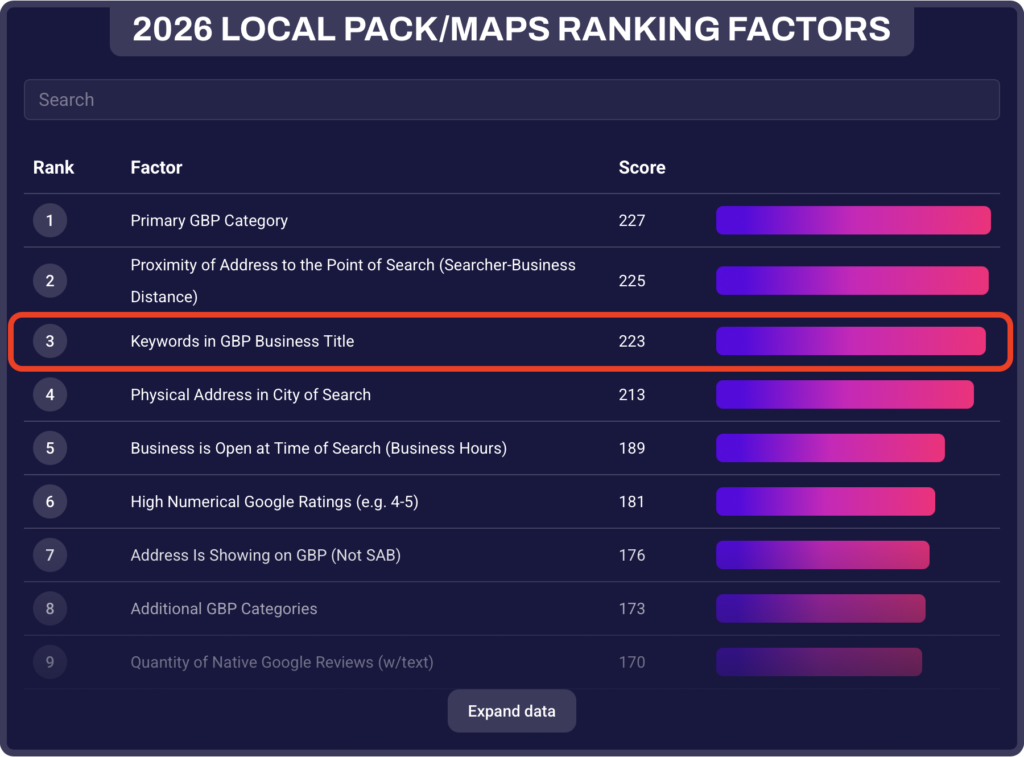
The annual Whitespark Local Search Ranking Factors Report surveys the world’s most respected local SEOs, and the most recent edition finds that keywords in GBP business titles are the third-most-influential local pack ranking factor. This factor comes just after choosing the correct primary Google Business Profile category, and the proximity of searchers to business locations. In other words, it’s a huge factor.
But it’s also a nuanced one. I’ve been a participant in this survey since its inception, and can personally state that my perception of the influence of keywords in business titles is, in part, colored by two things:
This dual phenomenon is something your business definitely needs to understand, so read on.
For well over a decade, local businesses and their marketers have noticed that Google has a positive bias surrounding matching search language with business titles. If a searcher looks up “Los Angeles car accident lawyer”, Google wants to show local pack/Maps results that match this intent as closely as possible. This is why you will see GBP titles that look like this:
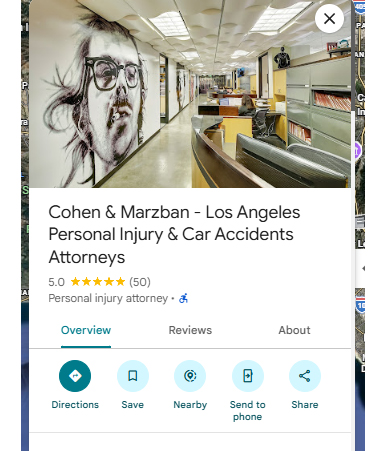
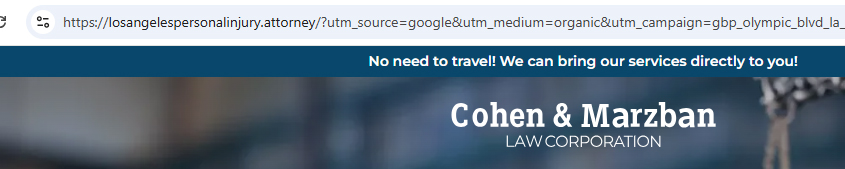
The Guidelines for representing your business on Google require (with a few specific exceptions) that Google Business Profile titles contain only the branding that appears in the real world. When we cross-check the above example with this legal firm’s website, we can see that they have added eight additional words to their real-world brand name in the GBP title field.
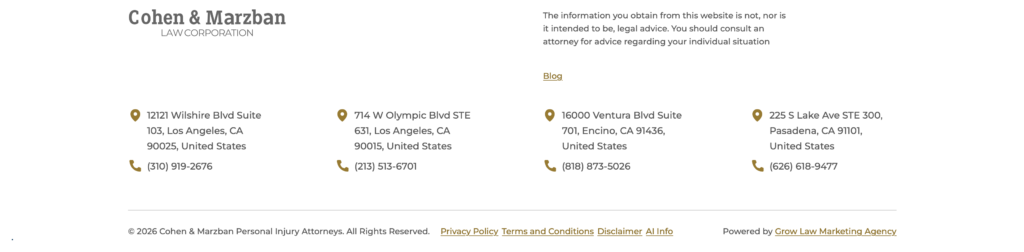
Nor could I find any explanation of a doing-business-as record (DBA) in the company’s website footer:
We can also check Google Maps’ Street View to see if real-world signage contains the keywords that are present in the GBP title, but in this case, I could not find any signage for the brand at the listed address. However, the GBP photo section contains many images of the company’s branding, none of which contain the keywords “Los Angeles Personal Injury & Car Accidents Attorneys”.
Instances of keyword stuffing in GBP titles are common enough that it took me exactly one search to turn up this example. Brands violate Google’s guidelines either unknowingly or because they have heard somewhere or been advised by their marketers to add additional phrases to their names because of its apparent positive impact on local rankings.
Our study today has confirmed a strong correlation between keywords in business titles and 2x, 3x, and even 5x more top-3 rankings in Google’s local packs across different industries.
But you don’t have to spam Google to gain this advantage. You can either legally re-brand your business, or get a DBA. This takes away the risk of competitors or members of the public reporting your business to Google for guideline violations, which can result in the search engine removing the spammy words from your title and you losing your ranking advantage. For a complete tutorial on this, read Everything That Can Go Right and Wrong with Your Local Business Name.
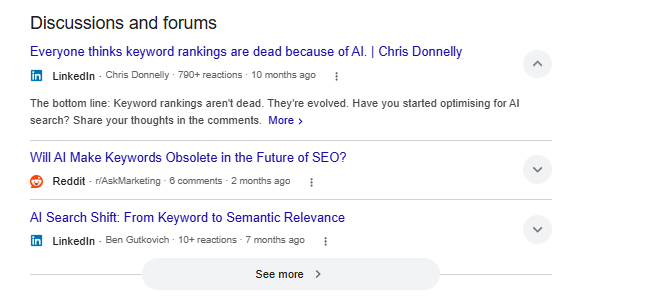
I couldn’t conclude this study without addressing this hot topic. If your brand pays any attention to buzz in the SEO space, you are almost certainly reading statements like “keywords are dead” due to the rise of AI.
Why are people saying this? There are several reasons, but a core factor is that AI is re-training the public away from simple keyword-driven queries like “plumber near me” to more complex prompts like “My wedding ring just fell down the sink. Are there any plumbers in my neighborhood right now who are open and who specialize in this and who are affordable?”
Basically, conversation and context are on the rise because of the way in which consumers can engage with tools like ChatGPT and Google AI Mode. Many marketers are encouraging clients to shift away from thinking in terms of short keyword phrases to thinking about more complex consumer intents.
But here is your helpful reminder that we exist in the local search space and our corner of the marketing world is always a bit special. I would suggest that keywords still matter very much when it comes to optimizing Google Business Profile titles because Google is clearly retrieving this kind of information in their AI environments.
I don’t have the necessary access to AI ranking data to draw clear correlations between optimized GBP titles and AI prominence, but what I can say for sure is that Google Business Profiles will continue to be important in the AI era, as they make up the richest local business dataset on the web, and Google’s Gemini is definitely training on them.
AI is not making GBP optimization irrelevant in any way, and highly recommend reading Whitespark’s Ultimate Guide to Google Business Profile Optimization to make sure your Profile can rank and convert in both traditional local search and AI search.
Too busy to scale business listing optimization? Check out Whitespark’s effective and affordable citation building service.
Miriam Ellis is a local SEO columnist and consultant. She has been cited as one of the top five most prolific women writers in the SEO industry. Miriam is also an award-winning fine artist and her work can be seen at MiriamEllis.com.
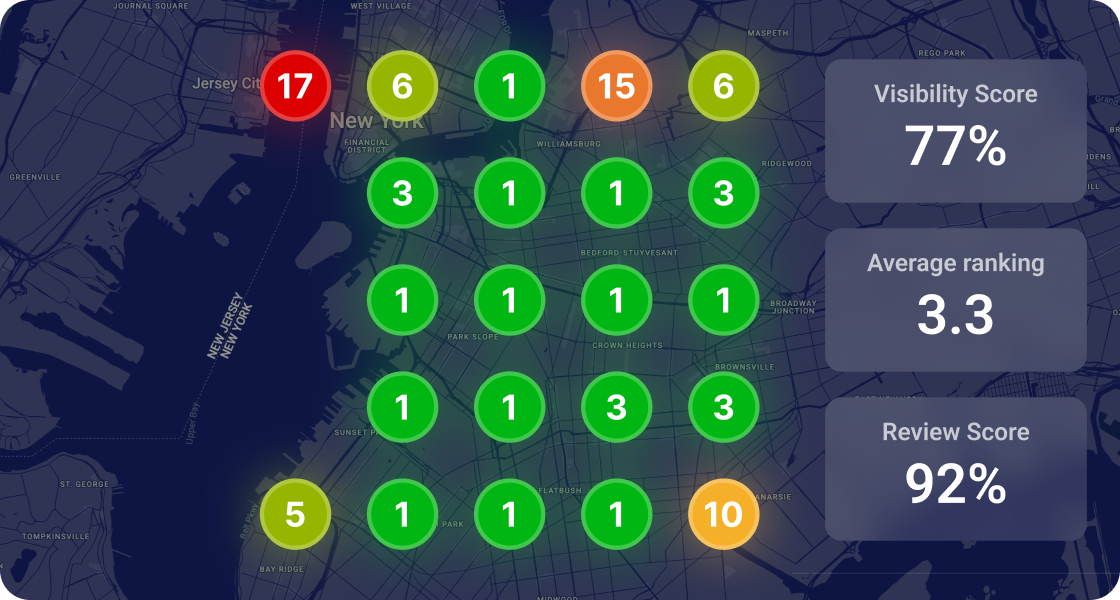


Whitespark provides powerful software and expert services to help businesses and agencies drive more leads through local search.
Founded in 2005 in Edmonton, Alberta, Canada, we initially offered web design and SEO services to local businesses. While we still work closely with many clients locally, we have successfully grown over the past 20 years to support over 100,000 enterprises, agencies, and small businesses globally with our cutting-edge software and services.