CONTENTS

🤓 The 2026 Local Search Ranking Factors are here!! Check out the report!

💡 Key findings and takeaways:
• Only 25% of GBP primary categories have review questions at all, and questions fall into two main templates: a richer “hospitality” set (restaurants, bars, cafes) and a shallower “service” set (contractors, medical practices).
• Restaurants top the list with 14 questions (the most of any category), while other hospitality categories (bars, cafes, etc.) each get 12.
• Service businesses mostly just get asked “Which services did you get?” and “How much did you pay?”, suggesting Google hasn’t fully built out this bucket yet.
• The “Which services did you get?” question reveals ready-made service lists, which can be used as intel for what services your business can provide and promote.
• A third small bucket exists for attractions/places of worship, focused on visit timing, tickets, and wait times.
• Across the whole dataset there are a total of 40 distinct review questions, the most common of which are “Which services did you get” (164x) and “How would you describe the price you paid” (149x).
• Review questions and Ask Maps suggested questions are related but distinct systems drawing on different signals, so both are worth monitoring separately.
Which GBP categories have the most review questions? Which review questions are appearing for which categories? These are the primary questions Darren Shaw and I set out to answer recently, and we’ve got some great proprietary data to share with you, including a .CSV file you can download, some interesting takeaways from our study of this dataset, and an actionable workflow for your team. Use our findings to fuel your:
Review questions are huge right now, and by reading this study, you’ll have an excellent grasp of what they are, how they work, and what to do about them.
Methodology
Whitespark collected this data manually by searching for 765 businesses across 180 different keywords, clicking through on the results, clicking the “leave a review” button, and then manually copying the review questions into a spreadsheet. I then analyzed the spreadsheet data to discover insights.
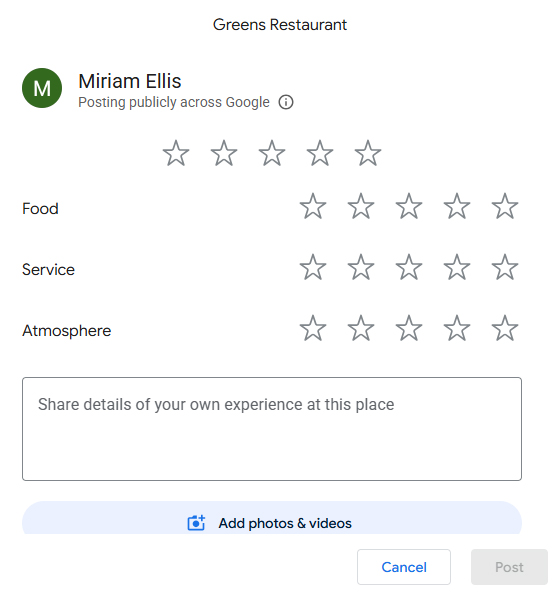
Pick any local business’s Google Business Profile (GBP) and start to write a review for it. For pretty much all business categories, your review template will start like this, with the function of leaving a star rating, writing a review, and, if you like, adding photos/videos to your reviews:
But keep scrolling and you’ll find that, for many businesses, Google is now asking a variety of review questions like these, prompting the reviewer to add more specific feedback:
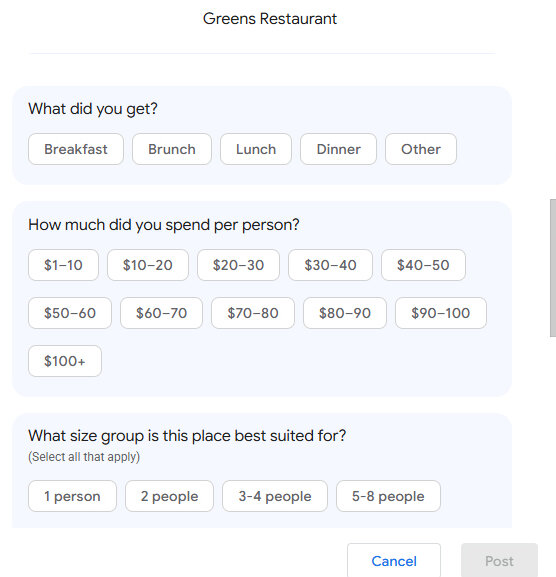
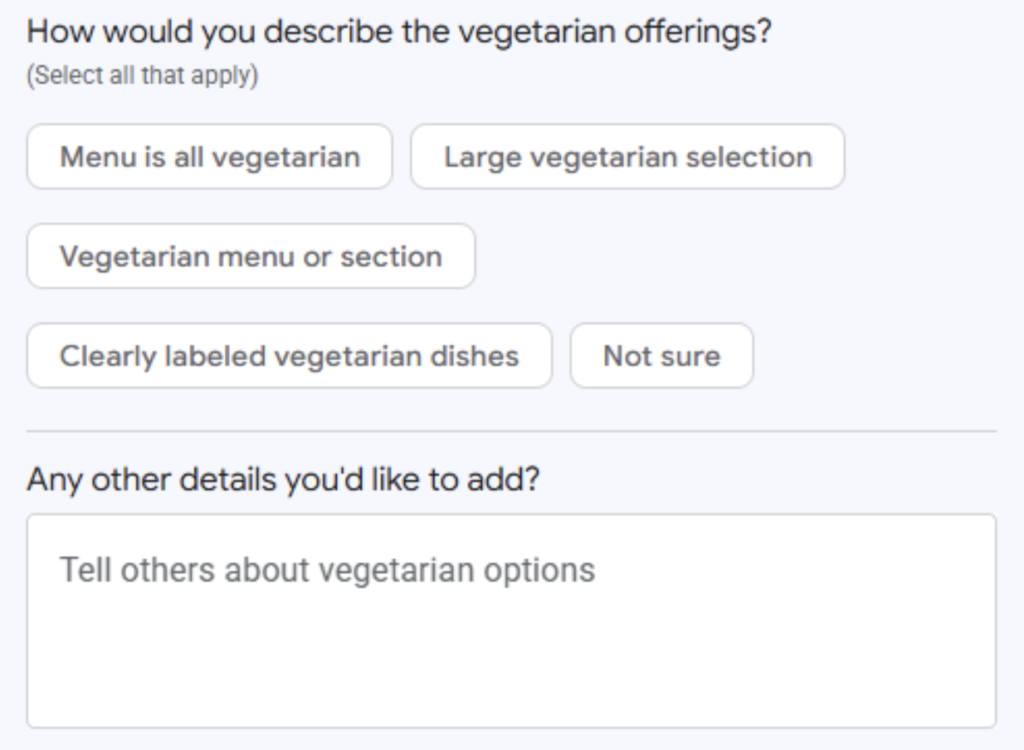
Review questions like those shown above can be pre-defined, with pre-set tabbed answers to choose from. Or, they can be open-ended, like this field asking for freeform feedback about other details the reviewer wants to share concerning a restaurant’s vegetarian options:
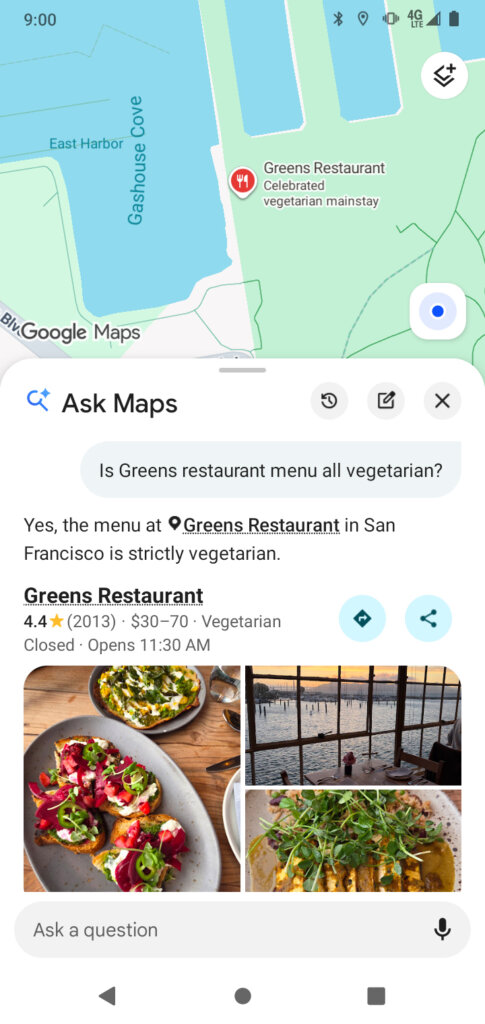
If you’re marketing local brands, it’s really important to pay attention to the emergence of this massive information layer Google has now added to their review interface. Clearly, they are very hungry for highly detailed sentiment, and the feedback left by reviewers is doubtless a primary influence on how the Google’s AI-driven Ask Maps feature is answering users’ questions:
Studying the review questions which Google is turning up for the brands you market can have both strategic and competitive value, as I’ll dive into in a moment, but first, let’s take a look at Whitespark’s data!
Need to know stat: Our research surfaced 521 primary GBP categories. We discovered that only 25% of these categories had review questions associated with them.
Here are the top 50 GBP categories for which Google is asking the highest number of review questions:
| Primary Category | Number of Review Questions |
|---|---|
| Restaurant | 14 |
| American Restaurant | 12 |
| Bar | 12 |
| Bar & Grill | 12 |
| Cafe | 12 |
| Cocktail Bar | 12 |
| Coffee Shop | 12 |
| Gay Bar | 12 |
| Live Music Bar | 12 |
| Lounge | 12 |
| Night Club | 12 |
| Sports Bar | 12 |
| Tiki Bar | 12 |
| Asian Fusion Restaurant | 9 |
| Asian Restaurant | 9 |
| Cajun Restaurant | 9 |
| Fine Dining Restaurant | 9 |
| Italian Restaurant | 9 |
| Modern French Restaurant | 9 |
| New American Restaurant | 9 |
| Spanish Restaurant | 9 |
| Steak House | 9 |
| Bakery | 8 |
| Donut Shop | 8 |
| Pie Shop | 8 |
| Cake Shop | 7 |
| Barber Shop | 6 |
| Beauty Salon | 6 |
| Hair Salon | 6 |
| Nail Salon | 5 |
| Tattoo And Piercing Shop | 4 |
| Tattoo Shop | 4 |
| Appliance Repair Service | 3 |
| Carpet Cleaning Service | 3 |
| Catholic Cathedral | 3 |
| Catholic Church | 3 |
| Christian Church | 3 |
| Electrician | 3 |
| Emergency Locksmith Service | 3 |
| Episcopal Church | 3 |
| Escape Room Center | 3 |
| Hiatorical Landmark * (we note that Google has made a spelling error with this category. It should read “Historical Landmark”) | 3 |
| House Cleaning Service | 3 |
| Hvac Contractor | 3 |
| Locksmith | 3 |
| Mover | 3 |
| Moving And Storage Service | 3 |
| Pest Control Service | 3 |
| Piano Moving Service | 3 |
| Plumber | 3 |
Don’t see a category you care about in our top 50? Don’t worry. Keep reading!
Here is an example of the variety of questions and either pre-set or open-ended answers that are being applied to the first category on our list, “Restaurant”:
| Review Question | Answer Options |
|---|---|
| How much did you spend per person? | Pre set: $1–10, $11–30, $31–50, $51–100, Over $100 |
| How long did you wait for a table? | Pre set: No wait, Up to 10 min, 10–30 min, 30–60 min, Over an hour |
| What size group is this place best suited for? | Pre set: Solo dining, Couples, Small groups, Large groups |
| How would you describe the noise level? | Pre set: Quiet, Moderate, Loud, Very loud |
| Do you recommend making a reservation? | Pre set: Yes, definitely, Recommended, Not necessary, No |
| Would you recommend this place to vegetarians? | Pre set: Yes, No, Not sure |
| How would you describe the vegetarian offerings? | Pre set: Menu is all vegetarian, Large vegetarian selection, Vegetarian menu or section, Clearly labeled vegetarian dishes, Not sure |
| Tell others about vegetarian options | Open-ended form |
| How is the parking here? | Pre set: Easy, Somewhat difficult, Difficult |
| What parking options are available? | Pre set: Free parking lot, Paid parking lot, Free street parking, Paid street parking, Valet, Free/paid parking garage, Parking unavailable |
| Tell others about the parking | Open-ended form |
| Tell others about kid-friendliness | Open-ended form |
| Tell others about wheelchair accessibility | Open-ended form |
| Tell others about your experience | Open-ended form |
Having seen this example, I’m sure what you want to know most is which review questions are appearing for the categories that apply to your business or clients. Sign up below and we’ll send you Whitespark’s Review Questions Database .CSV for free. It will show you all applicable questions for the categories we’ve researched for this study.
Several patterns worth sharing emerged from our data set that tell us something about how Google is handling review questions at present:
Pattern 1: Google is templatizing questions across sets of categories, rather than writing bespoke questions for individual business types
Our research indicates that there are two big buckets – a service bucket and a hospitality bucket – into which Google is organizing which questions appear for these two large groups of categories. If a brand you’re marketing falls into the “service” bucket, it’s likely to get one set of questions, while the same applies if you are in the “hospitality” sector.
Pattern 2: The hospitality bucket appears to have the richest review questions set
Google is really drilling down to specific consumer feedback when it comes to restaurants, bars, night clubs, and related venues. This suggests to me that consumers in these categories need the most information before making a decision about which business to choose for a transaction.
Pattern 3: The service bucket is shallower in terms of review questions depth
The two most common review questions appearing for service businesses (like contractors, medical practices, etc.) are:
This suggests to me that Google either believes that consumers need less information before choosing a service business (which seems unlikely) or that Google has simply yet to fully build out its base of questions for these categories (which seems the more likely answer).
Pattern 4: Top SEO takeaway for service-based businesses: service options are a goldmine
Our research has revealed ready-made service lists triggered by the review question: “Which services did you get?” For example, the category “Appliance Repair Service” asks the reviewer whether they received any of the following pre-defined services:
We’ve got an awesome .CSV you can download to see all of the pre-defined services associated with the primary GBP categories that receive the “Which services did you get?” question. Sign up below and we’ll send it to you.
Use this list to determine which services your brand should consider offering, and then to optimize both your service list on your GBP and the content on your website, social media profiles, and other digital assets.
*It’s important to note that all categories also end with a “service not listed” option. This is Google’s catch-all for services their lists don’t cover.
Pattern 5: We noticed a third bucket for Attractions and Places of Worship
If you’re marketing a church, temple, or other place of worship or a public attraction like a casino, escape room, or landmark, your category is likely to feature these review questions:
Pattern 6: There are only 40 distinct questions evidenced by our entire data set
This small number gives a sense of a limited Google project at this point, but I would certainly expect to see this figure grow over time. This is a good time to study any applicable review questions for the categories you care about while the total number of questions is relatively manageable.
Pattern 7: The single most common review question pattern (after zero questions) is 2 questions
120 categories have just 2 questions.
Pattern 8: Only 1 category gets 14 questions
“Restaurants” is the category with the maximum number of questions of 14.
Meanwhile, 12 other categories get 12 questions. These are “Bar”, “Cocktail Bar”, “Sports Bar”, “Tiki Bar”, “Gay Bar”, “Live Music Bar”, “Lounge”, “Night Club”, “Bar & Grill”, “Cafe”, “American Restaurant”, and “Coffee Shop”.
Pattern 9: It’s clear which questions Google is asking most frequently
These questions (and the number of times they appeared) are:
Pattern 10: Review questions appear to be a work in progress
Our data set contained 521 total primary categories. 140 of these categories featured at least one review question. The bigger takeaway here is that the rest of the primary categories we investigated do not currently have any review questions associated with them. Reviewer feedback is so critical to how Google is answering Ask Maps questions that I feel comfortable predicting that these numbers will change over time.
If you are not currently seeing any review questions associated with a category of interest to you, keep checking back. I think there’s a good chance you will eventually see something emerge in your sector due to the massive appetite of Google’s AI for detailed information.
Pattern 11: Review questions and Ask Maps questions are not the same
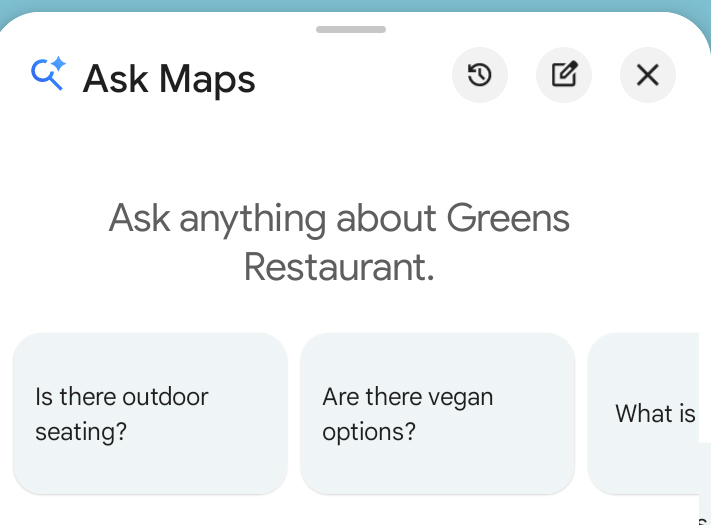
While review questions tend to fall into a general pattern across large buckets of categories and there may be some overlap with the pre-set questions being suggested by the Ask Maps function of Google’s mobile Maps app, don’t confuse these two different question sets.
I want to demonstrate this for you with this table. On the left are the GBP review questions we documented for the primary category “restaurant”. On the right are questions being suggested by Ask Maps for a specific restaurant called “Greens” in San Francisco:
GBP Review Questions for general restaurants:
How much did you spend per person?
How long did you wait for a table?
What size group is this place best suited for?
How would you describe the noise level?
Do you recommend making a reservation?
Would you recommend this place to vegetarians?
How would you describe the vegetarian offerings?
How is the parking here?
What parking options are available?
Tell others about the parking
Tell others about kid-friendliness
Tell others about wheelchair accessibility
Tell others about your experience
Pre-Set Ask Maps Suggested Questions for a specific restaurant:
Is there outdoor seating?
Are there vegan options?
What is the cuisine?
Is it dog-friendly?
Does it offer bridge views?
Is parking available?
Does it serve alcohol?
Is the menu seasonal?
Is it suitable for a birthday?
Is the ambiance quiet?
What is the dress code?
What really tipped me off about this difference is that Ask Maps is prompting searchers to ask whether Greens restaurant has a view of the bridge. This is, of course, a reference to the Golden Gate Bridge in San Francisco, and is a question specific to this venue rather than restaurants, in general.
While there is some overlap between GBP review questions and Ask Maps questions (e.g. both feature questions about parking availability), you need to treat these two environments as separate sources of business intelligence, as you’ll see when you get to the Workflow section of this study.
Hat tip to Guiding Brands for reaching out to Darren when discovering that a service-based business was seeing review questions for services the business didn’t offer:
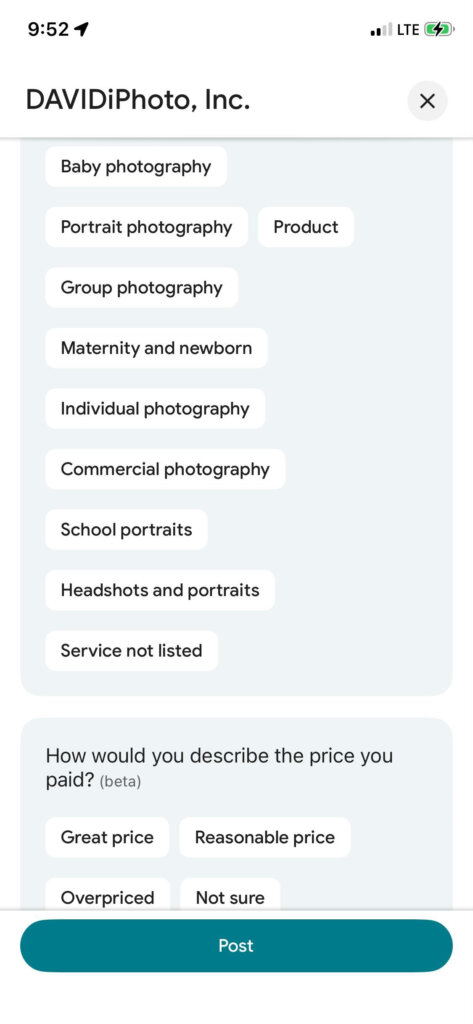
They were subsequently able to notice that the review questions matched services that Google was suggesting the brand in question might want to add to its Google Business Profile via the New Merchant Experience dashboard:
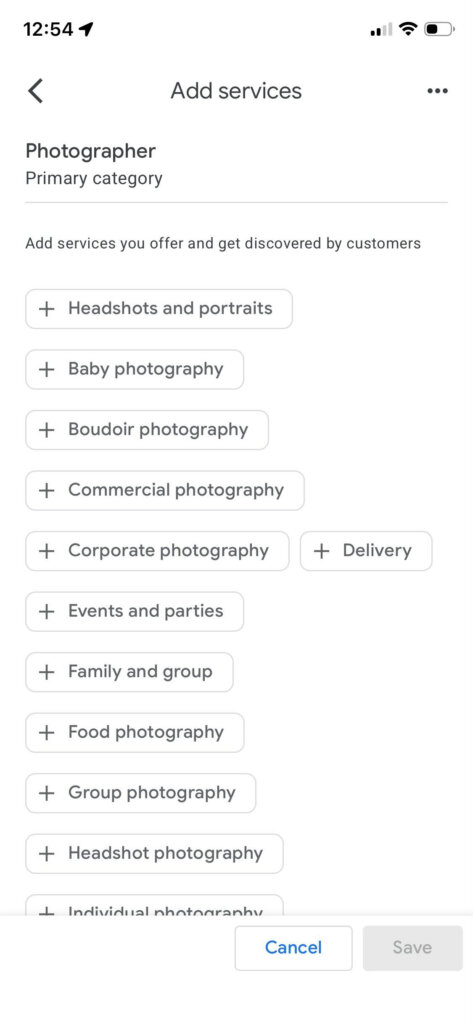
I think this phenomenon is worth sharing with you because:
In essence, review questions are worth studying because they can provide business intelligence about the products/services/amenities other brands in your category are commonly offering. The seeds of business growth could reside in this information, if there is sufficient local demand for expansion.
Here is a workflow for any local business to follow in response to Google’s increasing emphasis on seeking more detailed feedback from reviewers:
Step 1: Download Whitespark’s Review Questions Spreadsheet.
If your category is present in our data set, note down all the questions that appear for it.
If your category is not present:
Step 2: Go to your Google Business Profile via the mobile Google Maps app
Look up the business you’re marketing in the mobile Google Maps app. Click the “ask” button. Typically, Google will show you a set of suggested questions you can ask about the business, as you saw earlier with my example of Greens restaurant in San Francisco. Given that Google was suggesting that potential patrons ask whether this restaurant has a view of the Golden Gate Bridge, it’s a safe bet to assume that Google is basing these pre-set questions on its internal documentation of what it is seeing users ask, either about this specific business, or businesses in this location/category, or some other set of variables.
Such a dynamic makes Ask Maps a useful source of business intelligence. Document all of the suggested questions you see appearing for your business in this AI-driven app feature.
Step 3: Obtain customer contact information at the time of service
Make every possible effort to acquire the name and email address or SMS number of as many possible customers during transactions. This is crucial to your review acquisition strategy. Where possible, document what the customer ordered/purchased to enable full customization of review requests.
Step 4: Base customized review requests on the two lists you have created
In pattern #6 (above), you saw how I listed out both the GBP review questions and Ask Maps questions for a restaurant. You now have two similar lists of your own, informing you of what Google believes consumers most want to know about a business like yours before choosing it for a transaction.
You need abundant evidence that the business you’re marketing is the best answer to these questions.
One of the best ways to influence this is to earn reviews that specifically feature sentiment about the questions being asked. Customize the language of your review requests to ask for customer sentiment on detailed topics. Here is an example review question template that you can customize to feature the GBP review questions and Ask Maps questions that are relevant to the brand you’re marketing:
Dear [customer name],
This is [owner name], the [title] of [business name]. We were so honored to have you dine with us. One aspect of our location we want to share with as many neighbors as possible is the world-class view of the Golden Gate Bridge from our dining room. I wondered if you had enjoyed this beautiful view during your meal, and if you would take the time to write a review about this and your experience dining with us. It would really mean a lot to me. Thank you so much for considering this, and we’ll hope to have the pleasure of seeing you again soon. You can leave your review at:
[link to GBP]
Warm regards,
[owner name, title, business]
Create a variety of review templates to reflect multiple questions you have documented in your two lists.
Step 5: Switch up your review templates regularly
Don’t keep asking every potential reviewer the same questions. Do keep these three objectives in mind:
1. If your review acquisition process enables you to document the product/services a unique customer purchased, it’s a best practice to request their feedback on these specifics, but where you don’t have these details, you should be varying your requests to customers on a week-over-week or month-over-month basis to broaden the sentiment and themes covered by your review corpus over time.
2. It’s an accomplishment to get multiple customers mentioning the same attribute of your business in their reviews. For example, if four different reviewers mention your bridge view in the third quarter of the year, this should give Google and AI evidence that your business is a relevant answer to questions surrounding this topic. You might then choose to retire your bridge view review template for a bit and turn to asking subsequent reviewers about different elements of your business.
3. However, don’t permanently retire a review request template. Freshness matters to local consumers, and, possibly to AI. As an example, imagine a restaurant that is very busy in the summer, but quieter in winter. A consumer wanting to find a romantic lunch spot to take their sweetheart to after they visit a Christmas tree farm doesn’t want to know that past diners thought the restaurant was busy, crowded, and noisy on the 4th of July. They want to know whether they can count on a quiet ambiance in December. It’s fresh review content that provides an answer that meets the needs of this individual patron. Because of this, a practice that can help you continue to prompt up-to-date sentiment in your reviews across your consumer base is to periodically bring topical review request sentiments out of retirement to get new feedback on older topics.
Step 6: Do a competitive audit of review questions and Ask Maps prompts for business intelligence
Wonder what:
You can see the review questions for any business by beginning to write a review on its Google Business Profile, and you can look up any business in the Google Maps app to reveal what questions are appearing as suggested prompts to users.
This information about your competitors is valuable. Imagine the owner of a vegetarian restaurant who wants to increase their establishment’s appeal. When they look up a nearby competitor, Ask Maps is indicating that people want to know if the venue features a seasonal menu.
This fact should spark conversation. Is it important for vegetarian diners to eat with the seasons? Can one charge higher prices for covers if the menu features more seasonal local fare? What new review request templates would be needed to bring maximum visibility to new menu items featuring seasonal dishes?
Google is actually revealing a lot about consumer behavior with both review questions and Ask Maps prompts. You can learn about your competitors and the local commercial landscape by auditing these information resources. What you learn could improve your business operations.
Step 7: Monitor both GBP review questions and Ask Maps for new details
I recommend doing a quarterly review of the questions and prompts that are appearing in these two distinct but related environments to quickly discover whether new questions/suggestions have appeared. If so, create new review request templates to earn sentiment on new topics.
Step 8: Use documented questions to evaluate your GBP and content publishing strategy
Consulting your lists of both GBP review questions and Ask Maps questions, evaluate whether the brand you’re marketing has published additional evidence on your GBP and website to augment the rich answers consumers are seeking. Using our earlier-cited restaurant in San Francisco as an example, here’s what question-oriented optimization might look like:
☐ Clear pricing on both GBP and website-based menus
☐ Publishing website and Google Posts content describing least-busy times with the shortest wait periods
☐ Photographing different-sized groups dining at the restaurant to visually demonstrate capacity and posting this photos to the GBP image section and website
☐ Filming the restaurant to capture noise levels and publishing these videos in the video section of the GBP and on the website
☐ Describing the establishment’s reservation policy in the GBP description and on the website
☐ Fully covering vegetarian options via GBP categories, menus, photos, and videos and by documenting consumer sentiment about vegetarian options with first-party reviews and testimonials on the website
☐ Using GBP descriptions and any available attributes to describe parking availability, uploading an image to GBP images of the area highlighting designated parking, and photographing/filming nearby parking options as GBP content as well as website content
☐ Photographing and filming kid-friendly elements of the business for GBP and website publication, as well as ensuring that a children’s menu has been uploaded to GBP and the website if a special menu of this kind exists
☐ Photographing and filming wheelchair accessibility and other ADA features as GBP and website content
☐ Photographing and filming outdoor seating features as GBP and website content
☐ Promoting all vegan options in the same way as vegetarian options
☐ Ensuring that GBP categorization posts and photo image content fully capture the style of cuisine and that the website fully describes any special expertise possessed by the business regarding this type of cuisine
☐ Photographing, filming, and using GBP attributes that indicate dog-friendliness
☐ Photographing and filming views from the restaurant for both GBP and website publication and mentioning an especially spectacular view, such as that of the Golden Gate Bridge in the GBP description
☐ Photographing and filming any applicable alcohol licensing and beverage menu items for publication on both GBP and website
☐ Using Google Posts and menus to highlight seasonal fare, describing seasonal fare as part of the GBP description
☐ Photographing and filming seasonal menu items and using the website to fully describe the restaurant’s philosophy on seasonal dining
☐ Photographing and filming birthday parties at the restaurant for both the image and video section of GBP and website, and using Google Posts to highlight birthday special offers
☐ Describing any applicable dress codes in the GBP description, using the GBP and website photos and videos to give a sense of how diners dress
I created this checklist by looking at the two lists for the restaurant and creating a simple strategy that covers all of the surfaced review questions and Ask Maps questions. You can do the same for any local business you are marketing. In addition to offering supplementary evidence of specific features of a business via its GBP and website, I highly recommend connecting your social media profiles to your GBP. Google is now pulling social media posts directly into Google Business Profiles, giving brands a whole new way to signal to consumers that the amenities and features offered by a business match what the public is looking for.
Step 9: Be sure your structured citations corroborate your GBP
In the past decade, you may have come across multiple local search marketers saying that getting listed across a variety of local search directories had decreased in value. The emergence of AI has flipped this script. Environments like Google AI Mode, Google AI Overview, and ChatGPT are filled with citations of platforms like Yelp and TripAdvisor. You need to be sure these directories corroborate the evidence you are building via your GBPs instead of creating conflicting messaging.
Not sure what state your listings are in across the web? Whitespark’s Local Citation Finder will help you analyze your competitors’ citations and find your best opportunities for building out a stronger digital footprint of evidence.
Step 10: Develop unstructured citations as additional evidence of desirable features
Meanwhile, an additional source of evidence that should be a priority for all local brands in the AI era is to build up unstructured citations for applicable questions in your lists. For example, our featured restaurant could interest local reporters in publishing local newspaper pieces on the health benefits of seasonal eating, it could interest local bloggers in including it in a list of San Francisco restaurants with the best views, and it could connect sponsorship of nearby children’s programs with the availability of its kids’ menu. For more ideas, read Whitespark’s Guide to Unstructured Citations for AI Visibility.
Bring your creativity to this step in the workflow, seeing ways to build multiple sources of evidence that the brand you’re marketing is a great choice for specific patron needs.
If you found our review questions study useful, I want to be sure to share that Whitespark is planning to publish many more findings of this kind in the coming months. Please, follow Darren Shaw on Linkedin for first news of groundbreaking studies, and subscribe to the Whitespark Local Update in which Darren and Claire Carlile offer expert level commentary on local search developments. And, of course, check back soon for new studies, right here on our blog.
The point of being among the first to identify and understand new local search marketing opportunities is to create better experiences for your customers and become the most trusted source in your local markets. Google is giving you so many useful clues about what it knows consumers want in your categories. Both review questions and Ask Maps questions belong at the heart of your marketing strategy, because profitability has never been more closely tied to giving the customer what they want!
Miriam Ellis is a local SEO columnist and consultant. She has been cited as one of the top five most prolific women writers in the SEO industry. Miriam is also an award-winning fine artist and her work can be seen at MiriamEllis.com.


Whitespark provides powerful software and expert services to help businesses and agencies drive more leads through local search.
Founded in 2005 in Edmonton, Alberta, Canada, we initially offered web design and SEO services to local businesses. While we still work closely with many clients locally, we have successfully grown over the past 20 years to support over 100,000 enterprises, agencies, and small businesses globally with our cutting-edge software and services.