CONTENTS

🤓 The 2026 Local Search Ranking Factors are here!! Check out the report!

TL;DR:
• Google Business Profile reviews usually go missing for 3 reasons: business policy violations, spam attacks, or Google moderation errors.
• Common triggers include sudden review spikes, incentivized reviews, review kiosks/shared IPs, fake engagement tactics, and reviews from suspicious or inactive accounts.
• Competitors and spammers may also intentionally flood Profiles with fake positive or negative reviews to trigger Google penalties.
• Google now uses Gemini AI to aggressively filter reviews, which can mistakenly remove legitimate reviews, especially in spammier industries.
• Best practice: focus on steady, authentic review collection, encourage detailed reviews with photos, avoid manipulation tactics, and diversify reviews beyond Google.
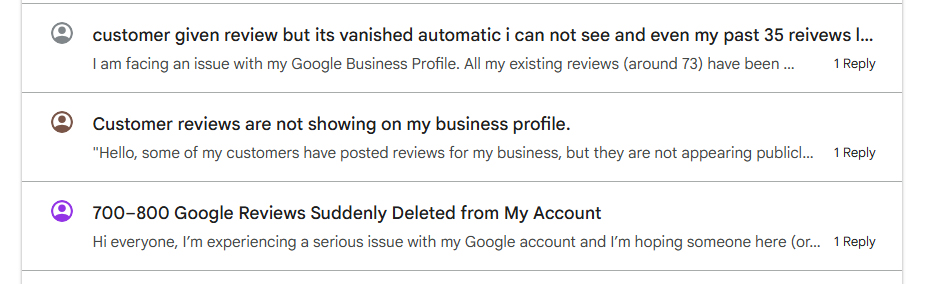
For as long as the Google Business Profile Help Community has existed, threads like the above about missing reviews have been one of the commonest topics there. If you’re heading over to this forum right now to report a mysterious review loss you’ve just noticed, read this simple but thorough blog post first to troubleshoot likely causes before you post to the community. This will help you identify what may have gone wrong so that you either:
With Google now using Gemini to catch and filter reviews that appear to violate the extremely stringent new review guidelines they rolled out in April 2026, I expect the number of review loss posts to increase over the next few quarters, but they will all still fall into three categories. Most of the time, when your reviews disappear, what you are actually trying to find out is the answer to this question:
Whose fault is it that your reviews are gone?
Bookmark this post to help you answer this question and to better understand the cause of your situation so you know what, if anything, you can do about it.
I take no joy in playing the blame game here, but you’ll benefit from scrolling through these checklists and tips to see if you find a likely solution to your missing review mystery before you seek help from Google:
Do any of the following checkboxes apply to reviews that either never posted live or that went missing at any time after they were posted to your Google Business Profile?
☐ Increased review velocity – Has there been a recent uptick in the number of reviews you are receiving on a daily, weekly, or monthly basis? Is your review velocity notably greater than what is common in your industry or locality? Did you recently run a contest, event, or other promotion that caused a sudden increase in review velocity?
☐ Inconsistent review velocity – Has your business had a lack of consistency in your review acquisition practices, resulting in getting bursts of lots of reviews when you’re committing to request reviews but then other periods in which you aren’t committing, creating a pattern of spikes and troughs instead of relative consistency?
☐ Use of staff names in reviews – Are you incentivizing staff to win awards/perks for receiving the highest number of reviews that mention them by name?
☐ Use of review kiosks – Are you collecting reviews via a centralized review station at your place of business?
☐ Shared IP address – Similar to the issue of review kiosks, any tactic that encourages customers to review your business while on your premises can increase the chances of their sentiment being filtered out.
☐ Use of incentives – Are you offering money, prizes, discounts, or incentives of any kind in exchange for customer reviews? Have you hired a third-party marketing firm who is purchasing reviews for you or offering any types of goods in exchange for reviews?
☐ Use of QR codes – Are you using a QR code that is taking customers straight from your physical location to your Google Business Profile review form, thereby creating a situation in which the consumer hasn’t engaged organically with Google in any way prior to writing a review? Despite the fact that Google offers a QR code generator, there is reason to believe routing it to your review form instead of to a branded search for your business may result in review loss.
☐ Recently updated reviews – Did a customer edit a review they left long ago, causing it to be re-evaluated by Google in the context of the stricter new review guidelines and then fail to pass muster, resulting in removal?
☐ CTR Manipulation – Are you instructing your staff or a third-party marketer to try to inflate your Google Business Profile rank by artificially engaging with your listing (via searches, clicks, etc.), thereby drawing Google’s scrutiny to your listings for suspicious behavioral patterns and calling the validity of your reviews into question because your other activities raise red flags?
☐ Consumer reports of business conduct – Is your business using any tactic in requesting reviews that could be causing customers to feel unduly pressured and to report you via the report business conduct form?
☐ Conflicts of interest – Are you, current or former employees, friends or family, or third-party marketers posting reviews of your business?
☐ Suspicious review volume – Is your overall review count far higher than industry and local norms, potentially causing automated flagging and manual review of your GBP for suspicious review practices?
☐ Inactive or remote reviewers – Was a missing review posted by a profile that has left few or no reviews in the past or that appears to stem from someone located remotely, such as across the country or in another part of the world? This can cause Google to filter these reviews out as suspicious.
☐ Customer impersonation – You are using your own devices to post reviews on behalf of customers instead of letting customers directly post their own reviews.
☐ You’re under a 30-day review block – Has your Google Business Profile been stamped with a public review removal warning resulting in no new incoming reviews going live during a 30-day period? It is also theorized that “review jail” of this kind can be present on a listing without any public warning notice.
☐ Record of past violations – Penalized in the past for suspicious review practices? Your listing could be under greater scrutiny and more prone to review loss.
If you’ve checked the box for any of the above scenarios, you may well have already identified the cause of review loss. But check out category 2, as well, for further sleuthing.
💡 Pro tip: Instead of linking your review QR code to the “Leave a review” form, link it to a branded search. This way, the reviewer will interact with your Business Profile before they leave a review, thus minimizing the likelihood of their review being removed (as per the 7th point in the checklist above).
Bad actors can target your Google Business Profile reviews with the intention of damaging your reputation and credibility. Sometimes referred to as “negative SEO”, practices can be employed by competitors to make it look like your business is suspicious. On its face, it might not seem like a bad thing if Google removes spam reviews from your listing, but what if Google thinks your company is behind the prohibited tactics? Have you noticed any of the following prior to review loss or public warnings being placed on your listings?
☐ Your business has received a sudden uptick in 5-star reviews – Spammers can make you look suspicious by flooding your business with fake positive reviews.
☐ Your business has received a sudden uptick in negative reviews – This can result from your brand making headlines for news that angers the public, causing non-customers to attempt to punish you with prohibited negative reviews.
☐ Your business has received an uptick in reviews with a rating that is slightly below your average star rating – Subtle spammers can begin posting 4-star ratings or reviews to a profile with an average rating of 4.5 with the intention of dragging it down.
☐ Your business is receiving a volume of reviews from remote profiles – When you click on review profiles, the reviewer appears to reside in another part of the country or even in a completely different country, and may be employed by a review fraud organization that earns its money from spamming remote businesses.
☐ Your business is receiving a volume of reviews from near-empty profiles – Clicking on review profiles reveals that many of your reviews stem from profiles that have left no other reviews or only a few of them, again suggesting that this content may stem from review fraud organizations.
☐ Your business is receiving a volume of reviews from category-specific profiles – Does a review stem from a reviewer profile in which the reviewer has left dozens of reviews for the same business category (e.g. they have reviewed 20 car dealerships across the United States)? Again, this is a common review fraud pattern.
☐ Your business is experiencing an uptick in reviews that mention employee names – Have an About Page on your website that identifies your staff? Spammers can use that to get your profile flagged because it looks like you are running employee review contests in-house.
☐ Your multi-location business is receiving identical reviews at scale – Have multiple branches or franchise locations received identical or near-identical reviews within a short time frame, making it look like you are generating fake reviews for yourself at scale?
☐ You have been contacted by an extortionist – If your business is contacted by an individual demanding money in exchange for removing fake negative reviews from your profile, you already have confirmation that your GBP is under attack, and that spammers may be taking multiple actions to try to get you put into “review jail” so that you cannot receive new legitimate reviews while penalized.
Review fraud organizations are continuously evolving tactics for exploiting weaknesses in Google’s spam detection capabilities in order to benefit the brands that pay them. This scenario emphasizes the need for continuous review monitoring to help you identify emergent suspicious patterns. To complete your troubleshooting, read on to the third category of causes of review loss.
The longevity of Google’s review product depends on them keeping it trustworthy. Because of this, they regularly invest in new technologies and tactics for catching and either suppressing or removing review spam. However, their efforts are sometimes denounced as ham-fisted by local business owners and their marketers because of unintended consequences. Review these possible causes of review losses in which Google is to blame:
☐ Blame it on AI – Google has gone all-in on tying itself to Gemini’s ability to detect suspicious review patterns. Unfortunately, AI is notorious for making mistakes and you may experience review loss due to technological error that mislabels you as a spammer.
☐ Blame it on manual interpretation – Observation within the local SEO community suggests that Google is currently using a combination of both AI and human oversight to identify review spam. A human moderator can mistake you for a spammer.
☐ Blame it on your category – If you are so unfortunate as to be a legitimate business operating in a notoriously spammy category like locksmiths, garage door contracting, or moving companies, your valid reviews may get caught up in a widespread Google sweep of your vertical.
☐ Blame it on a bug – If you head to the Google Business Profile Community Help forum and see multiple businesses reporting an inexplicable review loss that mirrors your own, a bug may be the culprit, in which case it will often be identified and resolved by Google, resulting in the return of your reviews at a later date.
☐ Blame it on Google’s apparent disconnection from the real world – Multiple departments within Google’s larger structure make decisions that impact the local business segment of their suite of products. Time and again, Google has created policies that seem insensitive to local business realities. For example, if your restaurant holds a charitable benefit once a year that causes your reviews to spike because guests are expressing their appreciation of the event, should Google punish you by suppressing and removing your sudden influx of positive reviews? These are classic cases of throwing out the baby with the bathwater, and unfortunately, they seem almost inevitable from the scale at which Google operates, which is quite different from the day-to-day operations of most small-to-medium local businesses.
💡 Pro tip: If you notice that a legit review is missing, you can reach out to the customer who left it and ask them to fill out the Customer Missing Review/Photo Recovery Form. This form can be used to request an investigation into recovering the missing review, as well as for missing photos.
If reading this post has made you realize that you have accidentally been violating any of Google’s Prohibited and Restricted Content Guidelines, then you probably don’t want to report your review loss to Google. If you can internally fix a violation (like having your staff remove reviews you shouldn’t have told them to post) you can do so. Any problematic reviews on your profile (even old ones) can increase your chances of a penalty at any time. In future, use creativity to earn guideline-compliant reviews that minimize loss.
💡 Pro tip: Anecdotal observation suggests that longer and more detailed reviews and reviews that contain photos are less likely to be suppressed or removed. Ideate ways to legitimately encourage this type of content from your customers, without breaking any rules.
If your perusal of this post has convinced you that your business is under a review spam attack, you can document what you are seeing and:
💡 Pro tip: Don’t count on Google removing spam reviews that you report, even if they clearly violate guidelines. Google often does not act on these reports. If your efforts fail to inspire Google to act, your options are:
1) to hire an attorney to investigate further actions you might take to investigate and contact a spammer,
2) to bring media attention to your story in hopes that public pressure might kindle a response from Google,
3) use the “owner response” function to the spam reviews when all else has failed to simply state that the review has been reported to Google for suspected spam activity, and,
4) to let it go as best you can and focus on earning new positive reviews.
If you believe that Google is to blame, you can either wait for a bug to be resolved or in non-bug cases, contact Google to request reinstatement of reviews you feel you’ve lost unfairly. Type “review reinstatement” into this form and select the tab for “review missing” to begin describing your issue to Google.
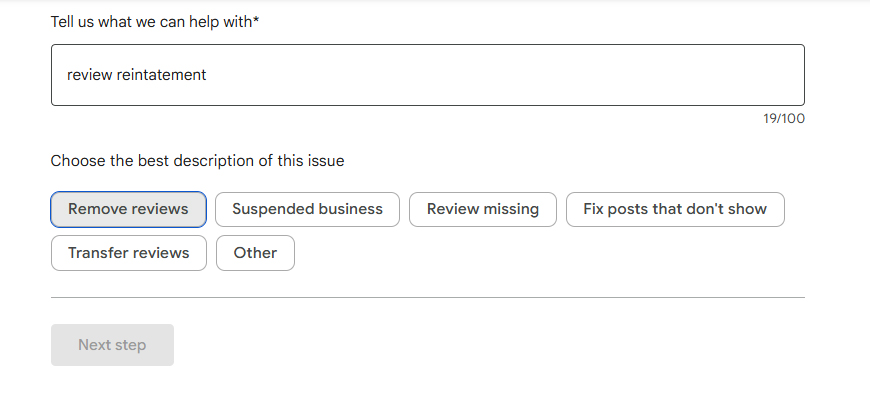
💡 Pro tip: Some lost reviews may never be reinstated, no matter how unjust their suppression or removal is. It’s important to be realistic about this, and while it hurts to lose valuable reviews you worked hard to earn, it can help to remember that:
1) reviews are a marathon rather than a sprint and you can continue to earn new reviews in future, and
2) your investment in earning first-party reviews offers a space over which you have full control and can’t experience review loss. Don’t let Google be your “everything” when it comes to local search marketing. Broaden your review profiles, especially as AI is clearly scraping reputation content from multiple sources, and develop as much first-party review content as you can on your own website and social profiles.
Looking to earn deeper reviews that stick? Check out Reviews + The Real World: Learnings from Famed Restaurant Reviewer, Marilyn Haggerty.
Feeling overwhelmed by the complexities of Google’s ever-changing review content policies, in particular, and reputation management in general? Whitespark can help. Grow your review count, improve your star rating, and monitor and respond to your reviews from an organized dashboard with Whitespark’s Reputation Builder. Test drive a free trial or book a demo today.
Miriam Ellis is a local SEO columnist and consultant. She has been cited as one of the top five most prolific women writers in the SEO industry. Miriam is also an award-winning fine artist and her work can be seen at MiriamEllis.com.
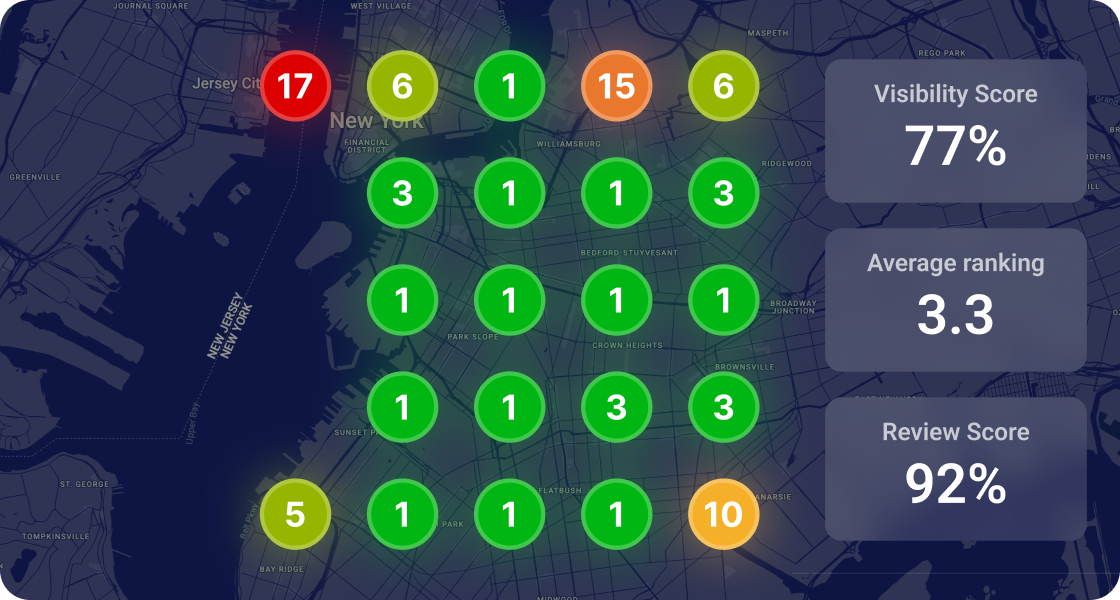


Whitespark provides powerful software and expert services to help businesses and agencies drive more leads through local search.
Founded in 2005 in Edmonton, Alberta, Canada, we initially offered web design and SEO services to local businesses. While we still work closely with many clients locally, we have successfully grown over the past 20 years to support over 100,000 enterprises, agencies, and small businesses globally with our cutting-edge software and services.