
🤓 The 2026 Local Search Ranking Factors are here!! Check out the report!

Local SEO is nuanced and sometimes mysterious. It happens to all of us that we have a strong sense of how some factor does/doesn’t influence visibility, until we see a study that proves us totally wrong! At other times, we have an unspoken gut feeling about some facet of Google’s behavior that an industry peer suddenly validates by voicing that they’ve been noticing the same thing. Those a-ha! moments can be valuable to finessing or completely changing the tactics you’re employing for your brand or clients.
Whether you’ve been working in local search for a short time or for years, “norms” are always open to change. Today, I want to share seven takeaways from the amazing new Whitespark Local Search Ranking Factors 2026 report that may challenge your current thinking about what’s influencing visibility and even how to do local SEO!
On a personal note, I’ve been involved with this survey of the world’s top local SEO experts since it launched nearly 20 years ago, and I have to say, the information in the 2026 edition is of outstanding value to creating your digital marketing strategy for local brands in the new year. I recommend reading the full report, but for now, let’s fast-track to some really interesting findings.

It may be the most loathed line in all of Google’s guidelines, instructing service area businesses (SABs) to hide their addresses on their Google Business Profiles (GBPs). Why? Because for years, we’ve witnessed the negative ranking impact on brands that comply with the guidelines, and we’ve had this phenomenon documented in good studies like this one from Sterling Sky.
It’s one of those givens in the local SEO industry that Google instructs SABs to do something that harms their visibility in local packs and Maps, causing a great deal of ill-feeling. In the new Local Search Ranking Factors report, having a visible address is the 7th most influential factor on local rank. I thought I knew everything there was to know about this old tale of SAB woe until Darren Shaw blew my mind with this video:
In brief, instead of rankings simply “going away”, Darren is proposing that one of two things may be happening:
Scenario 1: If you have a business that’s ever moved locations (Darren gives the example of a suburban business moving to city center) and you then hide the new city center address, Google is reverting your ranking radius to the suburbs where you originally verified your GBP.
Scenario 2: If you’ve never moved locations and you hide your address, Google is then attaching your ranking radius to a randomly-placed pin somewhere on the map. Darren suggests that this map pin confusion is actually a bug that Google needs to fix. In the video, Darren demos how to use Whitespark’s Local Ranking Grids tool to suss out this phenomenon.
Darren’s theories represent a fascinating departure from the typical industry narrative on this hot topic. If scenario 2 is, indeed, the result of a bug, I’d love to see tons of local business owners taking to support channels, local press, and general airwaves to try to elicit an official response from Google.
In the meantime, if there is any way your SAB can get a dedicated staffed physical office at which you see some customers, it remains your best tactic for avoiding the whole painful “hide address” fiasco. I truly wish Google would change this guideline.
This is headline-worthy news: local SEO experts cite businesses being open at the time users search as being the 5th most influential local pack/Maps ranking factor.
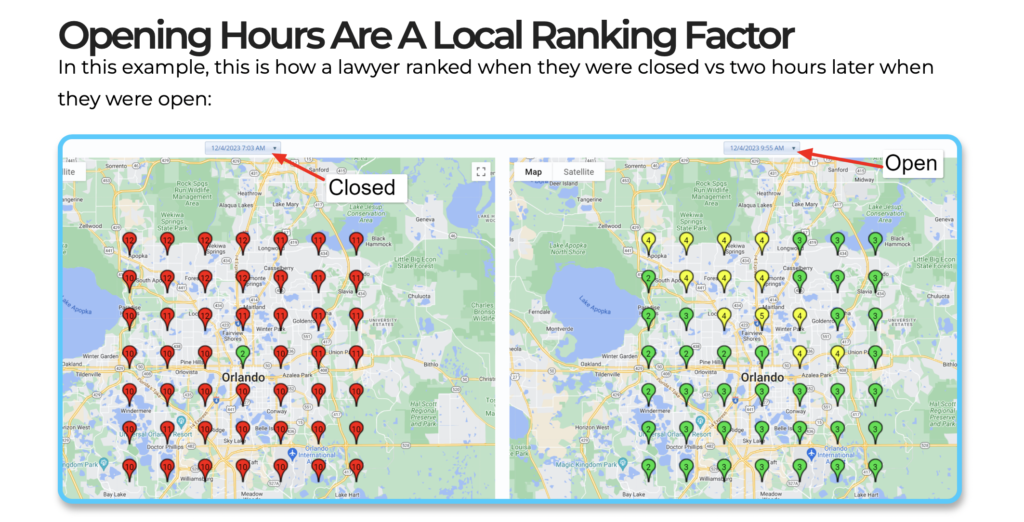
It’s probably not new news to you if you read this study from Sterling Sky in 2023 documenting dramatic ranking shifts correlating with whether a business is open or closed at the time of search. In fact, we’ve learned that rankings begin to degrade in the final hour that a business is open each day.
Here’s where the challenge comes in: your brand/most of your clients are still thinking of business hours as a fact of life. You’re open when you’re open, closed when you’re closed – end of story.
I highly recommend really pausing to think about the fact that, out of dozens of possible ranking factors, some of the world’s most experienced local SEOs are shining a huge spotlight on the influence of chosen hours on visibility. Hours of operation are slated as more influential than additional GBP categories, quantity of native Google reviews with text, and even proper placement of the map pin!
How might you and your clients start treating open hours as an optimization opportunity? Suggestions:
We seem to have a rather morbid fascination in the SEO industry with declaring things to be dead. AI bears evidence of these obituaries:
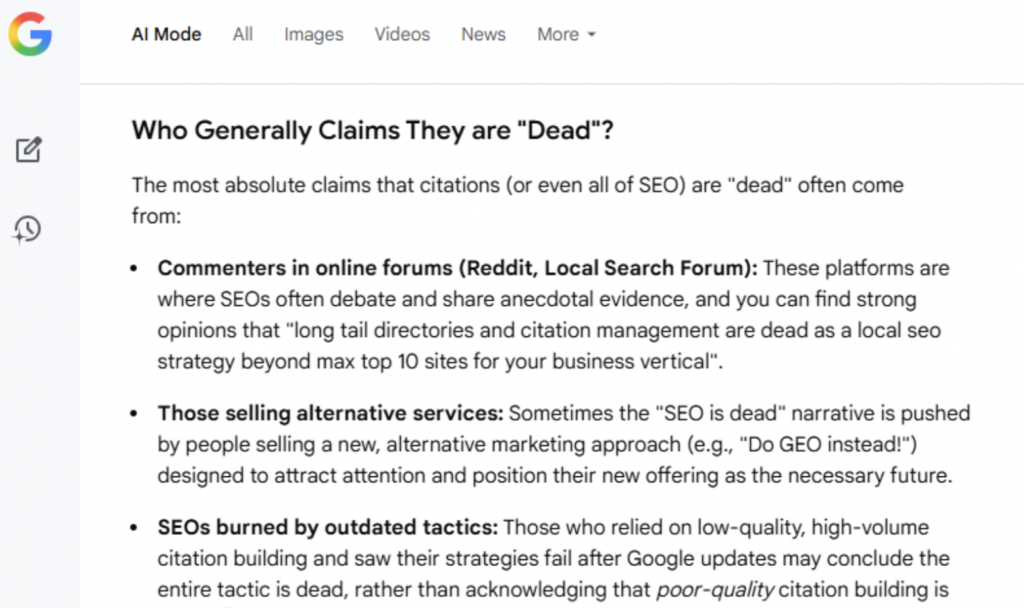
Before you don industry mourning attire, take hold of the good news that, “Citations are back!” in the tongue-in-cheek words of Darren Shaw. I’ll be even more controversial in saying that they’ve never gone away as a practical marketing factor.
I just have to shrug at articles suggesting that something like NAP (name, address, phone number) consistency on structured citations can be safely ignored because Google has become less reliant on third-party data to validate their own internal information concerning entities. This slant is misleading because it overlooks customer service (my own personal #1 influential factor on total business outcomes). Neglected citations become outdated and inconvenience the consumer public, costing companies positive brand impressions, conversions, sales, reputation, and referrals. NAP consistency on structured citations is simply vital.
Now, thanks to the new Local Search Ranking Factors report, you can further ward off the citation-death narrative with the information that AI is bringing citations of all kinds back into the digital marketing limelight. Here is how survey respondents rated the influence of citation-related factors:
#1: Presence of business on expert-curated “best of” and similar lists (think of Yelp)
#3: Prominence on key industry-relevant domains (think of FindLaw)
#4: Quality/authority of unstructured citations (think of business mentions on online news, blogs, industry association sites, etc.)
#5: Authority of third-party sites on which reviews are present (think of how reviews most typically occur in conjunction with local business listings)
#7: Quantity of unstructured citations (think of PR reach across the web)
#11: Diversity of third-party sites on which reviews are present (again, typically linked to structured citations)
#12: Quantity of unlinked brand mentions (a.k.a. “Unstructured citations”)
#15: Quantity of citations from industry-relevant domains (think of ZocDoc, etc.)
And so on and so forth
In point of fact, both structured and unstructured citations are dominating the AI visibility scenario. Show this list to brand leadership and clients who tell you this form of digital PR is dead. It’s actually livelier than ever.
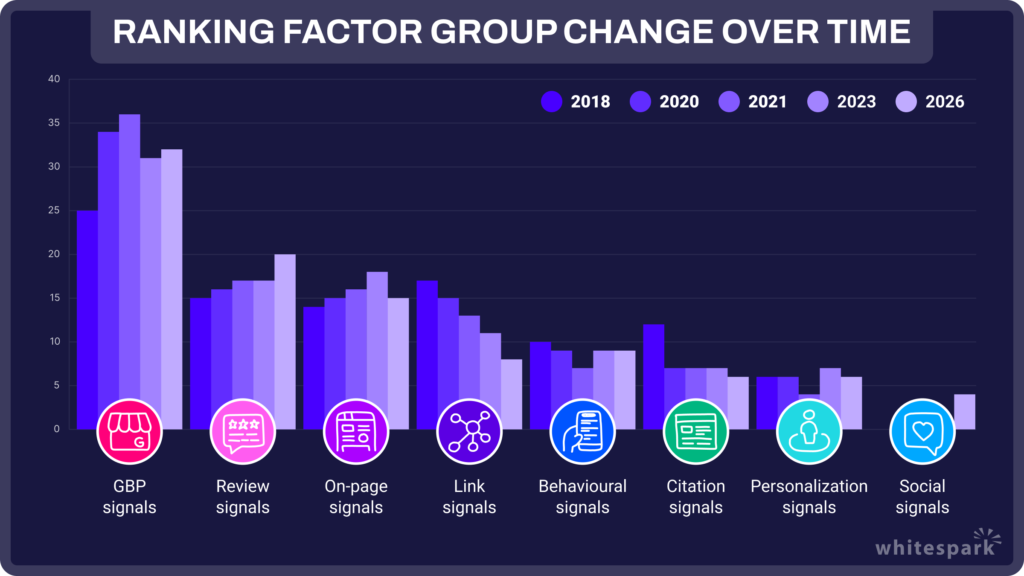
Like many local SEOs, a major percentage of the honored colleagues I’ve worked alongside throughout my career have been traditional SEOs. Because of this, I’ve photosynthesized the understanding that links are a HUGE DEAL. However, in our own corner of the web, the story reads a bit differently, as you can see from the above graphic capturing how local SEOs have rated link signals as local search ranking factors over time. It looks like a staircase going down to a dark basement.
By contrast, the one stairway on this chart that is leading upwards into a sunny place of enlightenment relates to reviews. Understanding of their importance has increased YOY, and that delights me because I’ve always personally rejected the narrative that reviews are a kind of add-on to local business listings. Instead of being shoved to the side like an overcooked vegetable, they belong at the center of the local digital marketing plate. Why?
GatherUp’s latest edition of their major consumer review survey (a report which I work on) is filled with validation of the centrality of anything concerning local business reputation signals. Check out these stats:
That last bullet point accords very well with Whitespark’s Local Search Ranking Factors survey respondents citing recency of reviews as the 11th-most influential local pack/Maps ranking factor. Review signals also repeatedly feature as influential on AI search visibility, as well as impacting Google Local Service Ads rankings.
These are stats that you can share with decision-makers at your brand and hesitant clients to put reputation management where it belongs: smack dab at the forefront of your marketing strategy. You need a steady, organized, repeatable process for acquiring reviews so that you always have recent content on your profiles. Whitespark’s Reputation Builder can help!
The same chart on which we looked at review signals vs. link signals changing in priority over time also shows that behavioral signals have held steady for the past couple of years.
Newcomers to local search may think of it as a relatively level playing field, but I urge you not to fall into this rut because the expert commentary section of the new Whitespark survey reveals just how experimental your most-motivated local competition may be when it comes to influencing Google’s concept of behavioral signals. Check these out:

It’s nice of Andrew Shotland to find a way to give local youths some pocket money, but imagine if this was your competitor, suddenly leaping ahead of you in the local packs for no evident reason.
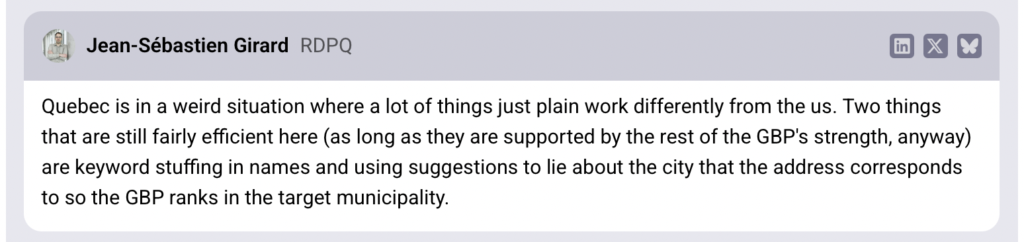
Color me unsurprised that your competitors are stuffing their business titles and lying to Google in a variety of ways – and not just in Quebec.
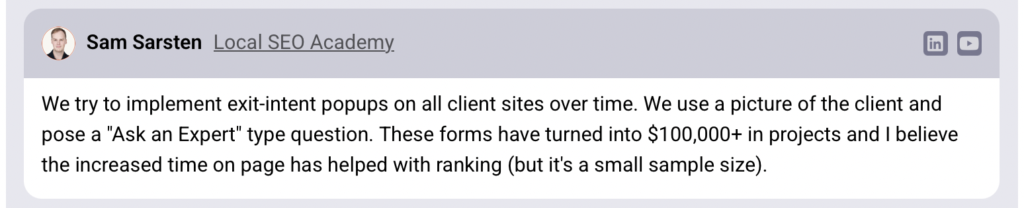
Very smart, but how do you feel if you’re losing $100,000+ contracts to competitors’ popups, which you may have dismissed as being too annoying to implement on your own sites?
If some of these things feel like they exist in a grey area, are downright dishonest, or are simply unfair, take the time to really examine that feeling. I’m a huge promoter of honest business practices + an obsession with consumer experiences being the best and highest road to brand longevity. But I’m also a realist, and you should definitely be tuning into all the tactics your competitors may be using to get ahead of you in Google’s very game-able system.

Coming in this year as the third-largest influence on local pack/Maps rankings, a keyword-oriented business name continues to hold massive sway over visibility outcomes.
The cons of this: This is one of the most spammable of all Google Business Profile fields. In the above screenshot, if this is your competitor and they aren’t legally named “The L.A. Law Firm – Car Accident & Personal Injury Lawyers” but are outranking you, in part, because they are violating Google’s guidelines, this can be very frustrating. Google wants real-world business names in the title field but they have displayed a lack of seriousness about enforcing this rule over the years. They don’t even assign heavy penalties when businesses are reported and found to be in error, so there’s not much of a disincentive.
The pros of this: If, instead, this is your competitor and they have legally changed their name to feature city and/or service keywords, then this should be a lightbulb moment for your brand.
The problem with local business names is that they are often chosen at the beginning of the business ideation process. An owner who has always dreamed of opening a plant-based coffee shop in Mendocino, California called “Zebra” registers their business this way and only realizes later that the public doesn’t associate this title with vegan drinks and snacks in a small town. The business finds itself at a competitive disadvantage in the local, organic, and even AI-based results, simply because it didn’t understand how their brand name would influence their visibility. And they may think they’re stuck with a bad choice.
The good news is that business names aren’t set in stone, and here at Whitespark, we’ve got a really detailed guide for you on Everything that Can Go Right and Wrong with Your Local Business Name, including how to legally change your title at any time. It’s not the easiest process in the world, but it’s certainly achievable if you realize that this ranking factor is one you could be winning on with a more keyword-oriented name. With a little care, you can still hang onto your dream, but by using a DBA to become “Zebra’s Mendocino Vegan Cafe” you can also do a better job of communicating what and where your business is.
80’s radio hit “I always feel like somebody’s watching me” turns out to be true when it comes to how your brand is handling phone call-based leads that come through Google Local Services Ads. I didn’t realize that this was an LSA ranking factor, and Darren decided to add this as a bonus to this year’s report, explaining that what is said on the call matters because:
“All of these phone numbers on the calls get routed through a Google number and Google listens to the calls (well, there’s not like a person listening to the call). Google uses their AI to get a transcript and understand how the call was handled. Did you close the lead? Did it seem like you were the right company for that customer? Did the customer have a good experience? They’re looking to make sure that has happened.”
If Google’s big listening ear comes as a surprise to you, then here’s the dilemma: if their tracking reveals that your staff is failing to respond well to leads, Google can give those leads to somebody else.
I’m personally in Darren’s camp that LSA’s are “annoying” in that they are forcing local business owners to pay for formerly-free visibility and in that they demote the visibility of local and organic results, but they’ve become table stakes in many industries. To be sure you’re gaining maximum leads from this program:
I hope this short list has whetted your appetite for thinking outside the box when it comes to specific industry norms. I haven’t even gotten into the great title tag debate or Joy Hawkins’ explanation of negative factors emerging from the Diversity Update, or Krystal Taing’s advice about the tracking/reporting adjustment AI is imposing on local SEOs, but you can get all of this information by heading to Whitespark’s 2026 Local Search Ranking Factors report. Go for it!
Miriam Ellis is a local SEO columnist and consultant. She has been cited as one of the top five most prolific women writers in the SEO industry. Miriam is also an award-winning fine artist and her work can be seen at MiriamEllis.com.
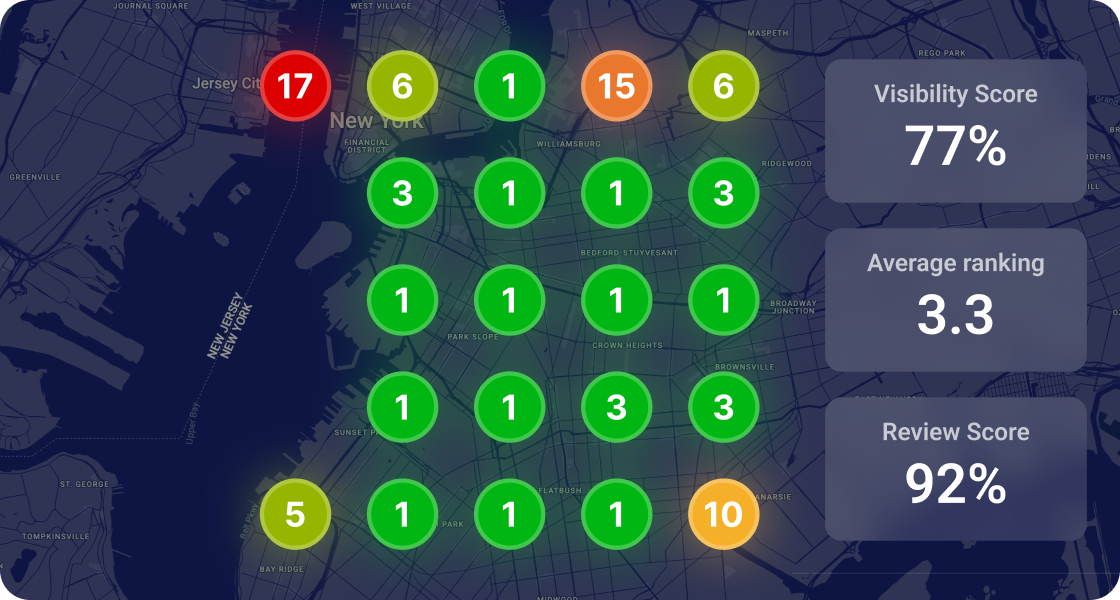


Whitespark provides powerful software and expert services to help businesses and agencies drive more leads through local search.
Founded in 2005 in Edmonton, Alberta, Canada, we initially offered web design and SEO services to local businesses. While we still work closely with many clients locally, we have successfully grown over the past 20 years to support over 100,000 enterprises, agencies, and small businesses globally with our cutting-edge software and services.